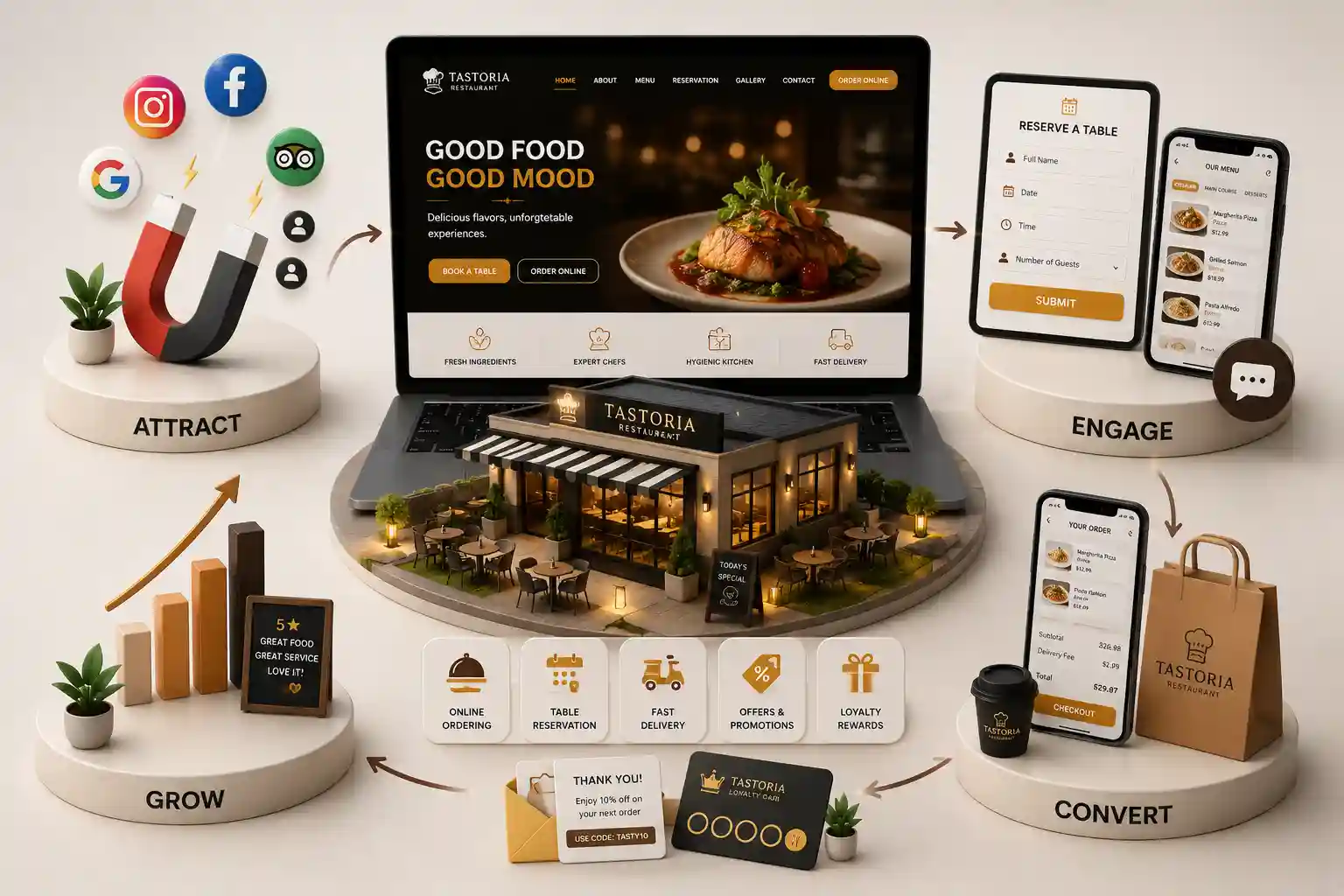
Restaurant Website Design in Salt Lake City (2026)
A practical 2026 guide to restaurant website design in Salt Lake City, from menus and reservations to neighborhood discovery and direct-order conversion. This guide explains the 2026 design priorities for Salt Lake City restaurants: conversion-focused menus, ordering and reservation paths, location pages, local trust signals, technical quality, and a practical measurement plan.
A restaurant can serve memorable food and still lose a hungry guest before the first visit. In Salt Lake City, many sites hide the menu in a PDF, make hours hard to confirm, or send every order to a marketplace without explaining the restaurant experience. A polished hero image cannot fix a journey that makes a guest work to choose, book, or buy. Restaurant website design Salt Lake City decisions now affect discovery, guest confidence, and margin at once. A Downtown diner may be checking parking and a reservation before an event; a Sugar House family may need allergen details and pickup timing; a Draper office manager may be comparing private dining options. The site must answer those jobs quickly on a phone.
This guide explains the 2026 design priorities for Salt Lake City restaurants: conversion-focused menus, ordering and reservation paths, location pages, local trust signals, technical quality, and a practical measurement plan.
It is for independent owners, restaurant groups, GMs, and Utah marketers planning a new restaurant site or repairing one that gets attention but not enough direct action.
Restaurant design starts with the guest’s next job
The best restaurant websites do not begin with a list of fashionable effects. They begin with the reason someone arrived. A first-time visitor wants to know what you serve, where you are, whether the experience fits tonight, and what to do next. Returning guests often want the menu, order link, reservation tool, or an answer about a changed special. Design should surface those paths before brand decoration competes for attention.
Map each entry point to a focused landing experience. A guest who searches for lunch near Downtown Salt Lake City should see lunch relevance, hours, location details, and a clear order or reserve action. Someone researching a celebration in Millcreek needs capacity, event photos, sample packages, and a short inquiry form. This approach makes a site useful to people and clearer for search engines without writing generic pages for every ZIP code.
Treat the menu as your most important product page
For most concepts, the menu carries more purchase intent than the homepage. Build it as accessible HTML with logical categories, clear prices, useful descriptions, and dietary or allergen notes that staff can maintain. A downloadable menu can be a secondary option, but it should not be the only way to learn what is available. Search, screen readers, and guests on a weak connection all benefit from an on-page menu.
Photography should help a guest decide rather than make a page heavy. Use a small number of real, well-compressed dish images where visual context sells the choice. Keep menu changes easy for the team: seasonal dishes, sold-out items, and updated hours must not require a developer ticket. When online ordering is available, every relevant menu category should lead naturally into the ordering flow with no mystery about pickup timing or service area.
Readable menu categories and current pricing
Dietary, allergen, and modifier context where appropriate
One-tap paths to order, reserve, or call
Staff-friendly updates for specials and 86'd items
Salt Lake City is not one uniform dining journey. Downtown traffic can be driven by office lunches, conventions, performances, and visitors who need transit or parking guidance. Sugar House guests may be looking for a relaxed neighborhood dinner. Millcreek and Draper can bring family, commuter, catering, and celebration intent. Your copy does not need to stereotype diners; it needs to answer the practical questions that each visit occasion creates.
Include precise address, hours, parking or transit notes, accessibility information, and an accurate map link. For a multi-location group, give each restaurant a substantial location page with its own menu, service details, phone number, imagery, and booking or order link. Avoid near-identical city templates. A page earns local visibility when it genuinely helps a guest choose that dining room and gives staff a reliable source of truth.
Ordering, reservations, waitlists, gift cards, catering, and private dining forms are only good design when they match the operation behind them. A pickup flow needs correct hours, fulfillment lead times, modifiers, and a clear handoff. A reservation tool needs the host team’s real availability rules. A private-event form should ask enough to qualify the lead without turning a celebration inquiry into paperwork.
Direct channels reduce dependence on marketplace commissions, but they should not create Friday-night confusion. Test every major action from a guest’s perspective and with the staff who receive it. Confirm confirmation emails, notifications, error states, and ownership for follow-up. The useful benchmark is not how many widgets appear on the site; it is whether the right request reaches the right person with enough context to serve it.
Choose actions by restaurant intent
Guest intent
Best on-site action
Operational check
Tonight's meal
Order or reserve
Hours, availability, and confirmation work
Group celebration
Private dining inquiry
Lead routing and response owner are defined
Office lunch
Catering request
Minimums, notice, and delivery zone are current
First visit
Menu and directions
Address, parking, and accessibility are accurate
Use real trust signals for local discovery
A new guest is deciding about atmosphere, hospitality, price expectations, and reliability before tasting anything. Use current photography of the food and dining room, selected reviews with permission, clear ownership or chef stories where relevant, and specific answers about service. Generic stock images and unmoderated social embeds rarely create the same confidence as proof that feels grounded in the actual restaurant.
Your website and Google Business Profile should agree on the business name, address, phone number, hours, category, and order or reservation destination. Keep holiday hours and special closures current in both places. The official guidance in
Google Business Profile Help is useful for maintaining the profile, but the restaurant team still owns the accuracy of its details and response habits.
Make the experience fast, accessible, and easy to maintain
A restaurant website is commonly used while someone is walking, driving with a passenger, or making a quick decision from a phone. Heavy video, oversized galleries, tiny type, poor contrast, and menu PDFs turn a simple task into friction. Start with a responsive layout, meaningful headings, keyboard-friendly controls, descriptive image alternatives, and tap targets that work on a small screen.
Speed is also conversion design. Compress images, reserve layout space, limit third-party scripts, and retest after a campaign or photo update. A menu that loads promptly can win the comparison even if a competitor's site looks more elaborate. Give a manager clear publishing responsibilities for menu edits, event details, and location changes so accurate content does not decay after launch.
Measure design by completed guest actions
Set measurement before announcing a redesigned site. Track completed direct orders, reservation starts and completions, calls, direction clicks, gift card purchases, catering forms, and private-dining leads. Separate completed actions from button taps, then review drop-off by device and landing page. These signals reveal whether a confusing menu, slow checkout, or unclear location page is costing revenue.
Run a simple monthly review with operations and marketing. Ask which guest questions still arrive by phone, which forms create poor-fit leads, which menu pages are most visited, and whether staff can make updates quickly. Improve one constrained journey at a time. That cadence is more valuable than a large redesign every few years because it keeps the site aligned with real service changes in Salt Lake City.
Plan a restaurant website that drives direct demand
Get a focused consultation on menus, ordering, reservations, local pages, and the handoffs your Salt Lake City team needs.
A practical next step for Utah restaurant teams
Audit your current site with one real guest task at a time: find tonight's menu, confirm hours, place a pickup order, reserve for four, or ask about a group event. Do it on a phone without relying on staff knowledge. Every hesitation is a clear improvement brief. Then prioritize the changes that protect direct revenue and guest confidence first.
Start with an accessible, current menu; accurate hours and location details; a prominent order or reservation path; real proof of the experience; and a way to ask about catering or private events if those services matter. Add features only when the team can operate them reliably.
Use an on-page HTML menu as the primary experience because it is easier to scan on mobile, update, access, and discover in search. A PDF can remain available for guests who need it, but it should not be the only menu.
It makes the direct order path obvious, answers timing and pickup questions early, and removes checkout friction. Track completed orders and compare them with referral sources to see which pages produce profitable direct demand.
A single strong location page can be enough when it contains useful details about that restaurant. Add separate pages only for distinct locations or meaningful service areas; thin pages written only to repeat city names do not help guests.
Put practical parking, transit, validation, and accessibility information near directions or reservations, not in a hard-to-find FAQ. Keep it current for construction, events, or changing garage arrangements.
Menu readability, fast loading, visible actions, tappable phone and map links, and forms or ordering tools that work without unnecessary account creation. Test on ordinary phones and cellular connections, not only on an office desktop.
They usually complement them. A direct site gives you more control over branding, guest data, and margins, while marketplace listings may still introduce new guests. Decide channel roles based on your actual fulfillment and acquisition economics.
Update menus, hours, specials, closures, and event information whenever they change. Review every key guest journey monthly and conduct a deeper content, speed, and conversion review each quarter.
Fix the clearest revenue bottleneck first: an unreadable menu, missing order path, unreliable reservation link, inaccurate location information, or slow mobile page. A focused improvement often produces more value than a visual overhaul.
Plan restaurant website budgets in the USA with clear cost bands for menus, online ordering, reservations, timelines, and direct guest acquisition ROI.
Explore US Restaurant Web Development pages. Every page is planned for stronger search visibility, faster performance, clearer customer journeys, and measurable enquiries.
My Perfect Solutions helps brokers, clinics, restaurants, and growing brands launch fast, SEO-ready websites that turn search traffic into qualified enquiries across India.