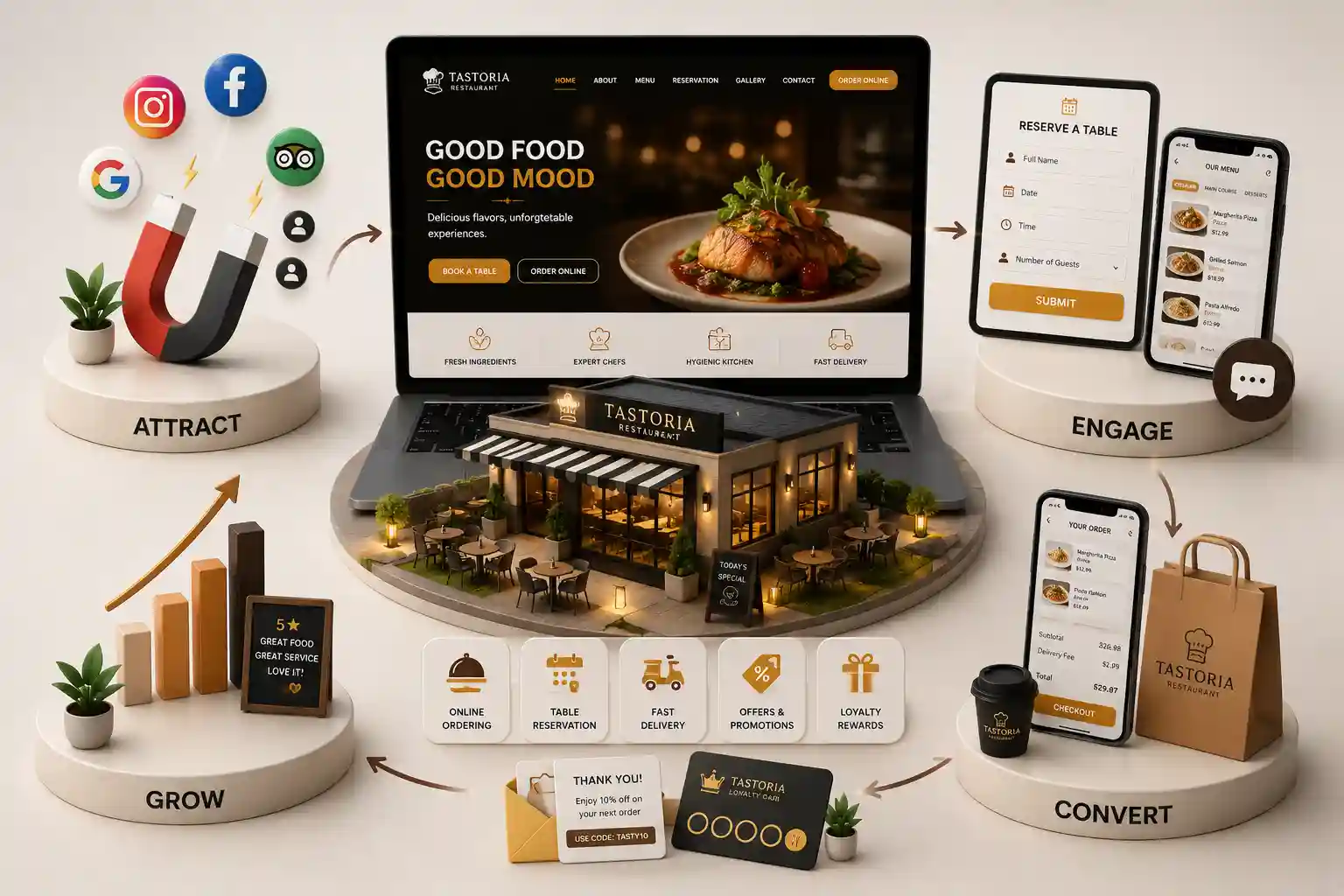
Why Every Restaurant Needs a Professional Website Instead of Relying Only on Delivery Apps
Learn why a professional restaurant website works with delivery apps to protect margin, build loyalty, and grow owned guest demand in the USA. This guide explains when apps help, where they hurt margin, how restaurant website development supports loyalty, and how to measure a healthier channel mix.
Many US restaurants treat delivery apps as the entire digital strategy. When fees rise or rankings shift, owners feel trapped because they never built a restaurant website strong enough to convert regulars directly. A professional restaurant website does not require abandoning marketplaces. It gives guests a better path for pickup and brand storytelling while restaurant marketing compound on lists and SEO you own.
This guide explains when apps help, where they hurt margin, how restaurant website development supports loyalty, and how to measure a healthier channel mix.
It is written for owners and marketers who rely heavily on delivery platforms and want a restaurant business website that protects profit.
Delivery apps help discovery, not ownership
Delivery apps put your food in front of hungry people who never heard of you. That reach has value, especially for new concepts. The tradeoff is commission, limited storytelling, and guest accounts that stay inside the platform. A restaurant website reclaims control for guests who already want you.
Regulars should not pay marketplace fees because your restaurant online ordering path is hard to find. Publish a fast menu, clear pickup timing, and a simple checkout. Restaurant website design that removes friction converts loyalty into better margin.
How a restaurant website improves profit and loyalty
Direct orders keep more of each check. First party emails and SMS lists let you fill quiet nights without renting attention again. Catering and private dining rarely start inside a delivery tile, yet they often begin on a restaurant business website with clear inquiry forms.
Restaurant website development also supports SEO and Google Business Profile consistency. Guests searching your brand name should land on a site that confirms hours, menu, and ordering in seconds. That brand search moment is too valuable to waste on a thin placeholder page.
Build a balanced channel mix, not an either or choice
Keep delivery apps for incremental reach. Push regulars and local searchers to your restaurant website. Industry operators track broader guest and labor trends through the National Restaurant Association, which can inform how you prioritize owned digital channels alongside marketplaces.
For firms entering catering or private dining niches, create dedicated pages that explain packages and lead times. Generic restaurant language hides differentiation. Clear positioning is a core job of restaurant website development when markets get crowded with lookalike delivery tiles.
Set leadership goals that match operations, such as raising direct order share or lowering average commission per ticket. Goals like those keep a restaurant website prioritized when other initiatives compete for cash and attention.
If you rely heavily on apps today, still invest in the site. App guests still check you online before reordering. A weak restaurant business website can quietly veto relationships your kitchen worked hard to earn.
Treat the first ninety days after launch as a learning window. Review incomplete orders, top exit pages, and response times weekly. Early corrections turn restaurant marketing spend into a durable advantage rather than a one time expense for the firm.
Reinvest a portion of commission savings from direct orders into content depth. Strong menu and catering pages reduce dependency on paid marketplace boosts over time. That compounding effect is one of the clearest financial arguments for sustained restaurant website development in competitive US markets.
If your market is highly competitive for a cuisine, differentiate with process clarity and access details rather than louder claims. Guests notice practical reassurance. That approach also keeps restaurant website design aligned with how kitchens can actually deliver.
Set a quarterly goal that leadership understands, such as raising direct order share or lifting after hours catering form completions. Goals like those keep restaurant website development prioritized when other initiatives compete for attention and budget.
Keep a short owner facing summary of what the restaurant website is for: prove the experience, qualify fit, and start a direct order or reservation. When every redesign proposal returns to that sentence, budgets stay aligned with profit instead of decoration for the year.
Grow direct orders with a restaurant website
Share your current app mix and goals. We will outline a restaurant website plan that protects margin while you keep useful marketplace reach.
Protect margin while still using delivery apps
Delivery apps can expand reach, especially for new concepts. They should not be the only path to your kitchen. A professional restaurant website gives guests a lower fee alternative and lets you communicate brand stories marketplaces compress into stars and photos.
Publish clear pickup offers, loyalty incentives, and exclusive specials on your site. Guests who already love you often prefer ordering direct when the path is easy. That shift improves restaurant marketing economics without abandoning marketplace visibility.
Build loyalty you actually own
Marketplace accounts belong to the platform. Email, SMS, and CRM lists collected through your restaurant online ordering flow belong to you. Over time that owned audience funds events, seasonal launches, and quiet nights without renting attention again.
Offer a simple reason to join your list at checkout
Send useful updates, not constant blasts
Track which campaigns drive direct orders
Respect opt outs and local messaging rules
Tell the story delivery tiles cannot hold
Apps flatten restaurants into thumbnails. Your website can show chef intent, sourcing, private dining, catering, and neighborhood context. That depth supports higher average checks and private events that rarely start inside a delivery feed.
Use real photography and specific language. Avoid stock images that make your restaurant website look interchangeable with every other cuisine tile in the app.
Measure direct channel health, not only app volume
Track direct orders, reservations, first party list growth, and commission saved. A busy app week with flat direct sales can still leave margin thin. Share reports with ownership so restaurant website development stays tied to profit.
Define one primary conversion per template
Tag campaigns with consistent UTM values
Review abandoned carts and incomplete reservations weekly
Test one CTA or menu change at a time
Share the scorecard with kitchen and floor leaders, not only marketing. When managers see which menu stories create direct orders, they become better partners for photography and specials. That collaboration keeps a restaurant website credible and useful.
Use the same scorecard when renewing marketplace contracts or plugins. If a tool adds cost without improving direct profit, cut it. Restaurant marketing stacks grow expensive when nobody revisits the original goal of profitable guest relationships.
Over a year, steady improvements beat one dramatic redesign. Keep a backlog, ship one change at a time, and record results. That habit turns restaurant website development into an operating rhythm instead of a panic project every few years.
Invite hosts into that backlog. They hear objections guests raise after browsing. Marketing teams that ignore those calls optimize for aesthetics while direct orders stay flat.
Revisit your top five landing pages every quarter. Read them on a phone. If any sentence sounds like internal jargon, rewrite it. Clarity is one of the highest ROI activities in restaurant website design.
Celebrate operational wins, not only traffic spikes. A week with faster catering responses and fewer incomplete online orders is progress even if sessions are flat. Restaurant marketing programs mature when teams value profitable guests over vanity charts.
Finally, protect continuity across seasons. Holiday rushes and summer patio seasons stretch staff thin and website ownership slips. Assign a backup publisher and a documented order test so peak weekends do not expose a silent checkout failure. Reliability is part of professional restaurant website development.
Usually no. Apps help discovery. The goal is balance: keep marketplace reach while making your restaurant website the easy path for regulars and brand searchers who do not need a middleman. Measure direct order share monthly so the mix stays intentional.
Direct restaurant online ordering avoids many commission costs, supports higher margin pickup, and captures first party contacts for future campaigns. Profit improves when guests who already trust you stop renting the transaction through a marketplace checkout they did not need.
Menu clarity, hours, pickup ordering, and a simple loyalty signup. Restaurant website design that nails those basics beats a flashy redesign with a broken checkout or an outdated PDF menu.
Organic search, Google Business Profile, and email can carry meaningful volume. Paid ads still help, but they convert better when the destination restaurant website is fast and clear enough to finish an order on a phone.
Offer a clear incentive, make reordering easy, and mention the direct path on packaging and receipts. Do not shame guests. Make the restaurant website the more convenient choice with saved favorites and faster pickup timing.
A brochure helps brand search, but most concepts need restaurant website development that supports ordering or reservations to change the channel mix meaningfully within a quarter.
Direct order share, average commission per ticket, first party list growth, catering inquiries, and repeat purchase rate. Sessions alone do not prove a restaurant business website is winning against delivery app volume.
As fast as staffing allows, ideally within an hour during business hours. Speed to contact strongly influences who wins the event when planners compare multiple restaurants the same day on mobile.
Fix mobile menus, order CTAs, and lead routing first. Then expand restaurant website development into SEO content and loyalty automation once the conversion path is trustworthy for hosts and kitchen managers.
A practical 2026 guide to restaurant website design in Salt Lake City, from menus and reservations to neighborhood discovery and direct-order conversion.
Plan restaurant website budgets in the USA with clear cost bands for menus, online ordering, reservations, timelines, and direct guest acquisition ROI.
Restaurant websites with digital menus, reservations, and online orders that fill more tables every week. Available for restaurants across major Indian cities. Every page is planned for stronger search visibility, faster performance, clearer customer journeys, and measurable enquiries.
My Perfect Solutions helps brokers, clinics, restaurants, and growing brands launch fast, SEO-ready websites that turn search traffic into qualified enquiries across India.