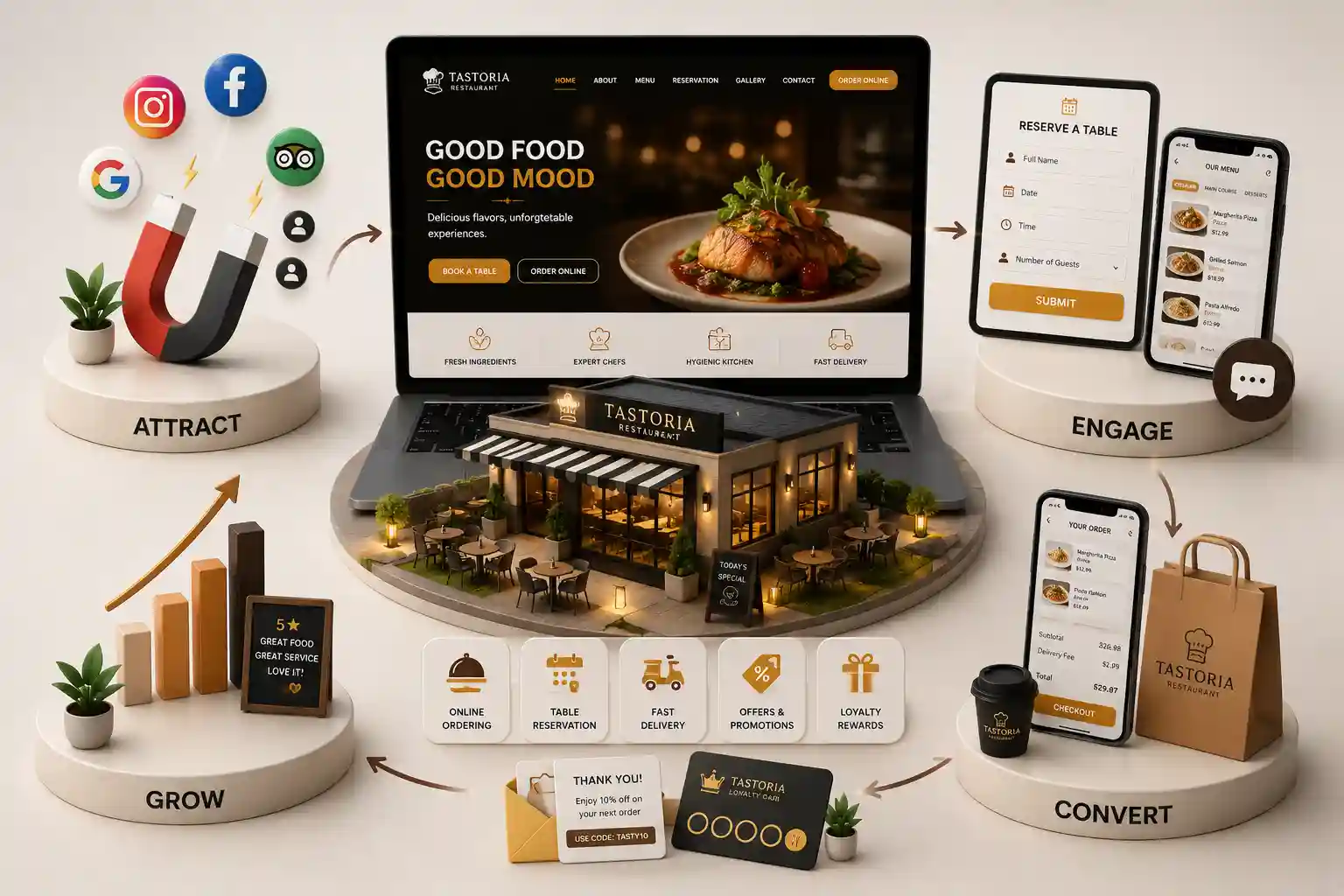
A 2026 restaurant SEO guide for Salt Lake City teams that want more qualified local discovery, direct orders, reservations, and event leads. This guide covers the local SEO system for Salt Lake City restaurants in 2026: site structure, Google Business Profile, content, technical signals, reviews, and measurement tied to real guest actions.
Restaurant SEO Salt Lake City is often reduced to adding the city name to a homepage title and waiting. That leaves guests with stale hours, a hard-to-read menu, a profile that points to the wrong order link, and no useful page for the questions they actually ask. Visibility becomes fragile because the website and local profile do not give a consistent, helpful answer. Local search is an intent channel. Someone searching for a dinner near Downtown, a Sugar House brunch, Millcreek catering, or a Draper private room may be ready to decide today. When accurate information, menu context, and a direct next step are easy to find, search can produce bookings and orders rather than just impressions.
This guide covers the local SEO system for Salt Lake City restaurants in 2026: site structure, Google Business Profile, content, technical signals, reviews, and measurement tied to real guest actions.
It is written for restaurant owners, operators, multi-location marketers, and Utah agencies responsible for making local discovery convert into sustainable direct demand.
Local SEO is a guest-information system, not a keyword trick
Google can only send a confident recommendation when it can understand the restaurant and the guest can verify the answer. That means your menu, location details, business name, phone, hours, service format, reviews, photos, and website pages should reinforce one another. Local SEO work is therefore partly technical and partly operational: publish accurate information, make it easy to navigate, and maintain it when service changes.
Begin with a short inventory. Search for the business name and key non-branded phrases, then compare what appears in your website, profile, map listing, social pages, and ordering partner. Note conflicts in hours, addresses, category selection, menus, and destination links. Fixing these foundational inconsistencies produces more durable value than creating a dozen thin articles that repeat Salt Lake City without helping a guest.
Build pages around menu, location, and service intent
A useful restaurant site normally has a clear homepage, structured menu pages, a complete location page for every real location, and focused pages for meaningful services such as catering, private dining, events, or gift cards. Each page should answer a distinct question and lead to a relevant action. This architecture helps guests move from discovery to decision and gives search engines a sensible map of the business.
Do not create a separate page for every neighborhood merely to capture a phrase. A Downtown page is justified when it describes a real location, event context, or service area. A Sugar House, Millcreek, or Draper reference can be natural when it helps a guest understand where you serve, deliver, or host events. Pages must have original substance and an honest operational connection; otherwise they become doorway content that neither ranks well nor builds trust.
A current HTML menu with useful categories and prices
A location page with hours, directions, parking, accessibility, and contact details
Service pages for catering, private dining, events, or delivery where applicable
Clear internal links from research pages to order, reserve, call, or inquiry actions
A stable URL structure and breadcrumbs that make pages easy to find
Run Google Business Profile as an active local channel
For many guests, the map result is their first real encounter with the restaurant. Claim and verify the Google Business Profile, choose categories that accurately describe the operation, and keep the name, address, phone, regular hours, holiday hours, website, and order or reservation links current. Use the exact same core business data on your location page so people do not have to decide which source is right.
Add useful photos that show the actual food, dining room, exterior, and service experience. Ask for honest reviews after a completed visit and respond professionally to feedback when a response is warranted. Avoid review incentives or copy-paste language. A steady stream of authentic guest proof and accurate details gives future diners a better basis for choosing you than a burst of promotional posts.
Use Google Business Profile Help for current profile-management instructions, then assign one accountable person to verify changes before they reach guests.
Publish content that answers high-value local questions
Restaurant content works when it reduces a real decision barrier. A complete event page can explain capacity, menu approach, lead time, and how to inquire. A catering page can clarify delivery areas, minimums, and ordering notice. A location page can give practical parking, transit, patio, or accessibility information. These pages are more likely to attract qualified local search because they are useful before a guest contacts the restaurant.
Keep the voice specific to the business rather than publishing generic dining advice. Use actual service policies, current offerings, and staff knowledge. If you update a seasonal menu, revisit related pages and internal links. If an event venue changes capacity, correct the page and form immediately. Freshness is not a date stamped on every paragraph; it is evidence that a guest can rely on what they read.
Content that supports restaurant SEO
Page
Guest question answered
Next action
Menu
What can I eat and what does it cost?
Order, reserve, or visit
Location
Where are you and how do I get there?
Directions, call, or reserve
Catering
Can you serve my group?
Qualified inquiry
Private dining
Does the space fit our event?
Event consultation
Strengthen technical foundations without overcomplicating the site
Technical restaurant SEO begins with pages that load reliably on mobile, are crawlable, use descriptive titles, and return the right status when content changes. Compress large images, minimize render-blocking scripts, preserve stable layouts, and test menu and location pages on regular cellular service. A guest who abandons before a menu appears cannot become an organic conversion, no matter how well the page is optimized.
Use structured data only when it reflects visible, accurate facts. Local business and restaurant information, breadcrumbs, and real FAQ content can help clarify page meaning. Do not invent ratings, create fake FAQs, or mark up content that users cannot see. A clean sitemap, sensible canonical handling, HTTPS, and redirects for retired URLs round out the fundamentals for most restaurant teams.
Build reputation and internal links that support discovery
Reviews are primarily trust evidence for people. Give happy guests a simple, compliant way to share feedback after a genuine visit, and use recurring themes to improve service. Avoid filtering who can leave a review or pressuring guests for particular wording. On the website, selected reviews can reinforce a relevant page when they are specific and representative, but they should not replace clear information about the restaurant itself.
Internal links should move a guest through useful choices: menu to order, location to directions, private dining to inquiry, and an article to the relevant service page. Link pages because the connection helps the reader, not because every paragraph needs a city anchor. This also helps search engines understand which pages are important and how the restaurant’s services relate.
Rankings and impressions can reveal visibility, but they are not the final score. Set up measurement for completed online orders, completed reservations, calls, direction clicks, catering inquiries, private-event leads, and gift card purchases. Review source, landing page, device, and location where possible. A page that ranks modestly but sends high-quality catering leads may be more valuable than a broad article with thousands of unqualified visits.
Create a monthly local SEO review. Check profile accuracy, new reviews, page errors, menu freshness, important search queries, and completed actions. Then pick one improvement: clarify an ordering flow, refresh a location page, reduce a slow gallery, or improve an event form. This steady practice compounds because it keeps the website and the operation aligned as service changes.
Turn Salt Lake City search visibility into direct demand
Get a consultation on local pages, profile-to-website journeys, technical SEO, and conversion tracking for your restaurant.
A 90-day restaurant SEO plan for Salt Lake City
Audit website, profile, menu, and directory facts for consistency.
Fix the menu, location page, and direct conversion path before publishing new content.
Complete service pages for the highest-value revenue lines, such as catering or private dining.
Set a repeatable review and photo routine with clear team ownership.
Improve mobile performance and validate every order, reservation, map, and form action.
Review completed local actions monthly and focus the next release on the biggest friction point.
The point is not to out-publish every restaurant in Utah. It is to become the easiest accurate answer for the guests you are equipped to serve. That outcome comes from a maintained local presence, useful pages, direct actions that work, and a team that learns from what guests do after they arrive.
It is the work of making a restaurant’s website, menu, location information, Google Business Profile, reviews, and conversion paths useful and consistent for guests searching locally. The goal is qualified discovery that leads to orders, reservations, visits, or event inquiries.
Profile and website accuracy fixes can improve the guest experience quickly. Sustainable organic visibility from stronger pages and reputation work often takes several months. Results depend on competition, site health, service demand, and how consistently the business maintains its information.
No. Create a page only when it represents a real location, service area, event context, or useful guest need. Thin pages that merely swap neighborhood names are not a sound local SEO strategy.
No. The profile supports discovery, but the website gives you control over menus, ordering, reservations, events, brand context, and measurement. The two should reinforce each other with accurate information and matching conversion links.
Useful HTML menu pages can be discovered and help clarify what a restaurant serves. They work best alongside accurate business details, a clear location page, natural internal links, and a mobile-friendly experience.
Track completed orders, completed reservations, calls, directions clicks, catering and event leads, gift card purchases, and meaningful form failures. Use rankings and impressions as context, but prioritize outcomes tied to revenue or guest service.
Reviews help prospective guests judge trust and may support local visibility as part of a broader profile. Ask for honest feedback after real visits, respond thoughtfully, and use the feedback to improve operations rather than trying to manufacture volume.
Structured data can clarify accurate restaurant and page information for search engines, but it is not a shortcut. Use it to reflect visible facts, and prioritize reliable content, speed, local information, and conversion paths first.
Audit and correct high-intent guest information: menu, hours, location, phone, order and reservation destinations, and mobile performance. Those fixes protect the traffic and local visibility you already have.
A practical 2026 guide to restaurant website design in Salt Lake City, from menus and reservations to neighborhood discovery and direct-order conversion.
Plan restaurant website budgets in the USA with clear cost bands for menus, online ordering, reservations, timelines, and direct guest acquisition ROI.
Explore US Restaurant Web Development pages. Every page is planned for stronger search visibility, faster performance, clearer customer journeys, and measurable enquiries.
My Perfect Solutions helps brokers, clinics, restaurants, and growing brands launch fast, SEO-ready websites that turn search traffic into qualified enquiries across India.