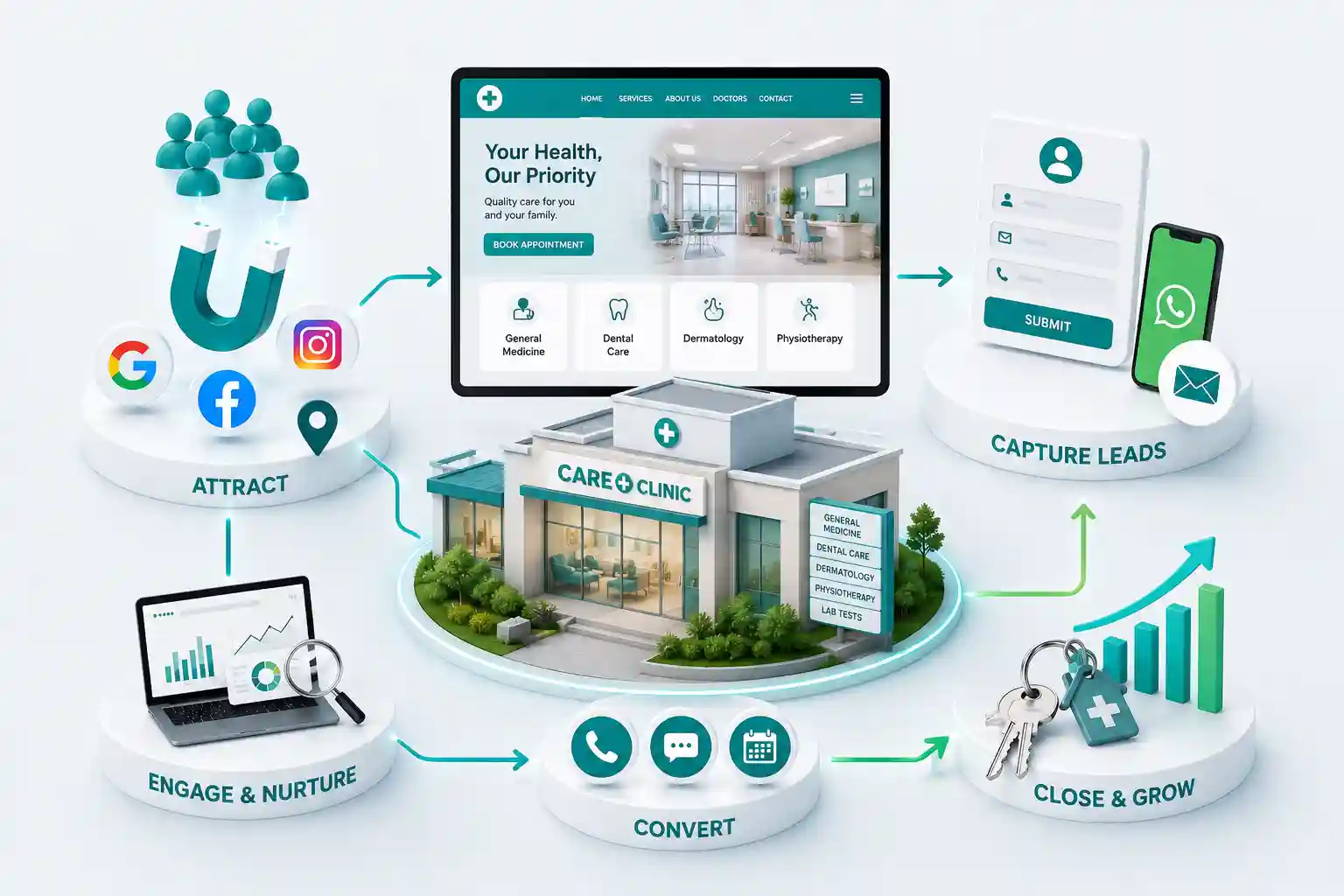
How a Professional Clinic Website Can Increase Patient Appointments
See how clinic website development turns search interest into booked visits through clearer services, stronger trust, faster mobile paths, and better follow up. You will see how healthcare website design influences appointment volume, which pages deserve priority, and how to connect website changes to front desk workflows that actually confirm visits.
Clinics invest in ads and directory listings, then watch interested patients disappear before booking. The doctor website looks fine in a screenshot, yet mobile visitors cannot tell what to do next, or front desk follow up arrives too late. A professional patient appointment website is not a brochure. It is a conversion system for medical practice marketing. Strong clinic website development clarifies services, builds trust quickly, and makes scheduling feel safe and simple.
You will see how healthcare website design influences appointment volume, which pages deserve priority, and how to connect website changes to front desk workflows that actually confirm visits.
Clinic owners, administrators, and marketers who need more qualified appointments without wasting budget on traffic that never converts.
Why clinic website development lifts appointment volume
Patients arrive with a job to complete. They want the right specialty, proof they will be treated well, and a low effort way to book. Medical website development that answers those jobs reduces drop off between first visit and form submit. Vague homepages force people to call only during office hours, which silently caps growth.
Owned digital channels also improve compounding returns. Directory leads stop when spend stops. A well structured doctor website keeps ranking for service and city queries, supporting medical practice marketing long after a campaign ends.
Think of clinic website development as a bridge between search intent and clinical capacity. If you cannot staff new visits in a specialty, do not overpromote that service page. Align marketing promises with scheduling reality so medical practice marketing does not create angry callers and burnt out front desk teams.
Also align paid and organic landing experiences. Sending ad traffic to a generic homepage wastes spend. Dedicated service pages with matching headlines and a patient appointment website CTA usually convert better and make reporting clearer for leadership.
Pages and messages that turn interest into bookings
High intent service pages outperform generic wellness copy. Speak to symptoms and goals patients recognize, then explain your approach and next step. Pair each page with a patient appointment website CTA that stays visible on mobile. Add logistics early: hours, parking, insurance notes, and new patient expectations.
Provider pages convert cautious visitors who want to know who they will meet. Healthcare website design should make credentials scannable and booking available without forcing users back to the homepage. Location pages help when you serve multiple campuses with distinct details.
Use plain language for anxiety heavy visits such as first time specialty consults. Explain what to bring, how long the visit may take, and how follow up works. Those details feel small, yet they reduce abandoned forms and last minute cancellations after a doctor website visit.
Keep CTAs consistent in wording across templates. If one page says Book Online and another says Request Appointment for the same action, tracking and patient understanding both suffer. Consistency is an underrated part of clinic website development that compounds across dozens of pages.
Website changes fail when leads land in a shared inbox nobody owns. Assign routing rules, after hours handling, and escalation. Track form completions, calls, booked appointments, and show rate by channel. That is how clinic website development becomes a growth lever instead of a design expense.
Create a weekly fifteen minute huddle between marketing and front desk. Review incomplete forms, unanswered calls from the site, and pages that generate confused questions. Those conversations uncover friction faster than any dashboard alone and keep medical website development tied to real patient behavior.
When capacity is tight, temporarily soften CTAs on overflowing service lines and promote visits you can staff. A professional clinic website should protect clinical quality, not only maximize form fills. Honest availability messaging builds long term trust in medical practice marketing.
Reinvest a portion of ad savings from better conversion into content depth. Strong service pages reduce dependency on paid clicks over time. That compounding effect is one of the clearest financial arguments for sustained clinic website development in competitive US markets.
If your market is highly competitive for a specialty, differentiate with process clarity and access details rather than louder claims. Patients notice practical reassurance. That approach also keeps medical website development aligned with compliance minded clinical leadership.
Set a quarterly goal that leadership understands, such as reducing cost per booked new patient or lifting after hours form completions. Goals like those keep clinic website development prioritized when other initiatives compete for attention and budget.
Increase patient appointments with a clearer website
Share your specialties, locations, and current booking bottlenecks. We will outline a practical clinic website plan for US practices.
Map the patient journey from search to booked visit
Most appointment losses happen between interest and confirmation. Patients find a clinic, scan trust signals, check logistics, then decide whether booking looks easy. If any step feels vague, they return to a directory or a competitor with clearer next steps.
Write the journey as a checklist your team can audit monthly: landing page relevance, proof above the fold, insurance and hours clarity, booking CTA, confirmation message, and same day follow up for incomplete forms.
Build trust that reduces booking hesitation
US patients compare clinics quickly. Clear credentials, real photos, readable reviews, and specific service language outperform generic wellness claims. Pair trust with logistics: parking, accessibility, languages spoken, and what to bring to the first visit.
Show provider credentials without burying them in PDFs
Use reviews that mention outcomes patients care about
Explain new patient steps in plain English
Keep contact options consistent across every template
Use local pages to capture high intent searches
Patients search with city and neighborhood language. Service pages that ignore location lose to practices with clear local landing pages. Keep NAP details accurate and align website copy with your Google Business Profile.
Do not create thin duplicate city pages. Create useful pages when you truly serve that market with distinct hours, parking notes, or specialty focus.
Measure bookings, not just traffic
Track form starts, form completions, click to call, and confirmed appointments by channel. A traffic spike with flat bookings means messaging, speed, or follow up is broken. Share reports with clinical and admin owners so fixes stick.
Define one primary conversion per template
Tag campaigns with consistent UTM values
Review incomplete bookings weekly
Test one CTA or form change at a time
Share the scorecard with clinical leads, not only marketing. When providers see which service pages create visits, they become better partners for accurate content. That collaboration is how clinic website development stays clinically credible while still converting.
Use the same scorecard when renewing vendors or booking tools. If a plugin adds cost without improving appointments, cut it. Patient appointment website stacks grow quietly expensive when nobody revisits the original goal of more confirmed visits.
Over a year, small weekly improvements beat one dramatic redesign. Keep a backlog of experiments, ship one change at a time, and write down results. That habit turns healthcare website design into an operating system for growth.
Invite front desk input into that backlog. They hear the exact objections patients raise after visiting the doctor website. Marketing teams that ignore those calls optimize for aesthetics while appointment volume stays flat.
Revisit your top five landing pages every quarter with fresh eyes. Read them aloud on a phone. If any sentence sounds like internal clinic jargon, rewrite it. Clarity is one of the highest ROI activities in clinic website development.
Finally, celebrate operational wins, not only traffic spikes. A week with faster response times and fewer incomplete forms is progress even if sessions are flat. Medical practice marketing matures when teams value booked care over vanity charts.
Yes when pages match patient intent, booking is easy on mobile, and staff respond quickly. Traffic without those pieces rarely becomes scheduled visits. Clinics that treat the site as a brochure and never measure bookings usually see flat calendars even after redesigns.
Make the primary CTA obvious on mobile service pages, shorten the form, and guarantee same day follow up during business hours. Many clinics see lift before a full redesign because friction, not branding, was the real blocker.
Yes. A doctor website and Google Business Profile reinforce each other. Keep NAP details consistent and link both ways where appropriate. Patients often bounce between map results and your site before choosing a clinic.
Better landing relevance and faster booking raise conversion rates, which can lower cost per acquisition. Weak landing pages waste ad spend even with strong targeting. Fix the destination before raising bids.
Create pages for services with real search demand and clinical capacity. Avoid thin duplicates. Quality healthcare website design beats a large set of empty templates that never get updated by clinical staff.
As fast as staffing allows, ideally within an hour during open hours. Speed to contact is one of the strongest predictors of booked appointments, especially for patients comparing multiple practices the same evening.
Qualified enquiries, booked appointments, show rate, and cost per new patient by channel. Sessions and bounce rate are supporting signals, not the goal. Share those numbers with front desk and clinical leads monthly.
Only if you can deliver it. Clear eligibility and scheduling options help. Overpromising telehealth creates no shows and frustrated staff, which undermines trust built by careful clinic website development.
Fix mobile CTAs, service clarity, and lead routing first. Then invest in stronger clinic website development for SEO content and booking automation once the conversion path is dependable.
Plan clinic website budgets in the USA with clear cost bands for booking tools, provider pages, HIPAA minded workflows, timelines, and patient acquisition ROI.
Prioritize clinic website features that turn research into booked visits: clear services, mobile booking, trust proof, local pages, and fast performance.
Patients find your clinic online, then leave before booking. Fix the friction in forms, doctor info, services, mobile speed, local SEO, and contact options.
A website UX guide for clinics: clearer care discovery, usable practitioner profiles, appointment paths, accessible forms, and dependable content operations.
Healthcare websites that build patient trust, simplify appointments, and help clinics grow. Available for doctors and hospitals across major Indian cities. Every page is planned for stronger search visibility, faster performance, clearer customer journeys, and measurable enquiries.
My Perfect Solutions helps brokers, clinics, restaurants, and growing brands launch fast, SEO-ready websites that turn search traffic into qualified enquiries across India.