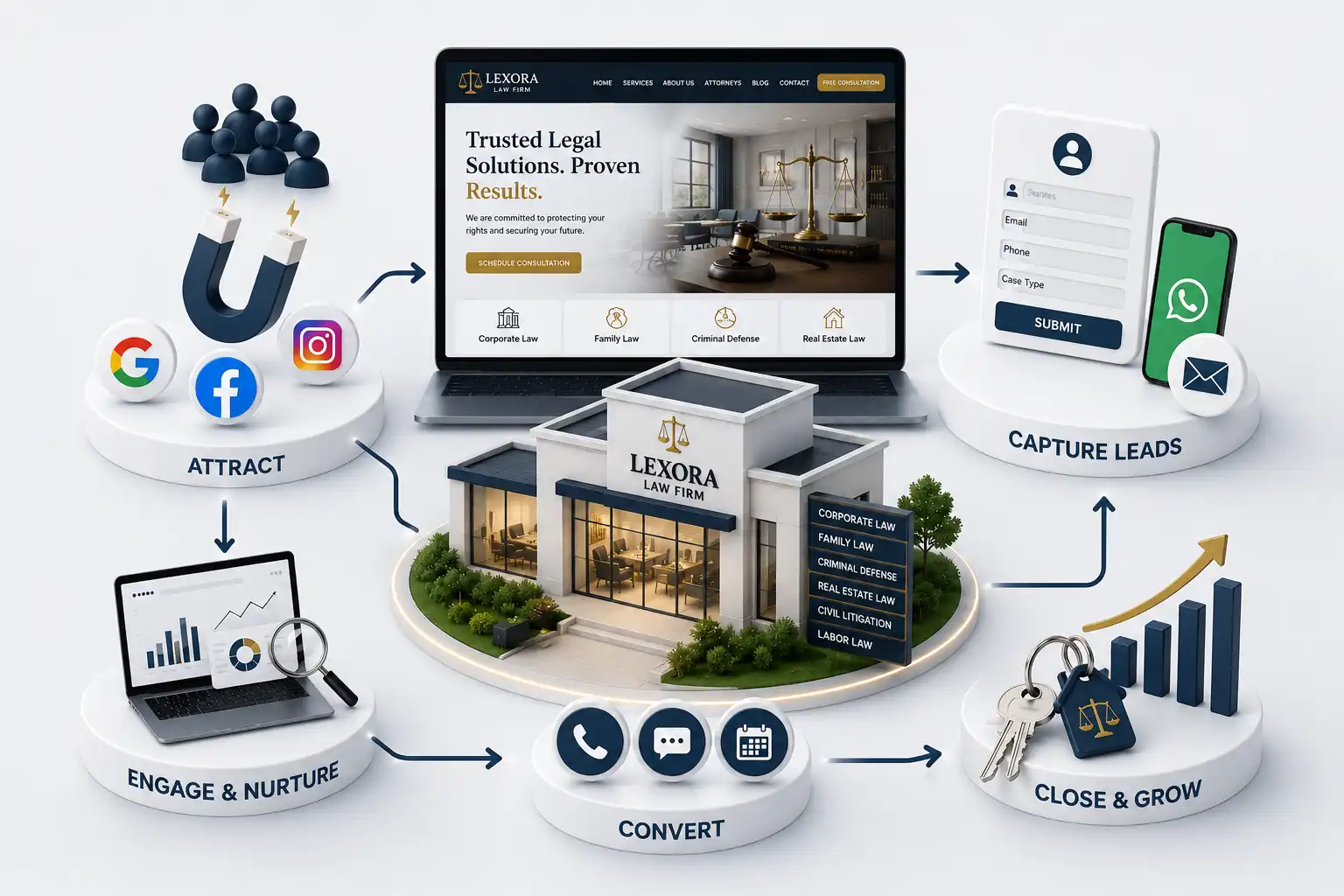
Law Firm Website Local SEO in Dallas: 2026 Playbook
Win Dallas Map Pack and organic consultations with practice pages, Google Business Profile discipline, neighborhood coverage, and a lead-ready law firm website. This playbook covers how law firm website local SEO Dallas works in 2026, which pages to build, how to run GBP as a consultation engine, which schema and technical signals matter, and how to measure qualified intakes rather than vanity rankings.
Dallas firms still publish a thin city homepage, paste the same practice blurb across ten pages, and hope to rank for lawyer near me. In 2026 that approach loses to practices that own hyperlocal pages, a disciplined Google Business Profile, and a website structured for both Map Pack clicks and AI citations. Clients search by practice need and micro-market first. Queries like personal injury lawyer Uptown Dallas or family attorney Plano reward specific pages with proof, attorney bios, and fast intake. Generic city SEO wastes budget while directories and better-prepared competitors capture the intent.
This playbook covers how law firm website local SEO Dallas works in 2026, which pages to build, how to run GBP as a consultation engine, which schema and technical signals matter, and how to measure qualified intakes rather than vanity rankings.
It is written for Dallas managing partners, intake managers, and marketing leads who want organic consultations from a law firm website without depending only on paid directories and referral spikes.
Why Dallas law firm local SEO changed in 2026
Search behavior across North Texas is hyperlocal by default. A client comparing Plano and Frisco counsel does not start with a national directory keyword alone. They ask about court familiarity, response time, practice fit, and whether the firm serves their neighborhood. Google and AI assistants answer those questions with pages that show clear local expertise, consistent business identity, and recent proof such as reviews and case-type clarity.
At the same time, AI Overviews and chat assistants reward entities they can verify. A firm with NAP consistency, Attorney or LegalService schema, clear service areas, and original neighborhood content is easier to cite than a template site with duplicated city blurbs. Local SEO is no longer a list of Dallas keywords in the footer. It is a system that connects your website, profile, practice pages, and intake follow-up.
Competitors who publish deeper neighborhood and practice guides while you refresh only the homepage will quietly take Map Pack and organic share. The fix is operational: prioritize farms you already serve, ship complete hubs, and keep intake handling as sharp as your phone intake for paid leads. Confirm compliance with your bar rules on any advertising claims before you publish.
Site architecture built for hyperlocal intent
Start with a clean hierarchy: firm home, practice area pages, attorney bios, contact and intake, and dedicated neighborhood hubs where they support real demand. Each hub should explain who you help in that area, which practice types you handle, and how clients can request a consultation by call, form, or chat. Thin pages that only repeat lawyer in Plano with a form will not compete in 2026.
Link neighborhood hubs to related practice pages, attorney profiles who actually serve that market, and nearby service areas such as Fort Worth when your team truly operates there. Internal links should help clients move from research to intake without bouncing to a directory. Keep URL structures stable and readable so that neighborhood pages can accumulate authority over time.
One neighborhood page per priority micro-market you actively serve
Unique intro, FAQs, and practice links per locality
Clear paths to call, form, and chat consultation actions
Breadcrumbs and related neighborhood links for crawl clarity
Separate pages for high-volume practice areas tied to local proof
Run Google Business Profile as a consultation engine
For many Dallas clients, the Map Pack is the first shortlist. Your Google Business Profile must match the website name, phone, and address exactly. Choose categories that reflect your practice reality, set service areas you can actually cover, and keep hours accurate. Enable messaging or chat where your intake team can respond within minutes during business hours.
Review velocity matters more than a one-time spike. Ask closed clients for specific reviews that mention practice type and service quality when appropriate and permitted. Post weekly updates with office news, community involvement, or practice education that stays within your advertising policies. Fresh photos of offices, team meetings, and accessible entrances reduce the trust gap that hurts local discovery.
Follow official setup and optimization guidance in Google Business Profile Help, then connect profile clicks to the same tracking used on your website forms and call buttons.
Content that ranks and converts in Dallas micro-markets
Useful neighborhood content answers real objections: which practices you handle near Uptown versus Downtown, how intake works after hours, parking and transit notes for the office, and how quickly a consultation can be scheduled. Clients researching Plano versus Frisco counsel want comparison context, not keyword stuffing. Aim for original notes from intake and matter experience rather than rewriting directory blurbs.
Pair every research section with a conversion module: a consultation form that carries practice and neighborhood context, a click-to-call button, or a chat start that routes to intake. Content without a next step trains clients to leave for a directory. Content with proof and a clear action turns SEO traffic into pipeline.
Schema, speed, and technical signals that support AI discovery
Add machine readable identity that matches what people see on the page. LegalService or Attorney markup on brand URLs, FAQ markup only where real questions appear, and breadcrumbs across the site help assistants attribute answers. Skip fake star ratings. Keep structured fields aligned with visible copy so Google and AI tools trust the entity behind each Dallas farm page.
Technical health still decides whether neighborhood pages can compete. Mobile performance, stable practice templates, compressed images, and crawlable bio paths matter when clients compare five firms on a phone after work. Slow galleries and broken intake buttons erase SEO gains instantly.
How to measure local SEO ROI for Dallas firms
Define success as qualified conversations: form fills that include practice type and timeline, calls that book consultations, and chats that intake accepts. Track UTM or call tracking for GBP versus organic website. Review which neighborhoods produce consultations, not only impressions.
Set a ninety day operating rhythm: publish or refresh two neighborhood assets, request a steady review cadence where permitted, fix technical issues weekly, and compare lead quality with directory spend. Local SEO compounds. The page that looks quiet in month one can become a durable consultation source by month six if content and responses stay current.
Want a Dallas local SEO website plan?
Map priority neighborhoods, GBP, and consultation paths for your firm.
A practical ninety day action plan
Audit NAP, GBP categories, website titles, and existing neighborhood coverage
Pick three revenue neighborhoods and outline unique page briefs
Launch or rebuild those hubs with practice links and intake CTAs
Align schema, analytics, and lead routing with intake SLAs
Start a weekly GBP posting and review request routine where permitted
Review qualified consultations by neighborhood and expand only where conversion proves out
Avoid building fifty empty neighborhood shells in week one. Depth in a few Dallas markets beats a map of thin pages across the entire metro. Expand to adjacent cities only when your team can answer inquiries with the same speed and practice quality.
Document owners for each neighborhood page: who updates practice notes, who replies to forms and chats, and who refreshes FAQs after major office or court process changes. Without ownership, even well designed hubs decay into brochure leftovers that stop converting. A light editorial calendar with two refreshes per month is enough for most Dallas desks.
When you compare vendors for the website build, ask how neighborhood templates, schema, and GBP landing URLs will be maintained after launch. A pretty homepage without an operating model will not protect rankings once competitors publish deeper guides with faster intake handling.
Conclusion: own the micro-market, not just the city name
Law firm website local SEO Dallas success in 2026 comes from hyperlocal architecture, a living Google Business Profile, trustworthy content, schema that clarifies your entity, and measurement tied to intake outcomes. Firms that still rely on a single Dallas homepage will keep paying directories for the same intent their website could own.
Invest first where you already open matters, prove the consultation loop, then expand. That discipline turns local SEO from a content chore into a predictable acquisition channel across Dallas and North Texas.
It is the practice of structuring your law firm website, Google Business Profile, neighborhood content, and technical signals so clients searching for Dallas micro-markets find and trust your firm, then inquire through call, form, or chat consultation requests.
Start with three to five areas where you already open matters and can keep practice notes fresh. Expand only after those pages produce qualified conversations and your team can maintain content quality.
Yes. Map Pack visibility often drives the first click. GBP and the website should reinforce the same NAP, categories, and offers so clients move smoothly from discovery to intake.
No. Doorway-style pages with duplicated text can harm trust and waste crawl budget. Build substantive hubs for real service areas instead.
Prioritize neighborhood plus practice intent combinations such as practice type and suburb names. Support them with entity clarity and useful answers rather than stuffing Dallas into every title.
GBP improvements can affect Map Pack visibility within weeks. Meaningful organic traction from new neighborhood pages often takes three to six months when content, reviews, and technical health stay consistent.
Both need neighborhood and trust signals, but multi-office firms emphasize location pages and routing while single offices emphasize personal proof and tighter farm focus. Architecture should match the business model.
Use organization, LegalService, or Attorney markup on brand pages, FAQPage where appropriate, and breadcrumbs sitewide. Never fabricate ratings in structured data, and confirm compliance with your bar rules on any claims.
Attribute calls, forms, and chat starts to organic and GBP sources, then measure booked consultations and accepted intakes by neighborhood. Compare cost per qualified lead with directory channels quarterly.
Usually no. Extend the same website with strong neighborhood hubs and clear service-area messaging when one intake team covers those markets. Separate sites only help when brands or operations are truly independent.
Build Dallas neighborhood landing pages that rank for micro-markets, connect practice intent, use schema, and link to attorney bios that convert consultations.
Google Ads can fill the phone this week. A strong law firm website builds trust, compounds organic demand, and stops paid traffic from bouncing. Here is how to choose—and when to use both.
A practical 2026 law firm website design guide covering trust, practice architecture, mobile consultation paths, accessibility, and durable content operations.
Explore US Law Firm Web Development pages. Every page is planned for stronger search visibility, faster performance, clearer customer journeys, and measurable enquiries.
My Perfect Solutions helps brokers, clinics, restaurants, and growing brands launch fast, SEO-ready websites that turn search traffic into qualified enquiries across India.