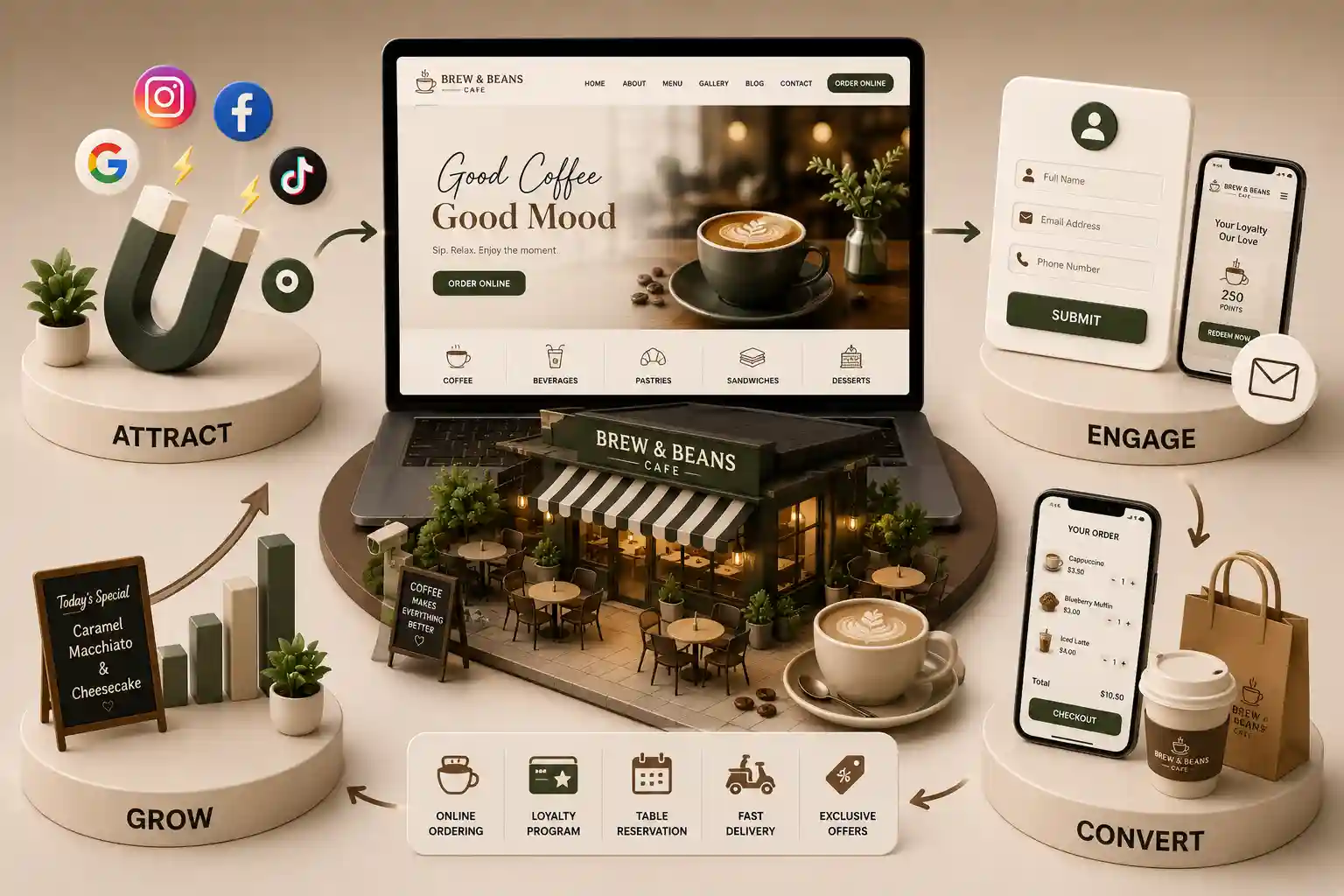
Multi Location Cafe Local SEO in India: A Practical Guide
Strengthen multi location cafe local SEO with genuine outlets, accurate profiles, cafe-specific evidence, review operations, and doorway-safe location pages. This guide treats multi location cafe local SEO as an operating model, not a page factory. It covers eligibility for real cafe locations, profile ownership, outlet-page content, cafe-specific evidence, reviews, structured data, CMS controls, measurement, and doorway avoidance. It follows the principle that public representation must match the cafe customers can actually visit or order from. It does not recommend fabricated offices, borrowed addresses, virtual pins presented as cafes, invented reviews, or guaranteed ranking claims.
A cafe brand with several genuine outlets can still look fragmented online. One Google Business Profile shows yesterday’s festival hours, another links only to a corporate homepage, a third publishes a citywide menu that does not match the counter at that branch, and the website repeats the same paragraph with the neighbourhood name swapped. Guests then struggle to confirm whether a cafe exists nearby, whether it is open now, whether seating is available, or whether pickup and order links belong to that outlet. Search systems inherit the same ambiguity. Adding more city pages does not repair weak cafe local evidence; it can multiply contradictory signals. Cafe discovery often happens close to a decision: finding a morning coffee stop, checking whether a branch still serves breakfast, requesting directions, viewing today’s specials, or starting pickup. Accurate multi location cafe local SEO supports those tasks, while inconsistency sends people to a closed shutter or an unsupported checkout. A governed local system also reduces operational friction. Managers know who owns hours, marketing knows what may be published, and support can explain why a profile differs from the website. None of this guarantees a map pack position, but it creates clearer, more useful cafe information.
This guide treats multi location cafe local SEO as an operating model, not a page factory. It covers eligibility for real cafe locations, profile ownership, outlet-page content, cafe-specific evidence, reviews, structured data, CMS controls, measurement, and doorway avoidance. It follows the principle that public representation must match the cafe customers can actually visit or order from. It does not recommend fabricated offices, borrowed addresses, virtual pins presented as cafes, invented reviews, or guaranteed ranking claims.
It is for cafe founders, multi-branch operators, franchise partners, regional managers, marketing teams, menu owners, agencies, developers, and outlet managers responsible for several cafes in India. The framework suits a small group with three branches as well as a larger brand with distributed publishing roles. Adapt it to your ownership model, platform capabilities, and current official guidance rather than copying a competitor’s map footprint.
Confirm eligible cafe locations before publishing
Separate real cafes from market ambition
A desired neighbourhood is not automatically a cafe location. Do not create a local profile or outlet page that implies a staffed cafe where the brand has only a future lease, a postal address, a sales desk, or a delivery possibility. If a legitimate pickup or delivery flow serves an area from a real kitchen, explain that service honestly through the appropriate page and ordering journey without inventing a storefront. If a branch is temporarily closed, relocating, or not yet open, use supported status handling and precise copy instead of leaving normal hours active.
Cafe location register decisions
Operating fact
Public representation
Governance question
Dine-in cafe
Address, access, hours, menu and seating cues
Who confirms daily changes?
Pickup counter
Exact counter identity and order handoff rules
Which menu and timing apply?
Future branch
Only approved opening information
Is timing sufficiently certain?
Admin office
Corporate contact where relevant
Could guests mistake it for a cafe?
Closed branch
Closed status and supported alternatives
Who removes stale links and offers?
Review the official Google Business Profile eligibility and ownership guidance before creating or claiming cafe profiles. Policies and product features can change, so use the current guidance for each location model rather than relying on an old checklist.
Govern cafe business profiles as operational records
Map profile fields to accountable owners
Map every field to a source. Operations may own opening hours, temporary closures, and seating capacity notes; the menu team may own menu URLs and specials; commerce may own pickup or order routes; customer care may own phone routing; brand may approve names and imagery. Set lead times for festival hours, renovation, relocation, phone failure, and temporary menu pauses. Check live profiles after updates because an approved internal request is not proof that every public surface changed correctly.
Use the cafe name customers encounter, without keyword stuffing
Choose categories that describe the real primary cafe activity
Keep direct local contact routes monitored during published hours
Upload current, owned or licensed photographs of the actual branch
Link to the corresponding cafe page, menu, pickup, or order route
Record who approved each material change and when it was verified live
“Cafe local accuracy is a recurring operational responsibility; it cannot be completed once at launch and left with no owner.”
Build cafe location pages that answer local questions
Give every genuine cafe a stable, indexable URL within a clear hierarchy. The page should identify the branch and help a guest complete a local task. Include the exact public address, landmark or access guidance where useful, current hours, local contact route, service modes, seating or takeaway context the team can verify, the appropriate menu, directions, and supported pickup or order options. Shared brand stories may appear, but the main value must come from facts specific to that cafe.
Show cafe-specific local evidence guests can verify
Useful difference does not require manufactured prose. It can come from a branch-specific menu, breakfast or late-evening availability, workspace cues the outlet actually supports, parking or metro guidance, verified accessibility notes, neighbourhood pickup windows, outlet photographs, and local contact expectations. State only what the team can support. If all cafes share a policy or story, publish it once and link to it rather than padding every page with a rewritten version.
A useful cafe location page
Page element
Guest question
Source owner
Identity and address
Is this the correct cafe?
Operations
Hours and exceptions
Can I visit now or on a holiday?
Branch manager
Local menu
What is actually served here?
Menu operations
Pickup and ordering
Which action applies to this branch?
Commerce owner
Access guidance
How do I arrive and enter?
Local team
Images
What does this real cafe look like?
Brand and outlet
Menus need their own publishing controls. Use the companion cafe menu website checklist for India to plan readable specials, mobile access, allergen presentation handled carefully, and alternatives to image-only PDFs.
Connect menus, actions, and genuine cafe reviews
Run a fair and traceable review process
Ask real cafe guests for reviews on a steady basis, without hiding negative experiences or promising rewards that were not disclosed upfront. Staff, agencies, friends, and synthetic accounts must not post ratings on the brand's behalf. Train responders on respectful tone, privacy limits, escalation paths, and when to continue in a supported private channel. Public replies may recognise what happened and outline the next step, but they must not expose ticket references, loyalty balances, dietary or health details, or internal staffing disputes.
Monitor each real cafe through an owned queue
Classify urgent safety or service issues for internal escalation
Answer with branch context rather than a copied defensive script
Avoid confirming personal details in a public response
Record recurring themes for operational review
Report policy-violating content through supported platform routes
Need a governed local system for every cafe?
Map real outlets, profile ownership, menus, actions, publishing roles, and review handoffs before scaling cafe location pages.
Align structured data with visible cafe facts
Use structured data to describe the cafe represented on the page, not to invent evidence the visible page lacks. A location page may use an appropriate CafeOrCoffeeShop or LocalBusiness type with supported properties such as name, URL, address, telephone, opening hours, image, menu, and geographic information. The exact implementation depends on the page and current vocabulary. Generate markup from the same governed records as visible content so opening-hour and address changes do not diverge.
Validate identity, URLs, and page scope
Compare marked-up name, address, phone and hours with visible text
Use the cafe's own canonical URL and corresponding menu URL
Render values from governed records rather than copied JSON snippets
Test the final server-rendered output after template changes
Remove properties that the business cannot verify or maintain
Treat search presentation as eligibility, never a guaranteed result
Govern the CMS and avoid cafe doorway pages
Model shared brand content separately from local operational fields. A cafe location record can require address, coordinates, hours, status, contact ownership, service modes, menu reference, pickup reference, order reference, accessibility notes, images, and last verification date. Use validation to prevent publication when essential fields are missing or when two records reuse an identifier. Give local managers controlled editing rights while reserving schema, URL, canonical, and template changes for trained owners.
Set publishing, exception, and retirement workflows
Doorway risk and a better cafe response
Risk pattern
Why it fails guests
Better approach
City-name swaps
No evidence of a distinct cafe or service
Publish only substantive real-location pages
All pages funnel elsewhere
Local promise disappears after the click
Preserve the branch through the task
Invented addresses
Guests may travel to a non-existent venue
Represent the real operating model
Copied menu and reviews
Facts can belong to another branch
Bind content to cafe location records
Orphaned closed pages
Stale actions continue to accept demand
Use a controlled retirement workflow
When budgeting the website work behind local pages, also review the cafe website development cost in India guide so location templates, CMS roles, and maintenance are scoped before launch.
Audit and measure the complete cafe local system
Create a recurring audit that samples every public surface and follows real tasks. Search for the cafe by brand and locality, inspect the profile, open the linked page, view the menu, request directions, start pickup or ordering where supported, and use the contact route. Compare the result with the location register. Include holiday hours, temporary closures, relocations, sold-out specials, and third-party outages rather than testing only a normal weekday.
Use measurement without ranking promises
Reconcile the master cafe register with live pages and profiles
Test the menu, pickup, ordering, call and directions paths
Inspect mobile readability, keyboard access and page performance
Validate canonical URLs and rendered structured data
Review permissions, inactive users and unresolved update requests
Assign every discrepancy an owner, priority and verification date
It is the practice of making each genuine cafe location understandable and useful across the website, business profiles, maps, menus, reviews, structured data, and local conversion journeys. It combines publishing with operations: the brand needs sources and owners for addresses, hours, phone routes, menus, pickup, orders, closures, and changes. It is not a method for creating imaginary city presence or a promise that every branch will achieve a particular search position.
No. A city target or delivery possibility is not automatically a physical cafe. Create outlet pages for genuine operations and make their service model explicit. If a real pickup or delivery operation serves an area, describe that accurately through an appropriate page and serviceability flow without implying dine-in access. Avoid mass city pages that merely replace place names and funnel everyone to the same destination; those pages provide little local help and can resemble doorways.
Show the cafe's public identity, exact address where customers can visit, current hours and exceptions, monitored contact route, local menu, available service modes, pickup or ordering routes, directions, useful access notes, verified venue images, and any accessibility information the team can substantiate. Preserve the chosen branch through each action. Shared brand stories and policies can be linked rather than repeated as filler on every page.
Use organisation-controlled ownership, named roles, strong account security, documented agency access, and a handover process. Assign a source owner for each field and establish workflows for holiday hours, temporary closures, relocations, menu links, phone failures, and images. Verify changes on live profiles rather than assuming an internal request was applied. Consult current official guidance because eligibility, verification, and product features can change.
Only when it is genuinely accurate for every linked outlet and the operational team can maintain that statement. Where prices, item availability, service periods, dietary statements, or ordering capabilities differ, connect each location to its correct menu record. Clearly identify the outlet and last managed context. A shared menu that sends guests toward unavailable items undermines both local usefulness and support operations.
Invite genuine guests consistently without filtering invitations according to predicted sentiment, buying reviews, or using staff and generated identities. Route feedback to the correct cafe and train responders on tone, privacy, escalation, and unsupported claims. Public replies should not reveal order, loyalty, health, or employee details. Review themes can inform operations, but no review volume, rating, phrase, or response schedule guarantees local rankings.
An appropriate Schema.org CafeOrCoffeeShop or LocalBusiness type may describe a genuine location, using properties supported by the visible page and current vocabulary. Typical facts can include name, URL, address, phone, opening hours, menu, image, and geographic information. Generate markup from governed location records, validate rendered output, and avoid marking up invented locations or hidden claims. Correct structured data does not guarantee a specific search feature.
Require a real location record, unique identifier, accountable owner, operational status, local actions, and substantive outlet facts before publication. Separate shared brand modules from location fields, validate required data, and reserve URL, canonical, and schema controls for trained roles. Use draft, review, and retirement workflows. Do not let a bulk tool create indexable pages from a city list when no corresponding cafe or meaningful local service evidence exists.
Track operational quality and supported actions alongside visibility: stale-field incidents, broken menu or pickup links, profile coverage, direction requests, calls, order handoff failures, review routing, and closure accuracy. Compare trends using consistent definitions and annotate major branch changes. Rankings and traffic can be monitored, but they are influenced by many factors. Use reporting for diagnosis and improvement, never as a basis for guaranteed placement claims.
Plan multi-outlet cafe information architecture, menus, domains, redirects, CMS roles, analytics, and staged migration without inventing thin location pages.
Design a cafe WhatsApp ordering workflow from enquiry to confirmation with clear consent, menu truth, payment boundaries, staff handoffs, and safe fallbacks.
Define cafe pickup and preorder requirements for slots, prep times, kitchen capacity, order confirmation, menu truth, and clear boundaries versus restaurant reservations.
Use this cafe menu website checklist India to plan readable digital menus, governed specials, careful allergen presentation, accessibility, and mobile usability.
Warm, conversion-focused cafe websites that highlight your menu, vibe, and drive more foot traffic and orders. Available for cafes and coffee shops across major Indian cities. Every page is planned for stronger search visibility, faster performance, clearer customer journeys, and measurable enquiries.
My Perfect Solutions helps brokers, clinics, restaurants, and growing brands launch fast, SEO-ready websites that turn search traffic into qualified enquiries across India.