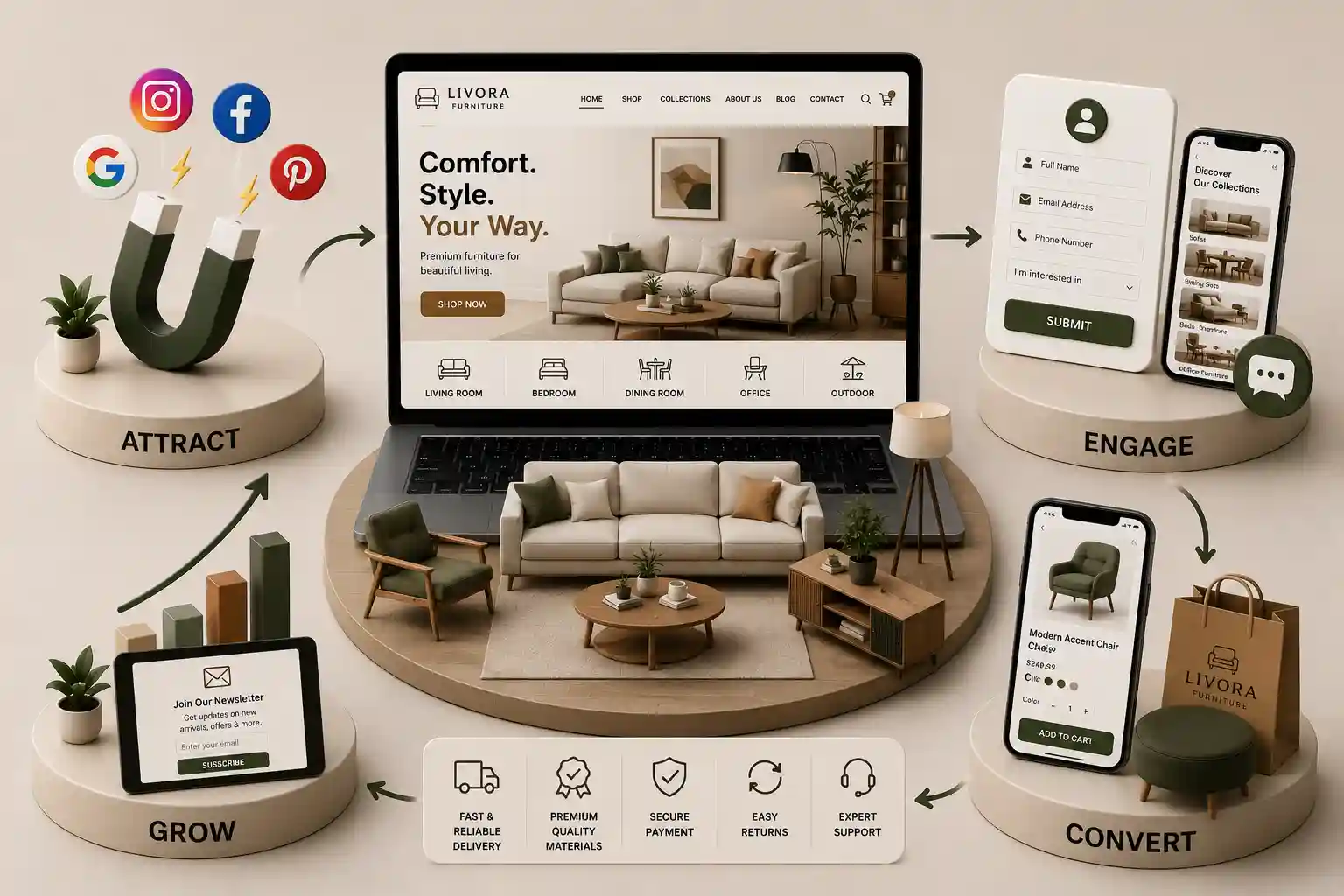
How Jaipur Furniture Brands Can Turn Online Browsers Into Real Customers
Jaipur furniture businesses have excellent products but need websites that convert browsing into enquiries. See how galleries, custom forms, and local SEO help. You will learn how to showcase products visually, structure custom enquiry flows, create inspiration content that keeps buyers engaged, use local search to attract nearby customers, and make WhatsApp part of a systematic sales process.
A Jaipur buyer searches for a dining table set on Saturday morning, finds your Instagram, clicks through to the website, and sees a page of small thumbnail images with no dimensions, no delivery information, and a phone number that goes unanswered on weekends. They message three other showrooms and buy from the one that replied with measurements and a photo of the piece in a similar room. Jaipur furniture business website sales depend on closing the gap between inspiration and action. The city's strong furniture and home-interior market—offering everything from traditional craftsmanship to modern custom pieces—means buyers are comparing online before visiting. A website that answers the right questions converts browsing into genuine enquiries.
You will learn how to showcase products visually, structure custom enquiry flows, create inspiration content that keeps buyers engaged, use local search to attract nearby customers, and make WhatsApp part of a systematic sales process.
For Jaipur furniture showroom owners, custom furniture makers, and home-interior brands who want more qualified website enquiries—not only walk-ins and social DMs.
What this guide covers
Introduction: why Jaipur furniture buyers research online
Show products with the detail buyers need
Build a custom furniture enquiry path
Create inspiration content that drives exploration
Use local search to attract nearby customers
Make WhatsApp part of the sales journey
Final thoughts
Introduction: Jaipur buyers research furniture online before visiting
Jaipur has a strong furniture and home-interior market, with businesses offering everything from traditional Rajasthani designs to modern and customised pieces. But having excellent products is not enough if potential customers cannot discover them online, understand what is available, or ask a question without visiting the showroom first.
Many furniture customers research across multiple sources before committing to a visit. They check Instagram for aesthetic, the website for specifications, and WhatsApp for availability. A showroom whose website cannot answer basic questions—dimensions, materials, lead time, delivery zone—sends buyers back to Instagram or to a competitor with better-structured information.
For Jaipur furniture businesses, the website can become the bridge between someone browsing for inspiration and someone requesting a quotation—provided it is designed around how buyers actually make decisions, not around what is easiest to upload.
Show products with the detail buyers need to decide
Furniture is visual. A website should give products room to stand out. Instead of displaying small images with minimal information, create detailed product pages featuring multiple photographs from different angles, material and finish close-ups, approximate dimensions, available customisations, lead time, and enquiry or pricing information.
Buyers considering a custom wardrobe or dining set want to understand scale before they visit. Publishing approximate dimensions—even if exact sizing is done on consultation—reduces the number of visits that end without a commitment because the buyer did not realise the piece was the wrong size for their room.
Organise the catalogue by room and use case rather than only by product type. A buyer shopping for a bedroom knows they want bedroom furniture; they should not have to filter through living room and dining options to reach it. Logical navigation structure reduces frustration and increases time on site.
Build a custom furniture enquiry path that works for sales
Many furniture customers do not want exactly what they see in a catalogue. They may want a different size, colour, fabric, wood finish, or storage configuration. A website can make these requirements easier to collect through a structured enquiry form that captures the information sales actually needs: room dimensions or photographs, preferred material, timeline, budget range, and delivery location.
Prefill WhatsApp from the product page when someone taps the custom quote button—passing the product name so sales does not have to ask which piece the buyer was looking at. That single change reduces vague opening messages and converts them into specific product enquiries.
Set and publish a response-time expectation. Many Jaipur showrooms promise a callback within a few hours during business days. Meeting that expectation builds trust before any conversation about price or specification begins.
Want a furniture website that turns Jaipur browsers into buyers?
Share your catalogue and custom process. We will design galleries, enquiry forms, and WhatsApp flows that your showroom team can run.
Create inspiration content that keeps buyers exploring
A useful furniture website includes sections that go beyond individual product pages. Living room ideas, bedroom furniture setups, home office configurations, and custom furniture project showcases give visitors reasons to explore more of the catalogue. They also help buyers visualise how pieces work together in a real room rather than in isolation.
Styled room photographs with links to individual products allow a buyer who admires a living room setup to identify and enquire about the specific sofa, coffee table, or storage unit that caught their attention. That shoppable inspiration format reduces the cognitive effort of moving from liking a room to enquiring about a specific piece.
Update inspiration content seasonally. A festival dining setup, a monsoon-resistant outdoor furniture arrangement, or a study room optimised for a Jaipur apartment layout each reflect current buyer needs and give returning visitors a reason to browse again.
Use local search to attract buyers already looking nearby
A furniture business serving Jaipur should not depend only on social media for new customers. Optimised location-focused pages and useful content can help potential customers discover the business through Google when they are actively looking for furniture in a specific area.
Targeting neighbourhood-specific terms—sofa showroom near Mansarovar, custom wardrobe Vaishali Nagar, modular kitchen C-Scheme—focuses effort on searches with genuine purchase intent. Buyers who search this way are typically ready to visit or enquire, not casually browsing.
Furniture purchases often involve questions about delivery, custom dimensions, material options, availability, and installation. A WhatsApp button makes starting that conversation much easier than a phone call, particularly for buyers who are outside business hours or prefer written communication.
Train staff to log WhatsApp enquiries in the same system as website form submissions. Keeping enquiries in a shared inbox rather than individual phones ensures that no lead is lost when a staff member is unavailable, and allows the sales team to track enquiry-to-sale conversion across channels.
Use the website to support after-sales and repeat customers
A furniture purchase is often the beginning of a longer relationship rather than a one-off transaction. Customers who are happy with a dining table may return for bedroom furniture, a home office setup, or a custom wardrobe. A website that makes it easy for existing customers to browse new arrivals, check ongoing promotions, and request a follow-up consultation keeps the business visible between purchase cycles. Building this customer retention value into the website from the start reduces dependence on paid acquisition for repeat sales.
Include a care and maintenance section for materials your showroom commonly sells—teak, engineered wood, upholstered pieces, metal. This type of practical content builds trust with existing customers, reduces unnecessary returns or complaints, and gives the website useful content that furniture buyers genuinely search for.
If the showroom has a seasonal or festival sale cycle—Diwali, Navratri, Akshaya Tritiya—publish this on the website with a way for interested customers to register for updates. An email list or WhatsApp broadcast built from existing customers converts at a higher rate than paid advertising to cold audiences during promotional periods.
Measure how the website contributes to actual sales
A furniture website that receives two thousand visits per month but generates three enquiries is not performing well—regardless of what the traffic numbers suggest. The useful measure is enquiry volume, enquiry quality, and the proportion of enquiries that lead to showroom visits and purchases.
Track WhatsApp click events, form submissions, and phone number taps as separate conversion goals. If the most-visited product pages generate no enquiries, investigate the page rather than increasing traffic. Common causes include missing dimensions, no clear enquiry path, or a price that is not contextualised with customisation options. Review your five highest-traffic product pages monthly and treat low-enquiry pages as a prioritised improvement queue rather than a passive problem.
Final thoughts: build a website that closes sales
A furniture website should not simply display products. It should inspire customers, answer their practical questions, and make requesting a quotation effortless. For Jaipur furniture businesses, that can turn online traffic into genuine sales opportunities—not just social media likes and showroom window shopping.
Multi-angle product photos, material and dimension details, a custom enquiry form, WhatsApp integration with product context, room inspiration galleries, and local SEO pages.
At minimum show price ranges or starting prices for catalogue items. Custom work can use a structured enquiry form instead. Hiding all pricing discourages serious buyers.
A short form collecting room size, preferred material, timeline, and budget—combined with WhatsApp prefilled with the product name—gives sales useful context before the first response.
Yes, provided enquiries are logged in a shared system and response expectations are published. WhatsApp works best when it starts with product context rather than a generic opening message.
Neighbourhood-specific pages with real inventory, maintained Google Business Profile, consistent NAP, and genuine product photographs outperform generic city-level content.
Missing dimensions, unclear delivery zones, no WhatsApp or hard-to-find contact, and mobile layouts that make browsing difficult. Fixing these typically increases enquiry rate without a full redesign.
Yes. Delivery zone, lead time for custom pieces, assembly included or separate, and any surcharges for narrow staircases should all be stated before checkout or enquiry to avoid surprises.
Whenever stock status, pricing, or materials change. Stale pages with discontinued products or old prices damage trust and generate refund discussions that waste both sides' time.
Close the gap between browsing and contacting with clearer galleries, dimensions, materials, WhatsApp, catalogues, store discovery, quotes, and stronger mobile UX.
Custom orders die in chat threads that lack product context, sizes, and owner. Build a furniture WhatsApp custom quote workflow that starts on the website and stays trackable.
Convert catalog browsing into showroom visits and project enquiries with useful product detail, clear filters, trusted proof, and a simple mobile enquiry path.
Explore Furniture Web Development for India. Every page is planned for stronger search visibility, faster performance, clearer customer journeys, and measurable enquiries.
My Perfect Solutions helps brokers, clinics, restaurants, and growing brands launch fast, SEO-ready websites that turn search traffic into qualified enquiries across India.