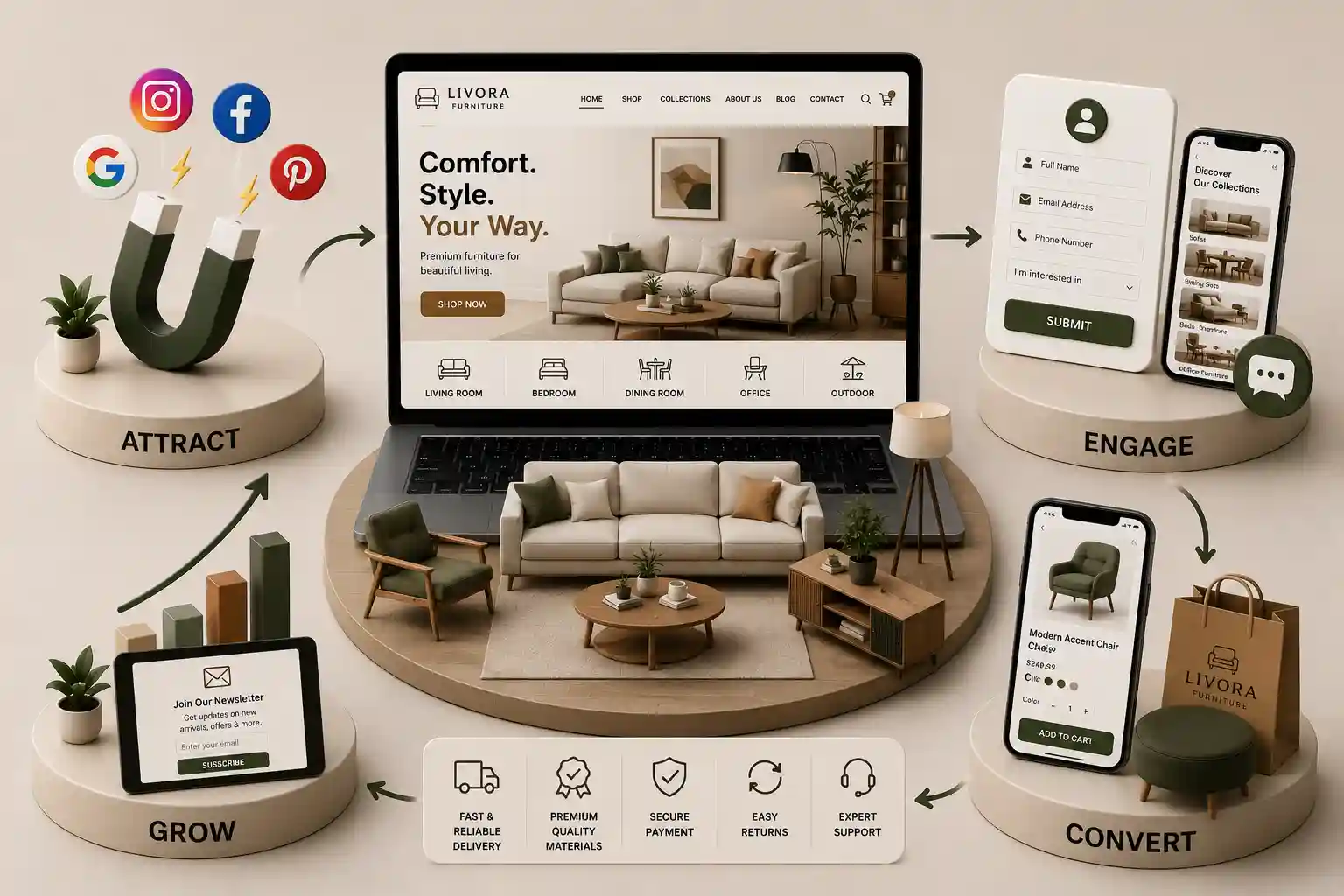
Build a Furniture Website That Helps Bengaluru Customers Buy With Confidence
Galleries, custom enquiry forms, room inspiration, local SEO, testimonials, and WhatsApp—how Bengaluru furniture brands turn browsers into buyers. You will learn high-quality galleries, custom enquiry forms, room inspiration pages, Google visibility, testimonials, and WhatsApp support that turn browsing into showroom visits and orders.
Traffic arrives from Instagram and Google, but the site shows twelve similar sofas with no dimensions, no delivery note for your zone, and a phone number that rings busy. The buyer opens WhatsApp, types “price?”, and messages three other showrooms while your team tries to guess which product they saw. Bengaluru furniture website visitors convert when they can see real products, request custom work cleanly, find your showroom, and continue on WhatsApp without repeating themselves.
You will learn high-quality galleries, custom enquiry forms, room inspiration pages, Google visibility, testimonials, and WhatsApp support that turn browsing into showroom visits and orders.
For Bengaluru furniture brands, showroom owners, and custom makers who want more qualified enquiries from their website—not only walk-ins and marketplace DMs.
What this guide covers
Introduction: why Bengaluru buyers research online first
High-quality product galleries
Custom furniture enquiry forms
Room inspiration galleries
Google Search visibility for showrooms
Customer testimonials that persuade
Easy WhatsApp support with context
Final thoughts
Introduction: Bengaluru buyers research before they visit
Furniture purchases are high consideration. Buyers in HSR Layout, Whitefield, and along ORR compare materials, delivery timelines, and whether your showroom actually stocks what Instagram promised. They want proof before they sacrifice a Saturday for traffic. A thin website forces them to visit competitors who answer size, finish, and price range online.
Turning visitors into buyers is not about tricks. It is about clarity: what you sell, what can be customised, how to visit, and how to continue the conversation without chaos.
Bengaluru buyers often visit two showrooms the same weekend. They compare feel, delivery timeline, and whether staff listened to room dimensions. Your site should pre-answer those comparisons: warranty terms, assembly scope, and typical lead time for custom work in your workshop.
Marketplace listings flatten your brand into price and star rating. An owned site lets you show craftsmanship, wood sourcing, and after-sales service—the reasons someone pays a premium over flat-pack alternatives.
High-quality product galleries that answer real questions
Each product page should show multiple angles, material close-ups, approximate dimensions, and what is included in the listed price. Note lead times for made-to-order pieces. Label stock versus custom clearly so buyers know whether they can take it home this week.
Compare materials plainly—solid wood versus engineered, fabric grade, and hardware origin. Bengaluru buyers increasingly ask these questions before visiting; answer them online to filter tyre-kickers respectfully.
Show care instructions beside premium finishes. A buyer worried about monsoon humidity or direct sunlight wants reassurance before committing to a large order.
Optimise images for mobile without killing load speed. Bengaluru buyers zoom on phones in apartments with average Wi-Fi. Huge uncompressed galleries slow the very moment you need attention.
Group catalogue items by room and use case—work-from-home desk setups, compact dining for 2BHK layouts, monsoon-safe outdoor pieces. Filters should match how people shop, not only how your ERP exports SKUs.
Show delivery zones for Bengaluru neighbourhoods you serve honestly. “Citywide delivery” that excludes many pin codes creates refund disputes. List surcharges for narrow stairwell carry or weekend assembly upfront.
Cross-link related products—dining table with chairs and bench options—so buyers explore higher basket size without hunting the menu. Internal links also help search engines understand your catalogue depth.
Mark made-in-India or imported components where buyers ask. Transparency on origin and warranty terms reduces post-purchase disputes for high-ticket orders.
Custom work needs city, room dimensions or photos, wood or finish preference, budget band, and timeline. Ask in a short sequence—not one overwhelming form. Prefill WhatsApp from the product page when someone clicks “Custom quote” on a specific sofa or wardrobe.
Add optional photo upload for room corners and existing furniture buyers want to match. Sales teams quote faster with visuals than with approximate dimensions alone.
Send an auto-acknowledgement with quote SLA—many Bengaluru showrooms promise callback within four business hours. Meeting that SLA matters more than fancy form design.
Reject generic “contact us”-only pages for custom work. Buyers comparing three brands will not call without knowing you serve their pin code and typical budget band.
Want a Bengaluru furniture site that converts browsers?
Share your catalogue and custom process. We will design galleries, forms, and WhatsApp handoffs that your showroom can run.
Room inspiration galleries that help buyers decide
Show complete room sets—living room, bedroom, home office—with links to individual products. Bengaluru apartments vary in size; include compact layouts alongside larger villas. Inspiration pages reduce “will this fit?” anxiety and give sales a reference during visits.
Update inspiration seasonally. A monsoon-friendly layout or festival dining setup feels current and shareable on social—driving return traffic.
Tag inspiration photos with product SKUs and “shop this look” links. Shoppable room sets shorten the path from browsing to enquiry or checkout.
Include compact layouts explicitly—many Bengaluru apartments need proof that a six-seater does not overwhelm a small dining nook. Scale references help buyers self-qualify before visiting.
Google Search visibility for local showroom intent
Target terms you can defend: “sofa showroom HSR Layout”, “custom wardrobe Whitefield”, not vague national keywords. Align website location pages with Google Business Profile. Keep NAP consistent and add genuine photos of your floor, not only supplier catalog shots.
Publish buying guides that answer Bengaluru-specific questions: humidity and wood care, termite treatment options, and lift size limits for sofa delivery. Helpful content earns links and reduces showroom time spent on basics.
Track which neighbourhoods produce enquiries from organic search versus Instagram. Double down on location pages and offers where intent is already strong.
Refresh title tags and meta descriptions when you add new collections. Stale snippets that mention discontinued lines waste clicks and hurt trust.
Customer testimonials that reduce purchase anxiety
Use real names, neighbourhoods, and product types where customers consent. Short video clips of delivered rooms outperform generic praise paragraphs. Address delivery and assembly honestly—Bengaluru buyers ask about lift access and narrow stairwells.
Respond to negative feedback publicly with a calm process fix. Silence reads as indifference.
Highlight delivery and assembly stories—teams that protected floors and carried pieces up narrow stairs resonate with apartment buyers. Specific detail beats generic “great service” quotes.
Refresh testimonials when you launch new collections so returning visitors see recent installs, not only projects from three years ago.
Easy WhatsApp support that remembers the product
WhatsApp is expected in Bengaluru furniture sales. It works when the site passes product name, SKU, and city into the first message. Train staff to log quotes and follow up once— not to send round numbers without dimensions.
Publish showroom hours and response times in the chat greeting. After hours, capture size and city so morning callbacks start ahead.
Train staff to confirm dimensions and access constraints before quoting. A quote that ignores lift size wastes both sides’ time and pushes buyers to competitors who ask better questions.
Offer showroom visit booking on the site for high-ticket custom jobs. Scheduled visits convert better than walk-ins when design consultants prepare swatches and mock layouts in advance.
Save chat templates for common objections—timeline, payment terms, and return policy—so staff respond consistently without sounding robotic. Consistency builds trust across shifts.
Close the loop after delivery: ask for a photo of the installed piece and permission to feature it. Fresh UGC feeds inspiration pages and gives sales credible proof on the next enquiry.
Benchmark conversion monthly: visits to enquiry form starts, form submits, and showroom visits booked. Drop-offs between steps tell you whether galleries, forms, or WhatsApp handoff needs work.
Keep financing or EMI options visible where you offer them. High-ticket furniture decisions in Bengaluru often wait on payment clarity before a family commits to custom work.
Audit top ten product pages each month for broken images, old prices, and missing dimensions. Catalogue drift is the silent killer of furniture conversion.
Celebrate local installs in blog or social posts that link back to product pages. Neighbourhood proof—“recently delivered in HSR Layout”—helps buyers imagine the same outcome at home.
Winning furniture sites treat every product page as a salesperson: specific, honest, and easy to continue on chat.
That discipline turns anonymous Bengaluru traffic into showroom appointments and paid orders—not endless “price?” messages.
Bengaluru furniture brands turn website visitors into buyers when the site answers fit, finish, timing, and trust before the first visit. Invest in galleries, structured custom enquiry, local visibility, and WhatsApp with context—then measure showroom visits and quote rate, not vanity traffic.
Review enquiry quality weekly: how many included dimensions, photos, and budget band. Low-quality leads often mean forms or product pages are unclear—not that demand is weak.
Iterate with sales: ask what buyers still ask on the first WhatsApp message. Move those answers onto product and FAQ pages until chat starts with specifics instead of “send price list.”
Usually missing dimensions, unclear custom paths, slow mobile pages, or WhatsApp with no product context—buyers leave for showrooms that answer faster.
Ranges or starting prices help for catalogue items. Custom work can use “from” pricing with a clear quote path instead of silence.
City, product interest, approximate size, finish preference, budget band, timeline, and optional room photos—mobile-friendly and short.
They help when they use real installs, internal links to products, and honest local context—not copied supplier images with swapped city names.
No. The site proves range and quality; WhatsApp continues the conversation. Start on the site so context is not lost.
Very important for high-ticket purchases. Respond professionally and showcase consented success stories on your site.
Many Bengaluru showrooms blend both: checkout for stock items, enquiry for custom. Label paths clearly.
Fix top product pages and custom WhatsApp handoff, then maps and reviews, then inspiration galleries.
Jaipur furniture businesses have excellent products but need websites that convert browsing into enquiries. See how galleries, custom forms, and local SEO help.
Close the gap between browsing and contacting with clearer galleries, dimensions, materials, WhatsApp, catalogues, store discovery, quotes, and stronger mobile UX.
Custom orders die in chat threads that lack product context, sizes, and owner. Build a furniture WhatsApp custom quote workflow that starts on the website and stays trackable.
Convert catalog browsing into showroom visits and project enquiries with useful product detail, clear filters, trusted proof, and a simple mobile enquiry path.
Explore Furniture Web Development for India. Every page is planned for stronger search visibility, faster performance, clearer customer journeys, and measurable enquiries.
My Perfect Solutions helps brokers, clinics, restaurants, and growing brands launch fast, SEO-ready websites that turn search traffic into qualified enquiries across India.