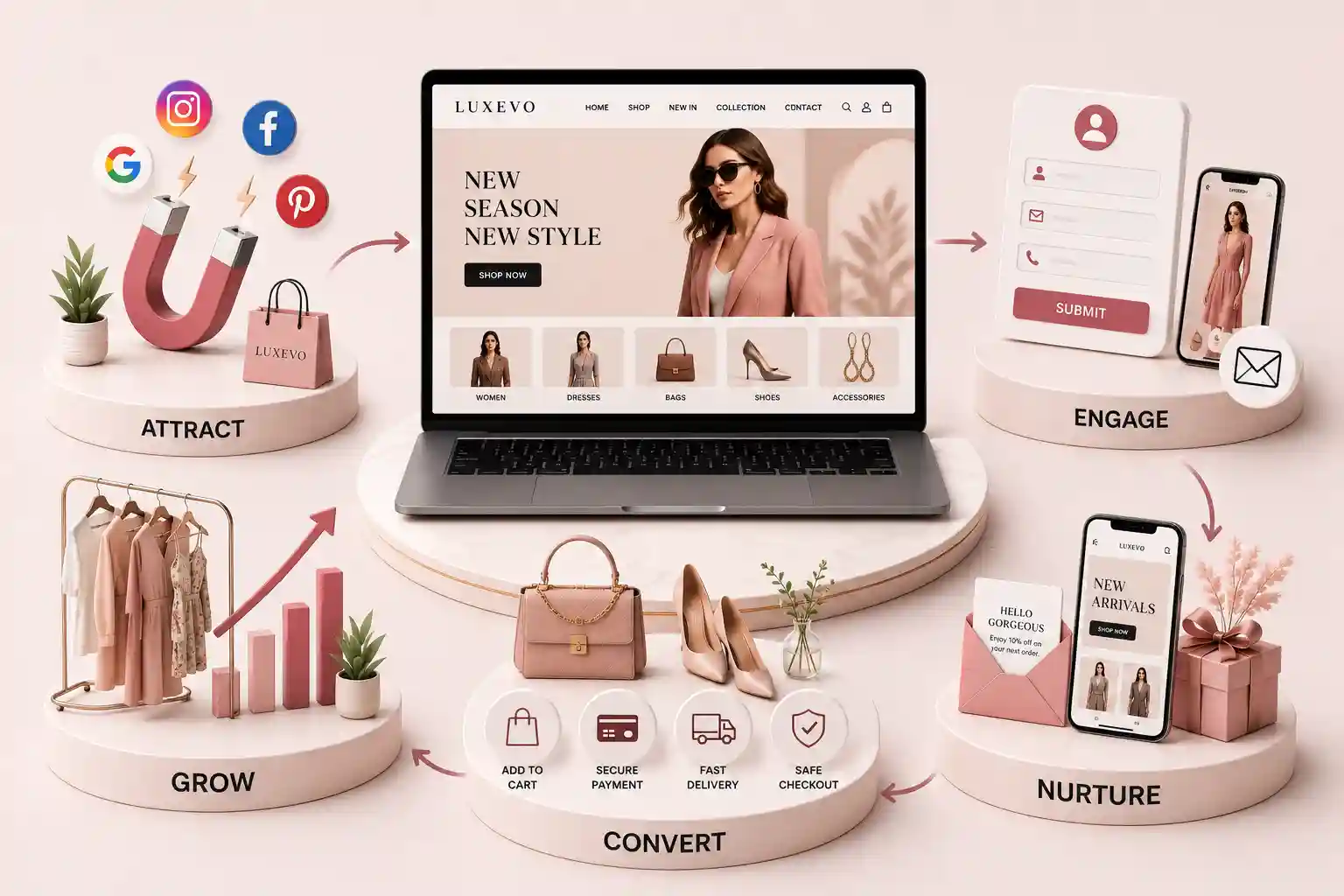
Jaipur Fashion Ecommerce Guide for Artisan and Clothing Brands
Learn how Jaipur fashion labels can present craft, fit, product detail, delivery, and trust online while turning discovery into profitable ecommerce sales. This guide covers brand positioning, product storytelling, size and fit, collection architecture, mobile performance, fulfilment communication, customer retention, and the measurements Jaipur fashion teams should use to improve profit rather than vanity traffic.
A shopper discovers a Jaipur clothing label through a reel, opens the product page, and sees beautiful photographs but no fabric weight, garment measurements, care guidance, delivery estimate, or explanation of the craft. The product is desirable, yet the purchase feels uncertain. Jaipur brands have a genuine advantage in design heritage, textile knowledge, and access to skilled production. Ecommerce converts that advantage only when the website makes quality, fit, origin, service, and fulfilment understandable to someone who cannot touch the garment.
This guide covers brand positioning, product storytelling, size and fit, collection architecture, mobile performance, fulfilment communication, customer retention, and the measurements Jaipur fashion teams should use to improve profit rather than vanity traffic.
For Jaipur designers, boutiques, artisan-led labels, ethnic and contemporary clothing brands, and export-focused teams preparing to improve or rebuild an online store.
What this Jaipur fashion ecommerce guide covers
Position the brand beyond generic heritage claims
Build product pages that prove quality
Make size and fit easier to trust
Organise collections around shopping intent
Balance visual storytelling with mobile speed
Design fulfilment and retention for profitable growth
Position a Jaipur fashion brand beyond generic heritage claims
Terms such as handcrafted, sustainable, traditional, and premium appear across thousands of fashion stores. They become meaningful only when the website supports them with specifics. Name the material, weave, print or surface technique, production location, maker relationship, finishing process, and reason for the design choice. If a piece uses a Sanganeri-inspired print or work produced in Bagru, explain accurately what the claim means and what part of the product it describes.
A clear point of view helps shoppers remember the label. One Jaipur brand may focus on breathable everyday cotton for warm climates; another may reinterpret regional techniques in contemporary silhouettes; another may specialise in occasion wear with made-to-order options. The homepage, collection names, photographs, and copy should reinforce that proposition instead of presenting an unrelated mixture of trends.
Avoid turning makers or cultural references into decorative marketing. Obtain permission for stories and images, credit collaborators appropriately, and distinguish inspiration from verified origin or certification. Transparent language creates stronger trust than exaggerated claims. It also gives wholesale buyers, journalists, and international customers information they can repeat accurately when describing the brand.
Build fashion product pages that prove quality online
A useful fashion product page answers questions in the order a shopper experiences them. Lead with a clear full-garment view, then show front, back, close detail, texture, construction, and movement. State fabric composition, lining, transparency, stretch, closure, pockets, garment measurements, model measurements, care, origin, dispatch time, and return eligibility. Keep essential purchasing facts visible without forcing visitors through several collapsed panels.
Craft detail deserves close photography and plain explanation. A shopper should be able to see print variation, embroidery density, seam finish, and colour relationship. If handmade processes create expected irregularities, explain them before purchase and show representative examples. This frames variation as part of the process without using craft as an excuse for defects or inconsistent quality control.
Product copy should help someone imagine use, not repeat the product name with adjectives. Describe climate, drape, weight, styling possibilities, occasion, layering, and care burden honestly. A light cotton dress suitable for Jaipur summers needs different context from a structured festive jacket. Useful specificity supports search visibility while making the page easier for customers and service teams.
Generic small, medium, and large labels are not enough because fit varies by silhouette and brand. Publish body measurements and garment measurements, explain ease, identify whether the cut is fitted or relaxed, and include model dimensions with the size worn. For adjustable, wrap, oversized, or elasticated products, describe how the construction changes the fit rather than forcing the item into a standard chart.
Add product-specific fit notes when a style behaves differently from the core range. Customer service questions and return reasons provide useful evidence: if shoppers repeatedly report a tight armhole or unexpected length, update the page and review the pattern. A fit recommendation tool can help at scale, but it should not hide the underlying measurements or pretend to be more certain than the available data.
Made-to-order and alteration options need operational boundaries. State which measurements are required, who is responsible for checking them, the expected production time, what changes are possible, and whether the product can be returned. Confirm custom details in writing before production. Clear rules protect the customer experience and prevent the workshop from receiving incomplete instructions.
Internal production categories do not always match customer intent. Shoppers may browse by occasion, garment type, fabric, craft, colour, climate, price, availability, or delivery timeline. Offer a small set of understandable collection routes and filters based on actual catalogue depth. A filter that produces one item or conflicting combinations creates more work than value.
Seasonal and occasion collections should have a clear purpose beyond grouping products. Introduce the use case, highlight compatible pieces, answer delivery questions, and link to relevant care or styling guidance. For festive demand, display order cut-offs and made-to-order timelines prominently. Remove outdated urgency rather than allowing last year's delivery promise to remain indexed.
Search and no-results states are part of merchandising. Support common spelling variants and product terms, show helpful suggestions, and let shoppers recover without restarting. Review internal search reports to discover demand the navigation misses. If visitors frequently search for plus sizes, cotton co-ords, or ready-to-ship pieces, the result should influence buying, content, and filters—not only SEO copy.
Balance editorial visuals with mobile shopping speed
Fashion depends on imagery, but oversized campaign files can make the mobile store frustrating. Export images at the dimensions the design actually uses, serve modern formats, define width and height to prevent layout movement, and load below-the-fold media only when needed. Preserve enough detail for fabric inspection through a controlled zoom rather than sending every visitor the original studio file.
Prioritise the path from social discovery to product decision. A shopper arriving from Instagram should see the promised product or collection immediately, not a generic homepage and several pop-ups. Keep variant selection, size guidance, price, delivery estimate, and add-to-cart controls stable on small screens. Test on mid-range devices and ordinary mobile networks used by real customers.
Accessibility improves both usability and resilience. Write descriptive alternative text, maintain readable contrast, label colour swatches with names, support keyboard navigation, provide visible focus states, and avoid conveying availability only through colour. Videos should not block purchasing information and should include captions when speech matters. These practices serve customers with disabilities and shoppers in noisy, bright, or bandwidth-limited situations.
Planning a stronger Jaipur fashion store?
We can review your catalogue structure, product-page evidence, mobile experience, performance, and conversion journey before you invest in a redesign.
Design fulfilment and retention for profitable fashion growth
Conversion is only the beginning. State dispatch time separately from carrier transit time, explain which products are ready to ship or made to order, show serviceable locations, and communicate delays before the customer asks. Packaging should protect delicate work without creating unnecessary volume. International orders need clear duties, documentation, return, and exchange expectations.
Returns are a product and information signal. Categorise reasons such as fit, colour expectation, quality, delayed delivery, or changed mind, then connect them to the relevant SKU and page. Repeated fit returns require pattern or measurement action; colour expectation may require photography and display guidance. Suppressing returns data protects a short-term metric while increasing support cost and weakening trust.
Retention should offer useful relevance rather than constant discounts. Send care instructions after delivery, notify interested customers when a compatible piece launches, invite verified product feedback, and provide early access selectively. Segment by purchase behaviour and consent. A Jaipur artisan brand builds long-term value when customers understand the product, care for it well, and return because the next collection feels connected to the first.
Measure contribution margin, conversion by device, product-page engagement, size-guide use, return rate by reason, dispatch accuracy, repeat purchase, and customer-service demand. Traffic and follower counts are context, not outcomes. Review these measures at product and collection level so creative, merchandising, production, and development teams can make one coordinated improvement at a time.
Google's product data specification is a useful reference when preparing accurate catalogue attributes for Merchant Center feeds.
Include clear imagery, fabric and construction, garment and body measurements, model context, fit notes, care, origin, dispatch time, delivery estimate, return eligibility, price, variants, and accessible purchase controls.
Explain the specific process and show realistic examples of expected variation. Separate acceptable handmade character from actual defects, and avoid broad craft claims that cannot be verified for the individual product.
It can reduce avoidable returns through accurate garment measurements, fit notes, model dimensions, product-specific feedback, and consistent charts. Returns will not disappear, so brands should also improve patterns using structured reason data.
The channels can complement each other. Marketplaces provide discovery, while an owned store offers stronger presentation, customer relationships, data, merchandising control, and retention. Compare contribution margin and operational effort by channel.
Use enough images to explain silhouette, front, back, scale, texture, construction, and relevant details. The right number depends on product complexity; quality and decision coverage matter more than filling a fixed gallery count.
Create responsive sizes, use modern formats, reserve layout dimensions, lazy-load noncritical media, limit unnecessary scripts, and provide controlled zoom. Test the actual product path on mobile networks and mid-range devices.
Track conversion, contribution margin, product engagement, search behaviour, size-guide use, abandonment, return reasons, dispatch accuracy, repeat purchase, and support contacts. Review by product, collection, source, and device.
Timing depends on catalogue cleanup, photography, integrations, migration, content, and approvals. A focused store may take weeks; a large catalogue or custom workflow can take months. Plan data and operations before visual production.
Instagram can fill your feed with interest and still leave the till quiet. See how a proper fashion website turns followers into orders with catalogue clarity, size help, and checkout that works.
Audit fashion product pages for useful galleries, specific copy, honest price and stock states, trust signals, structured data, and dependable mobile shopping.
Design clothing size guidance around clear measurements, honest fit context, accessible selectors and forms, useful filters, and resilient mobile behaviour.
Explore Fashion Web Development for India. Every page is planned for stronger search visibility, faster performance, clearer customer journeys, and measurable enquiries.
My Perfect Solutions helps brokers, clinics, restaurants, and growing brands launch fast, SEO-ready websites that turn search traffic into qualified enquiries across India.