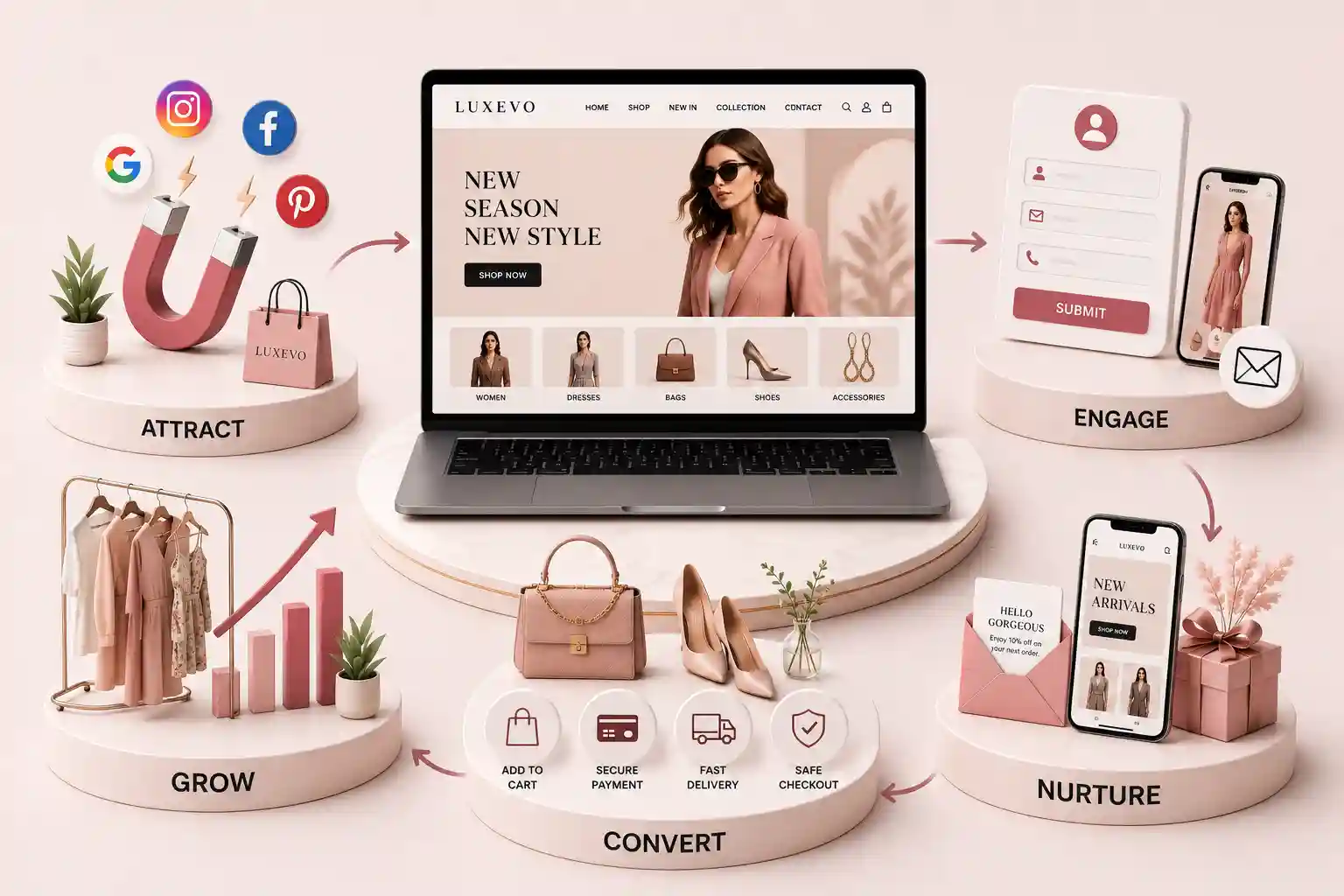
Fashion Instagram Website: Stop Losing Shoppers Before They Buy
Instagram can fill your feed with interest and still leave the till quiet. See how a proper fashion website turns followers into orders with catalogue clarity, size help, and checkout that works. This guide walks through why Instagram-only selling is risky, what Google traffic you are missing, how lookbooks and catalogues should work on a real site, and which practical pieces—size guides, wishlist, fast checkout, payments, and SEO—turn a curious follower into a paying customer. It is written for owners and merchandisers, not developers.
Plenty of fashion brands look busy on Instagram and still struggle to close sales. The comments say “price?” The DMs ask for sizes. Someone saves a Reel, then never comes back. The brand treats the app like a shop floor, then wonders why the till stays quiet when the algorithm dips for a week. That gap—between attention and payment—is where money leaks. Instagram is good at discovery. It is a weak place to finish a purchase when someone needs measurements, shipping rules, or a card payment they trust. A fashion Instagram website gives you a storefront you own: product pages that answer doubts, a catalogue that still works when reach falls, and checkout that does not depend on a staff member typing prices in chat. Brands that only sell in-app hand control of their pipeline to a feed they do not run.
This guide walks through why Instagram-only selling is risky, what Google traffic you are missing, how lookbooks and catalogues should work on a real site, and which practical pieces—size guides, wishlist, fast checkout, payments, and SEO—turn a curious follower into a paying customer. It is written for owners and merchandisers, not developers.
Boutique owners, D2C fashion founders, and small apparel teams who already have Instagram traction and want a website that catches that traffic instead of dumping it into endless DMs.
1. Instagram is a showcase, not a store you control
Your feed can look polished and still fail at the basic job of a shop: let someone choose a size, see the price in context, pay, and know when the parcel arrives. Shopping tags and reply stickers help, but they still leave gaps. A visitor who lands from a Reel often wants more angles, fabric notes, or a size chart before they commit. If the only next step is “DM to order,” you have turned every sale into a conversation—and conversations do not scale when you are also packing orders.
There is another risk people ignore until it hurts. Reach changes. Accounts get restricted. Staff leave and take the informal “how we take orders” process with them. When your entire catalogue lives in posts and highlights, you do not have a clean record of what is in stock, what sold last season, or which product page used to convert. A website is boring in the best way: it keeps the catalogue, prices, and policies in one place you can update without rewriting twenty captions.
2. Google still sends buyers your feed never shows you
Not every customer starts on Instagram. Someone hears your brand name from a friend, types it into Google, and expects a site that looks as serious as your grid. Someone else searches for “linen co-ord set under 3000” or “office wear kurtis with pockets.” Those queries will not reliably surface a three-month-old Reel. They surface pages that load fast, name the product clearly, and look trustworthy on a phone.
If you only sell on Instagram, you are invisible for that search demand. A fashion Instagram website does not replace your content calendar; it catches people who never scroll your feed. Even branded searches matter: when a customer Googles you after seeing a Story, the first result should be your store, not a random directory scrape or an old Facebook page.
For people-first page quality and search basics that still apply to product content, use Google Search documentation. Fancy Reels will not rescue thin product pages that hide price, size, or shipping.
3. Lookbooks and catalogues that work outside the app
On Instagram, a lookbook is a carousel. On a website, it should be a shopping path. Group outfits by occasion, fabric, or drop. Let someone open the kurta from the look and land on a product page with variants, not another photo dump. Keep collection names plain—“Wedding guest,” “Work basics,” “Summer linen”—so a first-time visitor from your bio link knows where to click without reading your brand manifesto.
An online catalogue also protects you when a drop sells out. Mark sizes as unavailable instead of deleting the post and confusing people who saved it. Show related pieces so a sold-out colour still leads to a similar style. That is how you turn “Instagram visitors” into browsing sessions that can still end in a cart, even when one SKU is gone.
Half the DMs under a dress Reel are size questions. If the answer lives only in your head—“this runs small, take L if you are usually M”—you will repeat yourself all day and still lose people who never messaged. Put a clear size guide on the site: what you measure, how to measure, and any honest fit notes. Link it from every apparel product page. Shoppers who sort themselves out buy with less hand-holding.
A wishlist (or save-for-later) helps the quieter buyers. Not everyone is ready to pay after one Reel. Let them save items on your site, then email or remarket with a restock or drop reminder you control. That is cleaner than hoping they remember which highlight folder held last month’s co-ord.
Build the measurement UX properly with our online clothing store size guide UX guide. Vague “see size chart” PDFs that open as a blur on mobile are almost as bad as no chart at all.
Want Instagram traffic that actually checks out?
Tell us how you sell today—DM, WhatsApp, or partial store—and we will outline a fashion website that catches the sale.
5. Fast checkout and real payment beats chat commerce
Chat selling feels personal until three people ask for UPI details at once and one payment fails without a clear order ID. A proper checkout on your fashion Instagram website should work on a mid-range phone, keep cart contents visible, and support the gateways your customers already trust. Guest checkout helps first-time buyers. Saved addresses help repeats. Surprises at payment—extra fees, COD rules that were never stated—send people back to the app to complain instead of completing the order.
WhatsApp can still sit beside the site for styling help or bulk orders. Just do not force every sale through chat. Use the site for standard SKUs and reserve chat for exceptions. Boutiques that already lean on messaging can keep that channel without making it the only till—see a practical WhatsApp ordering workflow for boutiques when you need clear statuses and payment boundaries in chat without abandoning the website.
Instagram-only selling versus site-backed selling
Moment
Instagram-only habit
Better website habit
Price question
Reply in DM for every Reel
Price and variants on the product page
Size doubt
Send a screenshot of a chart
Linked size guide on every apparel SKU
Payment
UPI note in chat, manual confirm
Gateway checkout with order ID
Sold out
Delete or ignore comments
Out-of-stock state + related styles
Return
Argue policy in DMs
Clear returns page before purchase
6. SEO so products survive after the Reel dies
A Reel peaks and fades. A product page can keep earning if you name it the way buyers search: fabric, occasion, silhouette, not only an internal style code. Write short, useful descriptions. Compress images so mobile pages stay quick. Use unique titles per product instead of copying the same brand slogan onto every URL. None of this replaces good design photos—it makes those photos findable when someone is not scrolling Instagram that day.
Internal links help too. From a lookbook, link to the products. From a blog about fabric care, link to the linen collection. From the homepage, link to current drops. Search engines and humans both hate orphan pages that only exist because someone pasted a random link in a Story once.
7. Trust signals for strangers who only know your handle
An Instagram follower may feel they “know” you. A Google visitor does not. Show real photos, honest reviews if you have them, shipping timelines, and a returns policy written in plain language. Put a phone or WhatsApp option where people expect help, but keep the buy button louder than the chat button for standard products. Brand story belongs on an About page; do not force a novel before the Add to cart control.
Security cues matter on payment pages: HTTPS, familiar gateway brands, and no surprise redirects that look like phishing. Fashion buyers are used to slick fakes. Your site should feel calm and specific, not flashy and vague.
8. A practical path from IG-first to site-backed sales
List your top 20 SKUs that get the most DMs and put them on product pages first
Add size guidance and shipping/returns before you redesign the homepage art
Point the bio link to a current collection, not a holding page
Turn on real checkout for those SKUs and stop taking card details in chat
Measure: bio-link sessions, add-to-cart rate, and completed orders from mobile
You do not need every ecommerce feature on day one. You need a path that respects how people already find you—and finishes the sale when they are ready. Instagram can stay your loudest megaphone. The website should be the shop that stays open when the megaphone goes quiet.
Yes for most brands. Instagram remains a strong discovery and community channel. The website should catch that traffic and finish the purchase with clearer product detail and checkout.
It can handle simple buys for some catalogues, but you still lack full control over SEO, complex size guidance, policies, and a stable catalogue when reach or tools change. Most growing brands need both.
Point it to a current collection or campaign landing page that matches what you are posting this week, with clear products and a mobile checkout path—not a generic homepage with no next step.
Start with your highest-DM products, honest size guidance, shipping and returns, and working payment. Visual polish can follow once the buy path works on a phone.
They answer the questions that clog DMs and reduce returns caused by guesswork. Link the guide from every apparel product page and keep measurements consistent across styles.
You can, for styling help or custom requests. Use the website for standard catalogue sales so payments and order records stay clean, and reserve chat for exceptions.
No. You still need clear product titles, useful content, fast pages, and ongoing updates. A website makes that work possible; Instagram posts alone rarely rank for lasting product searches.
Track bio-link and UTM sessions, add-to-cart and checkout completion on mobile, and compare DM volume for price and size questions before and after product pages go live.
Use a CMS or store admin your team can update without a developer for every drop. Mark sold-out sizes clearly and keep lookbook links pointed at live products.
Audit fashion product pages for useful galleries, specific copy, honest price and stock states, trust signals, structured data, and dependable mobile shopping.
Design clothing size guidance around clear measurements, honest fit context, accessible selectors and forms, useful filters, and resilient mobile behaviour.
Compare and design a boutique WhatsApp ordering workflow from product enquiry to confirmation, with clear consent, stock, payment, handoffs, policies, and fallbacks.
Premium fashion eCommerce experiences with catalogs, collections, and checkout flows. Available for clothing brands and boutiques across major Indian cities. Every page is planned for stronger search visibility, faster performance, clearer customer journeys, and measurable enquiries.
My Perfect Solutions helps brokers, clinics, restaurants, and growing brands launch fast, SEO-ready websites that turn search traffic into qualified enquiries across India.