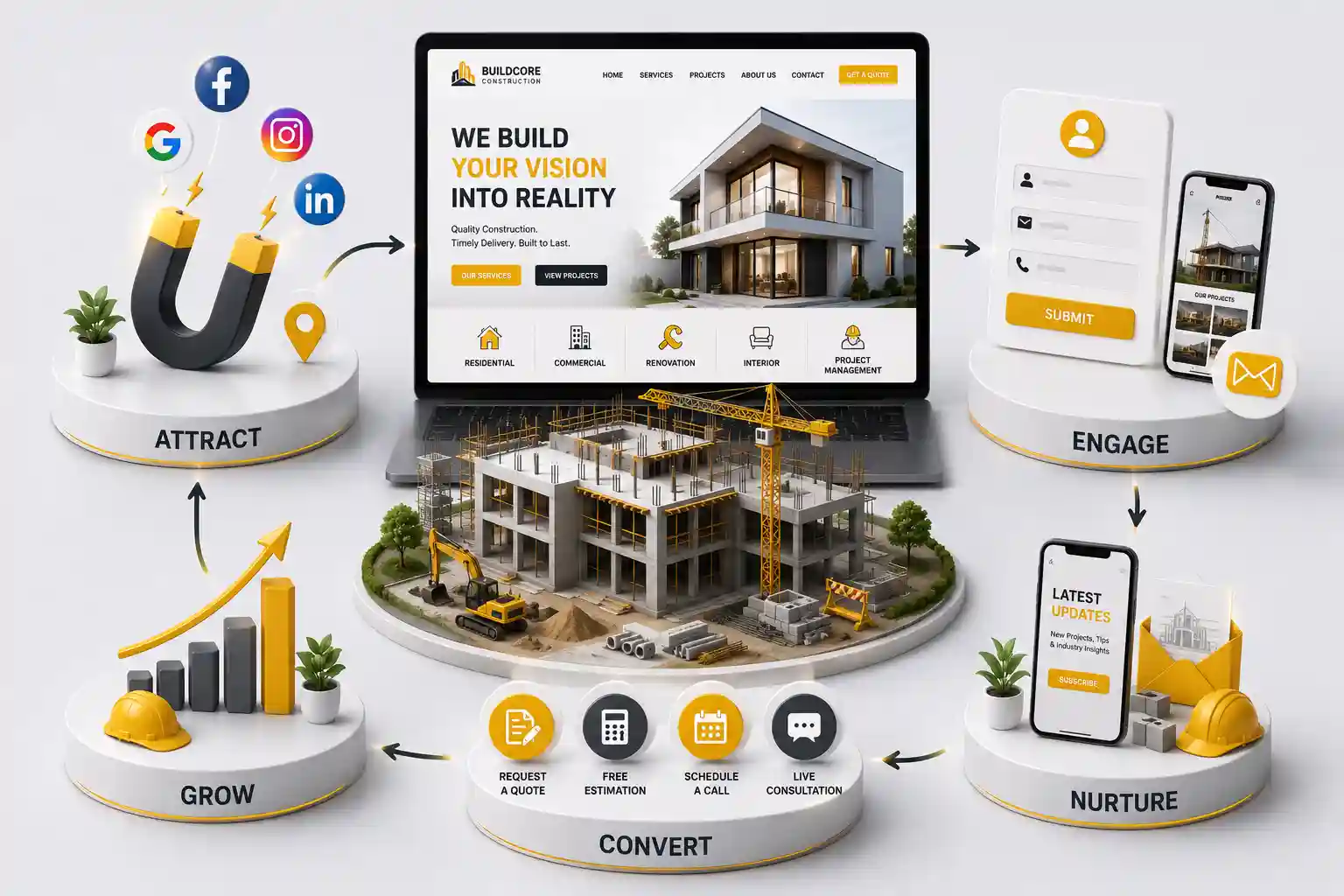
Why Every Construction Company Needs a Professional Website in 2026
Learn why a professional construction company website wins trust, improves lead quality, and supports contractor growth when marketplace leads get more expensive. This guide explains why a construction business website matters, which outcomes it should drive, and how to connect construction marketing website work to estimating operations that close jobs.
Construction firms still win work through relationships, yet more owners and facility managers research contractors online first. A weak construction company website makes a capable field team look risky before anyone visits a jobsite. Marketplace leads are expensive and inconsistent. Contractor website development creates an owned channel for proof, qualification, and repeat discovery. In 2026, builder website design is part of how serious firms protect margin and reputation.
This guide explains why a construction business website matters, which outcomes it should drive, and how to connect construction marketing website work to estimating operations that close jobs.
Owners and marketers at residential and commercial contractors who need more qualified opportunities without wasting estimating hours.
Why a construction company website matters more in 2026
Buyers compare safety culture, similar projects, and communication style before requesting bids. If your construction website development is outdated, prospects fill gaps with assumptions. A clear construction company website answers those questions early and keeps conversations moving toward a job walk.
Owned media also compounds. Directory spend stops when budgets pause. A strong construction marketing website continues capturing trade and city searches, supporting pipeline even between campaigns.
Treat your construction company website as a qualification filter, not a vanity brochure. Publish the work you want more of. If you are shifting toward higher complexity commercial jobs, feature those stories prominently and stop leading with outdated residential galleries that attract the wrong calls.
Also align sales and marketing language. If estimators talk about design build partnerships while the site still sells only hard bid packages, prospects arrive with mismatched expectations. Consistent builder website design and sales scripts reduce friction before the first meeting.
Outcomes a professional builder website should deliver
Credibility comes first: real projects, readable scopes, and proof you operate professionally. Qualification comes next: service boundaries and RFQ fields that filter poor fit work. Conversion comes third: mobile CTAs and fast pages that do not punish busy owners.
Finally, measurement. Contractor website development should report RFQs, calls, qualified meetings, and wins by channel. That is how leadership judges builder website design as a growth asset rather than a brochure expense.
Create a simple monthly ritual: review top landing pages, incomplete RFQs, and response times. Then choose one improvement. Construction marketing website progress compounds when teams ship small fixes instead of waiting for a perfect future redesign.
When you expand into new metros, do not clone empty city pages. Publish only markets you can staff and support. Useful local proof beats a long list of cities that make the construction company website look bigger than your field capacity.
If brand perception is a concern after a rough project cycle, refresh featured stories and testimonials before buying more ads. A construction business website that still showcases outdated work undercuts recovery. Proof should reflect the company you are today.
For firms entering design build or specialty niches, create dedicated pages that explain the delivery model. Generic contractor language hides differentiation. Clear positioning is a core job of construction website development when markets get crowded.
Set leadership goals that match operations, such as lowering cost per qualified RFQ or increasing job walks from organic pages. Goals like those keep a construction company website prioritized when other initiatives compete for cash and attention.
If you rely heavily on referrals today, still invest in the site. Referred owners still check you online before calling. A weak construction business website can quietly veto relationships your field team worked hard to earn.
Treat the first ninety days after launch as a learning window. Review incomplete RFQs, top exit pages, and response times weekly. Early corrections turn construction marketing website spend into a durable advantage rather than a one time expense for the firm.
Build a construction company website that wins work
Share your trades, markets, and lead bottlenecks. We will outline a practical contractor website plan for US growth.
Close the trust gap before the first site visit
Owners shortlist contractors online long before they invite anyone to walk a site. A professional construction company website answers capability questions early: similar projects, safety posture, service area, and how to start a conversation.
Without that proof, even strong field performance loses to firms that simply look more organized online. Your website is often the first superintendent impression you never get to redo.
Improve lead quality, not only lead volume
A construction marketing website should qualify. Ask for project type, timeline, and location. Publish service boundaries. That reduces tire kickers and protects estimating time for jobs you can win.
State residential, commercial, or specialty focus clearly
Show representative project scales
Explain your process from inquiry to proposal
Offer alternate contact paths for urgent repairs if relevant
Win local and regional search with useful pages
Contractors who ignore city and trade language leave demand to competitors. Create service pages that match how owners search, and add market pages when you truly operate there. Keep NAP details consistent with your business profiles.
Avoid thin location spam. Useful local content beats dozens of empty city templates that never get updated.
Measure awards and conversations, not vanity traffic
Track RFQs, calls, qualified meetings, and win rate by channel. A traffic spike with flat awards means messaging, speed, or follow up is broken. Share reports with ownership and estimating so website work stays tied to pipeline.
Define one primary conversion per template
Tag campaigns with consistent UTM values
Review incomplete RFQs weekly
Test one CTA or form change at a time
Share the scorecard with estimating and ownership, not only marketing. When field leaders see which project stories create conversations, they become better partners for photography and case notes. That collaboration keeps a construction company website credible and useful.
Use the same scorecard when renewing vendors or lead tools. If a marketplace or plugin adds cost without improving awards, cut it. Construction marketing website stacks grow expensive when nobody revisits the original goal of winning work.
Over a year, steady improvements beat one dramatic redesign. Keep a backlog, ship one change at a time, and record results. That habit turns construction website development into an operating rhythm instead of a panic project every few years.
Invite estimating into that backlog. They hear the objections owners raise after browsing the construction company website. Marketing teams that ignore those calls optimize for aesthetics while awards stay flat.
Revisit your top five landing pages every quarter. Read them on a phone. If any sentence sounds like internal jargon, rewrite it. Clarity is one of the highest ROI activities in contractor website development.
Celebrate operational wins, not only traffic spikes. A week with faster response times and fewer incomplete RFQs is progress even if sessions are flat. Construction marketing website programs mature when teams value qualified work over vanity charts.
When competitors launch flashy redesigns, resist panic. Compare their proof quality and RFQ clarity, not animation. Many awards still go to the firm that answers capability questions fastest on a phone. That is the quiet advantage of disciplined construction website development.
Keep a short owner facing summary of what the construction company website is for: prove similar work, qualify fit, and start a conversation. When every redesign proposal returns to that sentence, budgets stay aligned with pipeline instead of decoration.
Finally, protect continuity across seasons. Bid calendars get busy and website ownership slips. Assign a backup publisher and a documented RFQ test so summer pursuits do not expose a silent form failure. Reliability is part of professional contractor website development.
If you compete for owner selected work, yes. A construction company website is often the first credibility check before a job walk or bid invitation. Even referral heavy firms lose deals when owners cannot verify capability online.
Directories can supplement demand, but they do not replace owned proof, qualification, and SEO. Marketplace costs also rise without building equity. Treat directories as channels, not a substitute for your construction business website.
Similar projects, clear services, service area, and an easy RFQ path. Visual polish helps after those fundamentals convert. Owners forgive plain design faster than missing proof or broken contact forms.
By stating fit criteria and asking better RFQ questions up front. Estimating spends less time on poor fit inquiries. That protection of estimator hours is often the real ROI story for leadership.
Proof and process differ, but both need mobile speed, clear CTAs, and trustworthy project storytelling. Messaging should match the buyer. Mixing audiences on one homepage without clarity confuses both segments.
As fast as staffing allows, ideally within an hour during business hours. Speed to contact strongly influences who wins the conversation when owners are comparing multiple contractors the same day.
Qualified RFQs, job walks, awards, and cost per qualified lead by channel. Sessions are supporting signals, not the goal. Review incomplete RFQs weekly so form friction does not hide inside vanity traffic.
Yes at a right sized scope. A focused site with strong proof often outperforms a generic brochure that never gets updated. Specialty trades win when project stories match the exact work owners are researching.
Fix portfolio proof, mobile CTAs, and lead routing first. Then expand construction website development into SEO content and automation once the conversion path is trustworthy for estimating and ownership.
Prioritize construction website features that turn project research into qualified RFQs: proof, filters, mobile CTAs, local pages, and fast performance.
Plan a construction website budget through scope, phased delivery, RFQ complexity, content readiness, maintenance, timelines, and comparable vendor proposals.
Project-focused websites that showcase your portfolio, capture quote requests, and win more contracts. Available for builders and contractors across major Indian cities. Every page is planned for stronger search visibility, faster performance, clearer customer journeys, and measurable enquiries.
My Perfect Solutions helps brokers, clinics, restaurants, and growing brands launch fast, SEO-ready websites that turn search traffic into qualified enquiries across India.