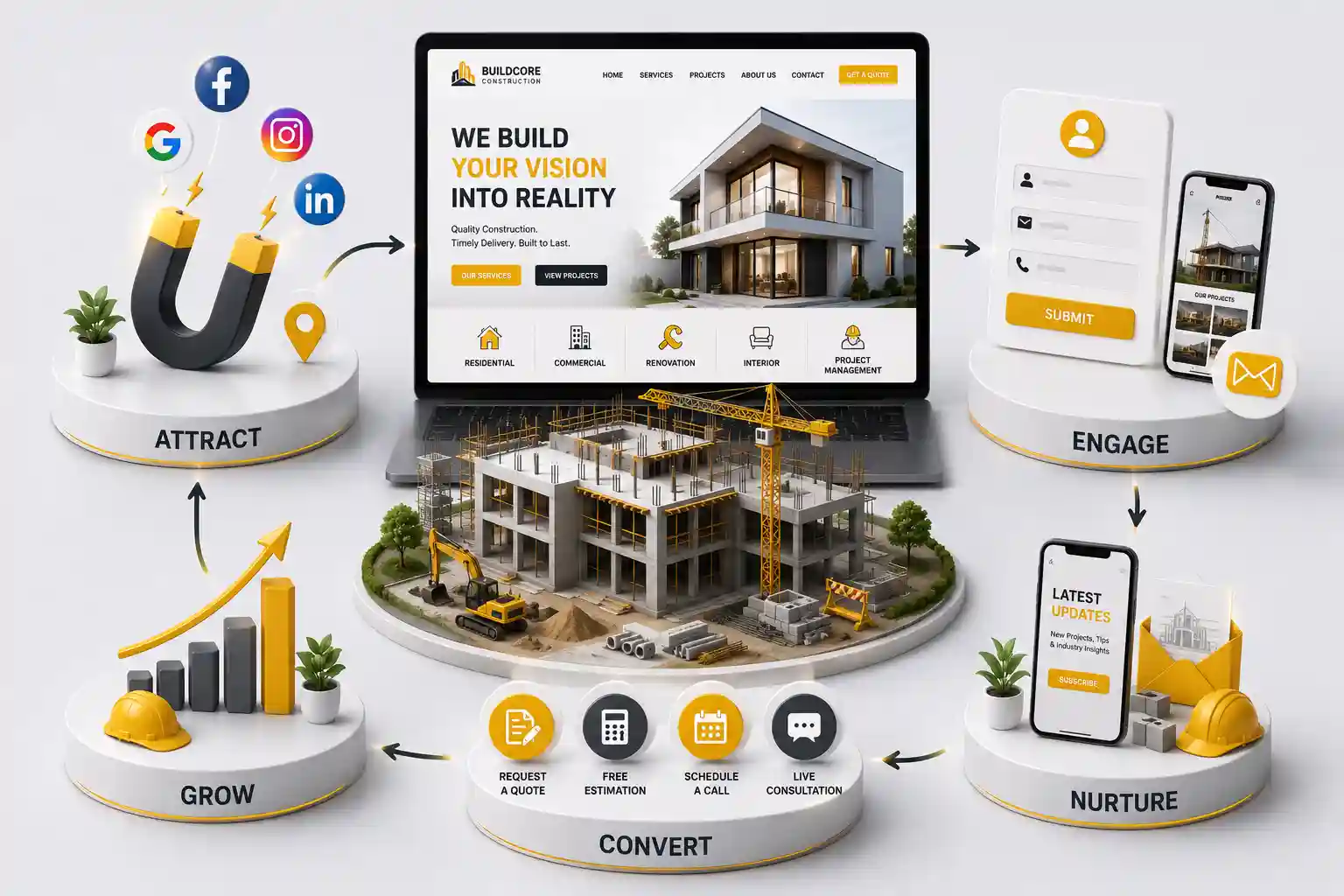
Turn a construction website into a lead generation system by connecting credible proof, scoped RFQ capture, fast routing, and follow-up measurement. This playbook lays out that system from end to end: define valuable leads, organize service and project proof, build an RFQ that gathers useful context, route submissions reliably, and measure what happens after the first contact. It is deliberately different from a generic feature list. The focus is the operating flow between marketing, estimating, sales, and delivery—not adding widgets for their own sake.
Many construction websites present capability without creating a dependable path to a qualified opportunity. They show a rotating gallery of finished work, a general contact form, and broad statements about quality, yet a buyer cannot quickly confirm project fit, describe a requirement, or know who will respond. Sales teams then rely on phone calls and inbox triage to reconstruct missing information. Valuable RFQs arrive without location, scope, budget context, timing, or contact preference, while less suitable requests consume the same attention. Construction decisions involve risk, coordination, and substantial commitments. Before a prospect requests a quote, they need evidence that a company handles comparable work, operates in the relevant service area, and can begin a competent conversation. After they submit, speed and accuracy matter just as much. A website that treats the form as the finish line creates avoidable delay; a lead generation system connects proof to a scoped RFQ, then routes it to a person who can take the next step.
This playbook lays out that system from end to end: define valuable leads, organize service and project proof, build an RFQ that gathers useful context, route submissions reliably, and measure what happens after the first contact. It is deliberately different from a generic feature list. The focus is the operating flow between marketing, estimating, sales, and delivery—not adding widgets for their own sake.
It is written for construction company owners, business-development leaders, estimators, operations managers, marketing teams, and agencies. General contractors, specialist trades, design-build teams, and commercial or residential firms can apply the framework. Adapt qualification fields, response commitments, and compliance requirements to your own services, team capacity, and procurement process.
Define the lead you want to win before designing the form
A lead generation website begins with a shared definition of a good opportunity. Meet with the people who answer enquiries, estimate work, and approve bids. Identify the project types, service areas, contract sizes, timing windows, and decision-maker roles that make an initial conversation worthwhile. Also identify requests the business cannot serve. This is not about excluding people with a clever form; it is about giving every enquiry a truthful route and protecting specialist time for the work the company is equipped to pursue.
Turn that definition into simple stages: new enquiry, qualified conversation, site visit or discovery, estimate or proposal, and won or lost. Assign an owner and a target response for each stage. Without these basics, a website may generate more messages but cannot demonstrate that it generates better pipeline. The form, automated notifications, and dashboards should reflect an existing operating decision, not create a parallel process nobody maintains.
Use project proof to create relevance before the RFQ
Prospects do not need a claim that you deliver quality; they need enough evidence to judge whether your experience resembles their requirement. Organize project evidence by the choices buyers make: sector, project type, service, scale range, building condition, delivery method, or technical challenge. A project page should explain the starting situation, the work performed, key constraints, the team’s role, and the outcome in factual terms. Obtain permission before publishing client names, photos, specifications, or sensitive site details.
Link each service page to the most relevant examples and each project page back to the applicable service. This creates a useful research path: a visitor can move from “Can this company do my kind of work?” to “How would I begin a conversation?” without restarting from the homepage. Keep project pages current and distinguish completed work from concepts. Evidence loses value when dates, roles, or project descriptions are unclear.
Review the foundational page structure in our guide to construction company website features. Once those pages are clear, this playbook connects them to a managed lead flow.
Proof blocks that support lead qualification
Proof block
Buyer question
Next action it supports
Relevant project case study
Have you handled comparable work?
View scope or request a discussion.
Service capability summary
What do you actually provide?
Choose the right enquiry path.
Process overview
What happens after I contact you?
Start a lower-risk RFQ.
Team or accreditation evidence
Who is accountable for the work?
Build confidence before sharing details.
Service-area clarity
Can you serve this location?
Avoid misrouted enquiries.
Build an RFQ that collects actionable context
An RFQ form should collect the minimum information needed to make a useful first response. Start with contact details, project location, service or project type, a concise scope description, expected timing, and a preferred contact method. Add budget range only when the team will use it respectfully to guide the conversation; do not present it as a trap. Let prospects attach drawings or documents when the workflow can receive them securely, while preserving a text option for early-stage enquiries.
Use progressive detail where it reduces friction. A visitor who only needs to ask whether a service is available should not face a long tender-style questionnaire. After a basic submission, an estimator can request plans, dimensions, site access information, or procurement documents using a secure follow-up. Explain what happens on submit: who reviews the request, expected response timing, and whether a site visit or qualification call may be needed. Never promise a quote when the company actually needs discovery first.
Make the form title match the visitor’s task: request a consultation, discuss a project, or request a quotation.
Use conditional questions only for information that changes routing or the next response.
Validate contact fields clearly and preserve entered values after an error.
Show a concise privacy statement near submission and define document handling internally.
Send a confirmation that gives the enquiry a clear next step rather than a vague thank-you.
For field-level planning, see the construction RFQ form requirements guide. Use it to agree on data needs with estimating and operations before development begins.
Need a website built around qualified RFQs?
Discuss your services, project proof, and enquiry workflow in a construction website consultation.
Route every submission to an accountable owner
The most polished RFQ form fails if the submission lands in an unmonitored shared inbox. Route leads by service, location, project type, or value band only when those rules have named owners and fallback coverage. Send the prospect an acknowledgement and send the internal team the context needed to respond. A CRM can help, but a reliable simple workflow is better than a complex integration that silently drops attachments or assigns every lead to one unavailable person.
Document exceptions as well as the happy path. What happens when a field is incomplete, an attachment cannot be opened, the service area is outside coverage, or a request arrives after hours? Define whether the team will refer, decline, invite a future conversation, or request more detail. These decisions protect the brand because every response becomes intentional rather than improvised under pressure.
Make the system work on mobile and in search
Construction research happens in offices, on site, and between meetings. Mobile pages need readable project imagery, tappable phone and RFQ actions, concise service summaries, and forms that do not require a long typing session. If documents are necessary, offer a follow-up route rather than forcing upload from a phone. Test site contact paths in the environments your team actually uses, including slower networks and devices with smaller screens.
Search visibility should bring people to the page that matches their intent. Follow Google's SEO Starter Guide for clear, helpful content and crawlable site structure. Then connect service, project, and location-relevant pages with editorial links rather than creating thin pages solely for rankings.
Performance matters here too. Heavy drone footage, project galleries, maps, and third-party lead widgets can make a site appear unreliable before a buyer sees the proof. Set performance budgets for templates, use optimized media, and monitor real-user loading behavior. A responsive mobile experience is not a cosmetic improvement; it gives a prospect a practical way to act while the project need is current.
Measure pipeline quality, not just form volume
Count enquiries, but do not stop there. Report how many leads reached a qualified conversation, site visit, estimate, proposal, and signed project. Segment by source, service, project type, device, and entry page when the data is trustworthy. A campaign that produces fewer enquiries but more estimable projects may be more valuable than a high-volume campaign that keeps coordinators busy with unsuitable requests.
Create a regular review between marketing and the team handling leads. Compare landing-page claims against the requests received, inspect form abandonment, sample response times, and record common reasons for disqualification. Feed those observations back into page copy, project proof, eligibility information, and routing rules. This loop turns the website from a brochure that collects messages into a system that learns what qualified demand looks like.
“Construction lead generation works when proof earns the enquiry, the RFQ creates context, and a real team owns the next response.”
Launch with operational acceptance tests
Before launch, run realistic test enquiries from every service path. Check confirmation messages, internal assignments, attachment delivery, CRM records, mobile behavior, spam handling, accessibility, and the escalation route for unassigned leads. Ask an estimator to judge whether a sample submission contains enough context for a sensible first reply. Ask a coordinator whether they can see ownership and status without searching through email threads. These tests are as important as checking typography and page layout.
Confirm every public phone, email, and form path has a response owner.
Test routing rules with combinations that should go to different teams.
Verify privacy copy, consent handling, and document retention with appropriate internal advisors.
Set baseline measures for response time, qualification, and estimate progression.
Schedule a post-launch review after enough genuine leads have entered the system.
It is the connected path from project and service proof to an RFQ, internal routing, human follow-up, and pipeline measurement. It treats the website and the response process as one operating system.
Start with contact details, location, project or service type, scope summary, timing, and preferred contact method. Add fields only when they materially improve routing or the first useful response.
It should be as short as possible while allowing the team to recognize the opportunity and respond appropriately. Detailed plans and procurement documents can often be requested after initial qualification.
They help buyers assess comparable experience, constraints handled, the company’s role, and whether the service matches their need. Relevant factual proof is more useful than a large unstructured image gallery.
Route each RFQ to a named owner based on rules the business can maintain, with a fallback when that person is unavailable. A shared inbox without accountability is not a routing process.
Set a target your team can meet consistently and communicate it accurately. Track actual first human response times, then improve coverage or expectation-setting before making faster promises.
Use a budget range when it helps the team guide scope and prioritization respectfully. If it will only be used to dismiss enquiries without conversation, it may damage trust and reduce useful context.
Keep service and project proof readable, make contact actions easy to tap, use short forms, avoid mandatory document upload, and test the full enquiry process on ordinary mobile connections.
Track qualified conversations, site visits, estimates, proposals, and won work in addition to enquiry count. Review source, service, entry page, response time, and disqualification reasons together.
Plan a construction website budget through scope, phased delivery, RFQ complexity, content readiness, maintenance, timelines, and comparable vendor proposals.
Prioritize construction website features around credible project proof, clear capabilities, safety evidence, accessible mobile quote flows, and measured performance.
Create construction case studies with verified status, honest media, approved claims, useful filters, and project evidence that supports relevant RFQ decisions.
Project-focused websites that showcase your portfolio, capture quote requests, and win more contracts. Available for builders and contractors across major Indian cities. Every page is planned for stronger search visibility, faster performance, clearer customer journeys, and measurable enquiries.
My Perfect Solutions helps brokers, clinics, restaurants, and growing brands launch fast, SEO-ready websites that turn search traffic into qualified enquiries across India.