Restaurant Website Mumbai vs Zomato: Why You Need Both in 2026
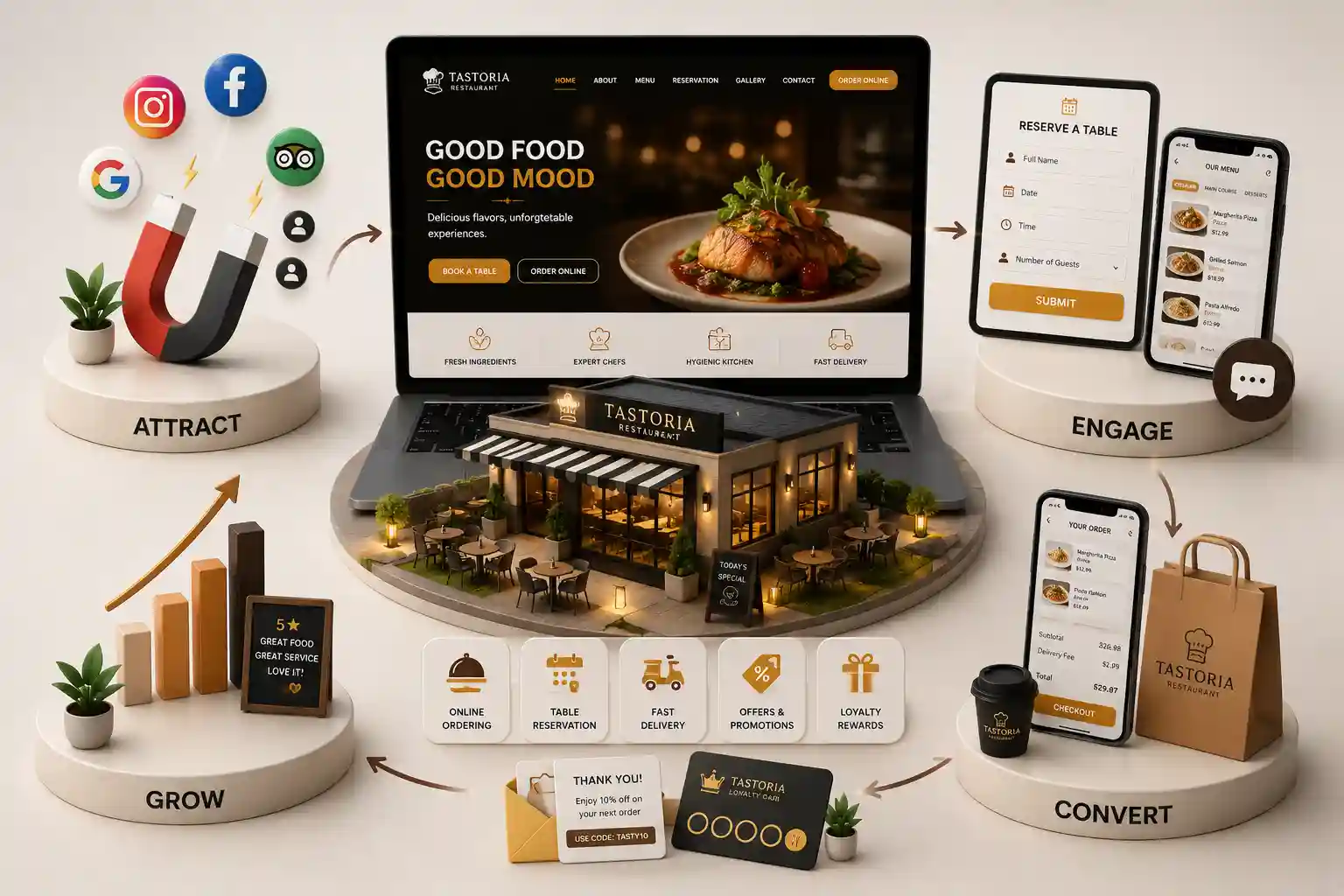
A restaurant website Mumbai owners can use for direct orders, table bookings, and margin protection alongside Zomato and Swiggy, not instead of them. This guide breaks down what a restaurant website Mumbai owners should actually build in 2026: direct ordering that customers will use, table booking that reduces no-shows, FSSAI and compliance display that builds trust, WhatsApp capture for repeat orders, and how to run a website alongside Zomato and Swiggy instead of trying to replace them outright.
Most Mumbai restaurant owners treat Zomato and Swiggy as their entire online presence, sometimes with a Facebook page as backup. That works until the commission statement lands and a third of the month's delivery revenue disappears before payout. A restaurant website Mumbai diners can actually order from directly is not a replacement for aggregators, but running without one means every single order pays a toll that never has to be paid again. Aggregator commissions in India typically run between twenty and thirty percent per order once payment processing and promotional placement fees are included. On a high-volume Mumbai outlet, that is real monthly revenue that a direct ordering channel can partially reclaim, while also giving the restaurant a customer database, a table booking channel, and a Google-searchable presence that does not depend on app rankings.
This guide breaks down what a restaurant website Mumbai owners should actually build in 2026: direct ordering that customers will use, table booking that reduces no-shows, FSSAI and compliance display that builds trust, WhatsApp capture for repeat orders, and how to run a website alongside Zomato and Swiggy instead of trying to replace them outright.
Written for Mumbai restaurant owners, cloud kitchen operators, and multi-outlet managers who want to reduce aggregator dependence without walking away from the discovery volume those platforms still provide.
The real cost of running only on Zomato and Swiggy
Commission is the most visible cost, but it is not the only one. Aggregators also own the customer relationship. When someone orders through Zomato, Zomato has their contact details, order history, and the ability to show them a competitor's ad the next time they open the app. Your restaurant becomes a supplier inside someone else's storefront, competing on the same page as every other kitchen in Bandra or Andheri that paid for better placement that week.
There is also a resilience problem. If your account gets flagged, a delivery partner issue tanks your rating, or the platform changes its algorithm, order volume can drop overnight with no direct channel to fall back on. Restaurants that also run a website with even a modest direct order base have a cushion during exactly those moments, plus a way to message existing customers directly instead of hoping the app surfaces them again.
What a direct ordering website actually needs to work
A PDF menu with a phone number is not a direct ordering system. Customers who are used to app-level convenience will not call and read out their order verbally if a faster option exists elsewhere. Your website needs a real menu page with categories, prices, images where useful, and an add-to-cart flow that leads to a simple checkout: item selection, delivery or pickup choice, address or table detail, and payment.
Keep the checkout to as few steps as possible. Every extra field between browsing the menu and confirming the order is a chance for someone to abandon and reopen Zomato instead, because that app already has their saved address and card on file. Save-address and repeat-order shortcuts for returning customers close much of that convenience gap over time, but only if the first order experience is fast enough to earn a second visit.
Categorised menu with accurate, current pricing
Add-to-cart and checkout in three steps or fewer
Delivery radius and minimum order clearly shown before checkout
Saved details for returning customers to speed up reordering
Order confirmation via SMS or WhatsApp, not only email
For the exact technical requirements behind a working order flow, see our restaurant direct ordering system requirements guide, which covers payment integration, delivery radius logic, and order routing to your kitchen.
Table booking on your own website reduces no-shows and phone chaos
Mumbai restaurants that rely only on phone reservations lose time to unanswered calls during peak hours and lose covers to no-shows that were never confirmed properly. A simple booking form on the website, with date, time, party size, and a confirmation message, gives customers a way to reserve without waiting on hold, and gives your host stand a clear list instead of a notebook of scribbled names.
Add a confirmation and reminder message by SMS or WhatsApp a few hours before the booking. This single step measurably reduces no-shows because customers who are reminded are far more likely to either show up or cancel in time for you to fill the table. For weekend-heavy outlets in areas like Bandra or Lower Parel, this alone can recover several covers a week that would otherwise sit empty.
Booking channel comparison
Channel
Customer effort
No-show risk
Phone call
High during peak hours
Higher, no confirmation trail
Third-party booking app
Low, but another commission layer
Moderate
Website booking form
Low, direct and fast
Lower with SMS/WhatsApp reminder
Trust signals that matter to Mumbai diners before they order
Before ordering from an unfamiliar website, Mumbai customers look for the basics: is this a real, licensed restaurant, where exactly is it located, and does the menu look current. Displaying your FSSAI license number, a real address with a map, current hours, and recent photos of the actual space and food does more to build first-order confidence than any promotional banner.
Confirm your license status and display requirements against the official FSSAI website, and keep the number visible on both your menu page and footer so customers and inspectors can verify it without searching.
Reviews matter too, but curated screenshots on an Instagram highlight are not enough. Link to your live Google reviews or embed a small live-updating widget so visitors see recent, real feedback rather than a static image that could be years old. Consistency between your Google Business Profile, your aggregator listings, and your website builds the kind of trust that turns a first-time website visitor into a first-time direct order.
Use WhatsApp to turn one-time orders into repeat customers
Mumbai customers are comfortable ordering and asking questions over WhatsApp, often more comfortable than filling out a web form for a quick clarification about a dish or delivery time. A WhatsApp button on your menu and checkout pages, prefilled with context like the item or table request, turns hesitant browsers into completed orders faster than making them wait for a callback.
More importantly, WhatsApp gives you a durable channel for repeat business that Zomato will never hand you. A customer who orders once through your website and opts into WhatsApp updates can be reminded about a weekend special or a new menu item directly, at zero commission, whereas the same reminder through an aggregator app is invisible to you and controlled entirely by their algorithm.
Ready to build a direct ordering website?
Map your menu, checkout, table booking, and WhatsApp capture for Mumbai diners.
How a website and Zomato or Swiggy work together, not against each other
The most effective approach for Mumbai restaurants in 2026 is not choosing one channel over the other. Keep aggregators for discovery, especially for new customers who are browsing a neighbourhood for the first time and comparing several kitchens at once. Use your website and direct channels for everything after that first order: reordering, table bookings, loyalty offers, and any customer who found you through Google search, Instagram, or a friend's recommendation rather than an app search.
Print a small QR code on receipts and packaging linking to your website's reorder page with a modest discount for direct orders. Over a few months, this quietly shifts a percentage of repeat business away from the commission-paying channel without requiring customers to abandon the apps they still use for discovery. The goal is a healthier revenue mix, not aggregator elimination.
See how we structure this dual-channel setup for restaurant website development in Mumbai, and compare approaches for multi-outlet groups expanding into Pune or Bengaluru, where delivery radius and dine-in mix often differ from Mumbai outlets.
Local SEO so Google search sends diners to you first
A meaningful share of Mumbai restaurant discovery still happens through plain Google search and Maps, not only aggregator app searches. Someone searching for a specific dish, cuisine, or restaurant name near their office in Lower Parel or their home in Andheri should land on your website or Google Business Profile before an aggregator listing, if your local SEO basics are handled properly.
Keep your Google Business Profile categories accurate, respond to reviews, post photos regularly, and make sure your website's menu page is genuinely crawlable text rather than an image or PDF. A current, text-based menu page also lets Google surface specific dishes in search results, which image-only menus cannot do. Match your address and phone number exactly across the website, Google Business Profile, and any directory listings to avoid confusing both customers and search algorithms.
Local SEO priorities for Mumbai restaurants
Element
Why it matters
Quick fix
Text-based menu page
Lets Google surface specific dishes
Replace PDF/image menus with HTML
Google Business Profile accuracy
Drives Map Pack visibility
Match NAP across all listings
Review response cadence
Signals active, trustworthy business
Reply to new reviews within 48 hours
Fresh photos
Improves click-through from search
Upload new dishes and interior shots monthly
Measuring the shift from aggregator-only to a healthier mix
Track direct website orders and their average order value separately from aggregator orders, along with table bookings made through the website versus phone. Compare the effective margin per order across channels once commissions and payment fees are accounted for. Most Mumbai owners are surprised how much a modest direct order volume, even fifteen to twenty percent of total orders, improves overall profitability once commission savings are counted.
Review this monthly alongside customer repeat rate on the direct channel. A rising repeat rate on website orders is the clearest sign that customers are choosing to come back to you directly instead of rediscovering you through an aggregator search each time, which is the real long-term goal of running your own ordering channel.
Audit current commission cost as a percentage of total delivery revenue
Build or upgrade the website menu, checkout, and table booking flow
Add FSSAI display, live reviews, and current photos for trust
Set up WhatsApp capture with prefilled order context
Promote the direct channel via QR codes, receipts, and social posts
Review direct order share and repeat rate monthly, then expand promotion where it works
Conclusion: run both channels, but stop paying commission on loyalty
A restaurant website Mumbai customers can actually use for direct orders and table bookings is not about abandoning Zomato or Swiggy. It is about making sure every repeat customer, every Google searcher, and every walk-in who wants to book ahead has a faster, cheaper way to reach you than routing back through a commission-charging app they only used the first time out of convenience.
Start with a working direct ordering menu and table booking form this month, add WhatsApp capture and trust signals next, and measure the shift in direct order share over the following quarter. That is how Mumbai restaurants keep the discovery benefit of aggregators while quietly reclaiming the margin that repeat business should never have to pay away.
No. Aggregators still provide valuable discovery for new customers. A website works best as the direct channel for repeat orders, table bookings, and customers who find you through Google or social media, run alongside aggregators rather than replacing them.
Commission plus payment processing and promotional fees often total twenty to thirty percent per order in India, which is significant on high-volume outlets and makes even a modest direct order share meaningful to overall margin.
A text-based categorised menu with current prices, a checkout flow of three steps or fewer, clear delivery radius and minimum order information, and an order confirmation sent by SMS or WhatsApp.
Yes, especially when paired with an SMS or WhatsApp reminder a few hours before the reservation. Confirmed bookings with a reminder show up or cancel in time far more often than unconfirmed phone reservations.
Yes. Displaying the FSSAI number on the menu page and footer builds first-order trust with new customers and keeps the restaurant transparent about its licensing status.
WhatsApp gives the restaurant a direct, commission-free channel to remind opted-in customers about specials or new menu items, something aggregator apps never hand over to the restaurant directly.
Print a QR code linking to the website's reorder page on receipts and packaging, offer a modest discount for direct orders, and mention the website on social media and in-store signage consistently.
Not separate websites, but dedicated city or outlet pages with accurate delivery radius and menu availability per location, since delivery mix and dine-in demand can differ meaningfully between cities like Mumbai, Pune, and Bengaluru.
Track direct order volume and repeat rate separately from aggregator orders, and compare effective margin per order once commissions are factored in. A rising repeat rate on the direct channel is the clearest success signal.
Most Mumbai restaurants see initial direct orders within weeks of launch, but a meaningful and sustained shift in order mix typically takes two to three months of consistent promotion through receipts, social media, and repeat-customer WhatsApp outreach.
Build local visibility around genuine restaurant locations, accurate profiles, useful menus, review operations, structured data, and governed city content.
Explore Restaurant Web Development for India. Every page is planned for stronger search visibility, faster performance, clearer customer journeys, and measurable enquiries.
My Perfect Solutions helps brokers, clinics, restaurants, and growing brands launch fast, SEO-ready websites that turn search traffic into qualified enquiries across India.