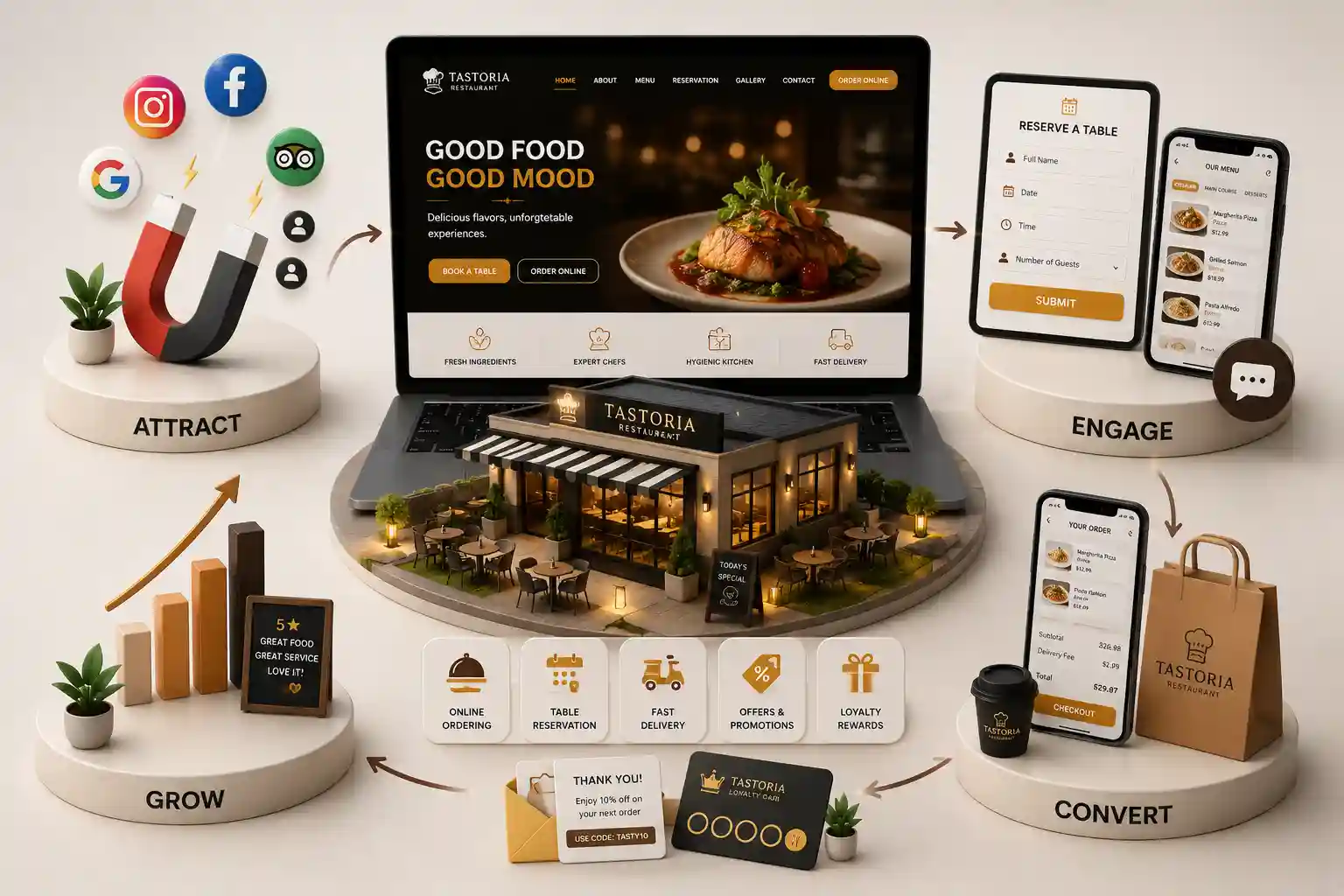
How a Modern Restaurant Website Can Increase Direct Orders in Bengaluru
Delivery apps take a cut and hide your brand. See why Bengaluru restaurants lose direct orders without a modern website—and what to fix first. You will learn the hidden cost of app-only dependence, how to accept direct orders, showcase ambience and menu, enable reservations, improve local SEO, and build loyalty without abandoning discovery apps entirely.
Your kitchen is full, but the margin on every third order disappears into aggregator fees. Guests who loved Friday dinner re-order through an app that shows three competing banners before they find you again. The website still lists a monsoon menu from last year and has no way to pay. A Bengaluru restaurant online orders website you control captures direct margin, keeps guest data, and supports both delivery and dine-in—not only whichever platform ranks you today.
You will learn the hidden cost of app-only dependence, how to accept direct orders, showcase ambience and menu, enable reservations, improve local SEO, and build loyalty without abandoning discovery apps entirely.
For Bengaluru restaurant owners and managers who want more direct orders and reservations from an owned website—not only aggregator traffic.
What this guide covers
Introduction: the Bengaluru dining landscape
The hidden cost of relying only on delivery apps
Accept direct orders without high commission
Showcase ambience and menu on your site
Enable table reservations on the same property
Improve local SEO for neighbourhood diners
Final thoughts
Introduction: diners in Bengaluru decide on their phones
Bengaluru eats out often and orders in often—sometimes from the same guest in the same week. A professional in Whitefield orders lunch between meetings; a family in Jayanagar browses brunch spots on Sunday morning. Both start on a phone. If your brand only exists inside an aggregator grid, you compete on rating stars and promo badges, not on the story of your kitchen or dining room.
A modern website is not a PDF menu on a slow page. It is fast mobile ordering, clear reservations, photos that match reality, and a path to WhatsApp when someone needs a custom party order. Without that, you leak repeat business to apps that charge for every transaction.
Koramangala, Indiranagar, and Whitefield each have different peak patterns—late-night delivery in some corridors, office lunch rushes in others. Your site should reflect operating hours, delivery radius, and packaging standards honestly. Guests who discover you on Instagram expect the same portion size and plating they saw in reels; mismatches show up as app reviews even when the food quality is fine.
Corporate catering and bulk orders often start on a website enquiry, not an app cart. If your site hides party menus or forces a phone maze, you lose high-margin jobs to brands with a simple form and WhatsApp follow-up. Direct channels capture margin and relationship; apps capture convenience for single-meal orders.
The hidden cost of relying only on delivery apps
Aggregators solve discovery and logistics for a fee. That is useful for new neighbourhoods and new concepts. It is expensive as a default for every order—especially repeat guests who already know your biryani or wood-fired pizza. Commission, promo subsidies, and paid placement add up quietly because revenue still looks healthy on the POS.
You also lose data. The app knows the guest; you see an order ticket. Without an owned channel, you cannot message a loyal customer about a chef’s tasting menu or a monsoon special unless you pay the platform again.
Promotional economics are stacked against you on aggregators. When platforms run city-wide discounts, guests remember the deal—not your brand. Your margin shrinks while competitors with deeper pockets buy the same placement. A direct order path lets you reward loyalty on your terms: early-bird pickup, birthday dessert, or free delivery within your own zone.
Kitchen ops also suffer when every channel uses different item codes and modifiers. A modern site integrated with your POS reduces mis-picks and refund arguments. Fewer wrong orders mean fewer one-star reviews that hurt both app ranking and Google visibility.
Accept direct orders without high commission
Direct ordering starts with a menu guests can read on mobile, modifiers that work, and checkout that completes in a few taps. Offer UPI and cards your audience actually uses. Show pickup time or delivery zone honestly—surprises after payment generate one-star reviews.
Promote direct order links from Instagram bio, Google Business Profile, and receipt inserts. Train staff to mention the site for repeat orders. Many guests will switch if saving them money is framed as supporting the restaurant they already like.
Show allergen and spice levels clearly on the direct menu. Bengaluru diners often filter for vegetarian, Jain, or egg-free options before they add to cart. Aggregator filters help, but your owned menu can tell the story of how a dish is prepared—not only a binary veg tag.
Offer order tracking or honest ETAs on your site when you control delivery. Even a simple SMS when the rider leaves builds trust. Guests who feel informed are less likely to cancel and reorder elsewhere while waiting.
Run a monthly report: direct orders versus app orders, average ticket size, and repeat rate. Many Bengaluru restaurants discover direct guests spend slightly more per order because they add sides and drinks without hunting for a minimum cart promo.
Showcase your ambience and menu—not only dish names
Photos of the dining room, open kitchen, and terrace matter for Bengaluru guests choosing where to spend a Saturday evening. Pair them with menus that mark vegetarian, Jain, and allergen notes clearly. Stale PDFs force guests back to apps that at least show current prices.
Tell short stories: chef background, sourcing, or why a signature dish exists. Search engines and humans both reward specificity over generic “fine dining experience” copy.
Video works when it is short and honest—a thirty-second pass through the dining room beats a cinematic reel that hides cramped seating. Host videos on your site or embed from your own channel so traffic stays associated with your domain.
Seasonal menus deserve landing sections, not buried PDF links. When mangoes arrive or you launch a festive thali, update the homepage and push the direct order link in email and WhatsApp broadcasts to past guests who opted in.
Want direct orders and reservations from one Bengaluru site?
Share how you sell today—dine-in, delivery, or both. We will design a modern restaurant website your guests can actually use on mobile.
Enable table reservations alongside ordering
Many Bengaluru full-service venues need both takeaway and covers. One owned site can route guests to book a table or order ahead for pickup. That reduces phone chaos on Friday night and gives the host stand a single system to trust.
Confirm policies on deposits, late arrivals, and large groups on the same page as the booking button. Clarity prevents arguments at the door.
Sync reservation capacity with kitchen load. A full dining room plus a delivery spike creates service failures that show up online the next day. Your website should reflect real availability, not unlimited tables.
Send confirmation and reminder messages with map links and parking notes. Bengaluru guests often arrive by cab; accurate gate instructions reduce no-shows and angry calls to the host stand.
Improve local SEO so neighbours find you first
Optimise for “restaurant near me” and neighbourhood names you actually serve. Align Google Business Profile categories, hours, and website links. Fresh photos and menu updates signal an active business to search and to humans.
Build location pages only if you truly operate there—do not spam city names. One strong Indiranagar or Koramangala presence beats ten thin clones.
Publish answers to common questions on your site: parking, kid-friendly seating, pet policy, and average spend per person. FAQ content earns long-tail search and reduces repetitive Instagram DMs.
Encourage satisfied dine-in guests to review on Google after booking through your site. Link the review request in a post-visit email or WhatsApp thank-you. Authentic recent reviews lift both local pack ranking and direct order confidence.
Bengaluru restaurants lose online orders without a modern website because repeat guests have nowhere easy to return—except an app that charges you both ways. Fix mobile speed, menu clarity, direct checkout, and reservations. Keep aggregators for discovery; win loyalty on your own URL.
Measure one metric monthly: share of orders from your owned channel. Even a five-point shift away from commission-heavy volume can materially improve net margin when rent and labour costs are fixed. Use that trend to justify photography, site upgrades, and staff training on promoting direct links.
Pair your site with packaging that shows the direct URL and a QR code for reorder. Small physical reminders at the table convert satisfied dine-in guests into lower-cost delivery customers the following week.
Treat the website as a revenue channel with its own weekly review—not a one-time design project.
You can operate, but you pay for every order and lose repeat guest data. A modern site captures direct orders and supports reservations alongside apps.
Fast mobile menus, honest delivery zones, simple checkout, table booking, current photos, and clear dietary labels—not a PDF from 2022.
Not if you keep profiles active. Many brands use apps for discovery and push repeat guests to the owned channel.
Link from Instagram, Google Business Profile, packaging inserts, and staff mentions at checkout. Repeat guests switch when the path is easy.
Often yes for dine-in, but direct delivery ordering still matters. Match features to how you actually serve guests.
Many venues launch core menu and ordering in a few weeks if content is ready. Complex integrations may take longer.
WhatsApp helps conversations, but it does not replace SEO, menu structure, or payment flows guests expect before they message.
Fix mobile menu and one direct order path, then add reservations if you serve dine-in. Measure direct share monthly.
Build local visibility around genuine restaurant locations, accurate profiles, useful menus, review operations, structured data, and governed city content.
Explore Restaurant Web Development for India. Every page is planned for stronger search visibility, faster performance, clearer customer journeys, and measurable enquiries.
My Perfect Solutions helps brokers, clinics, restaurants, and growing brands launch fast, SEO-ready websites that turn search traffic into qualified enquiries across India.