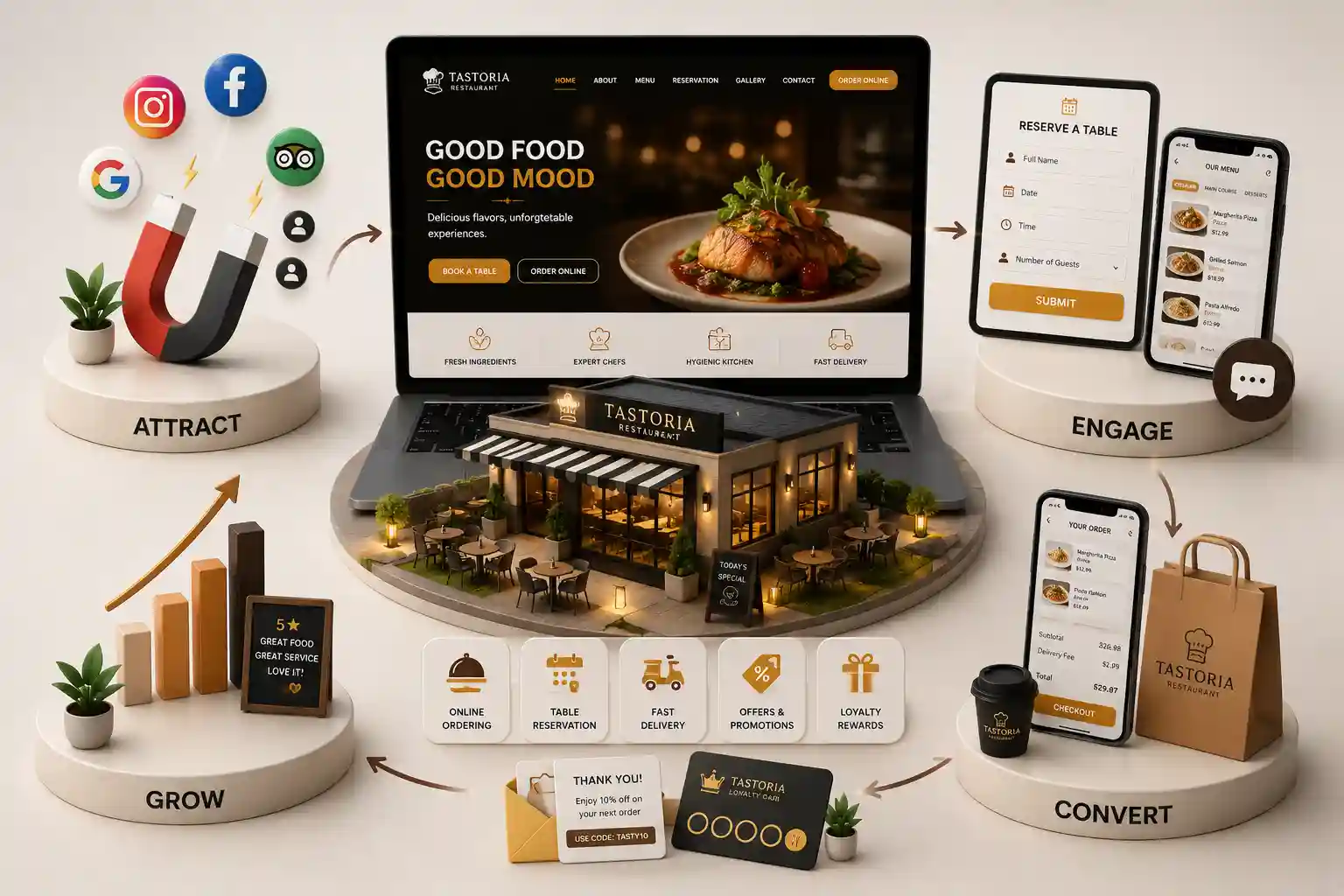
Restaurant Website Bangalore Guide to Direct Reservations in 2026
Increase direct table bookings for Bengaluru restaurants with a website that owns reservations—without depending only on third-party platforms. You will learn booking UX essentials, no-show controls, how menus support reservations, hybrid use of third-party tools, measurement, and a rollout plan focused on covers—not delivery checkout.
Bengaluru restaurants—especially Indiranagar and Koramangala favourites—lose margin and guest data when every cover is booked through third-party platforms. Phone lines jam on weekends while the website remains a pretty gallery that cannot reserve a table. A restaurant website Bangalore diners can book on captures direct reservations, reduces platform dependence, and feeds a CRM you own for repeat occasions.
You will learn booking UX essentials, no-show controls, how menus support reservations, hybrid use of third-party tools, measurement, and a rollout plan focused on covers—not delivery checkout.
For Bengaluru full-service restaurants, cafes with table service, and groups that want direct bookings instead of exclusive third-party dependence.
Why direct reservations matter in Bengaluru’s dining market
Weekend demand is intense and discovery platforms are crowded. Paying a toll on every booked cover erodes contribution—especially for premium rooms. Guests who already love you will often book direct if the path is obvious and mobile-friendly.
This guide focuses on table reservations—not delivery marketplace ordering. Delivery hybrids matter elsewhere; here the job is covers, turn times, and guest relationships.
Consider a Friday night in Indiranagar: a group planning a birthday dinner starts checking availability around Wednesday, comparing two or three restaurants they already like. If your phone line is busy handling walk-in enquiries and your website has no way to check or hold a table, that group books the restaurant that let them reserve in thirty seconds from their phone, even if your food and room are the better fit. The lost booking never shows up as a complaint—it simply never happens, and you never see it in any report.
Discovery platforms are genuinely useful for a new opening or a slow month in a Koramangala neighbourhood saturated with competing restaurants, but they charge for every seated cover regardless of whether the guest already knew your name. A returning guest who searches your brand directly and finds a working reservation path costs you nothing beyond the website itself. The strategic question is not whether to use third-party discovery, but whether your own site gives loyal guests a reason to skip the toll.
Booking UX essentials for a restaurant website
Date, time, party size, and occasion fields
Instant or near-instant confirmation messaging
Clear cancellation and late policy
Mobile-first calendar that works on mid-range phones
Fallback WhatsApp or call when inventory is complex
Design the form around how a Bengaluru guest actually decides, not around what is easiest for your reservation software to collect. Occasion context—birthday, anniversary, business dinner—lets the host stand prepare a small touch like a candle or a printed menu note, which costs nothing but noticeably improves the guest's experience. Asking for dietary notes or seating preference at booking time, rather than discovering them at the table, avoids the awkward mid-service scramble that frustrates both guests and staff during a busy Koramangala weekend rush.
Test the entire flow on a mid-range Android phone with one hand, the way most guests will actually book while walking or between meetings. A calendar widget that requires precise taps on tiny date cells, or a confirmation page that takes ten seconds to load over patchy mobile data, will lose bookings before a guest ever reaches the confirm button. The best-performing booking flows on Bengaluru restaurant sites usually take under a minute from landing on the page to receiving a confirmation message.
Reminders by SMS or WhatsApp, deposit rules for peak slots, and easy self-cancel links reduce empty tables. Policies must be clear before payment. Overly aggressive deposits without communication create social backlash.
A no-show on a Saturday night at a premium Indiranagar room is not a minor inconvenience—it is a table that could have earned two or three times its cover charge from a walk-in queue that was turned away an hour earlier. Send a reminder message roughly two hours before the reservation with a one-tap confirm or cancel option, so a guest whose plans changed can free the table with minimal friction instead of simply not showing up. Restaurants that add this single reminder step typically see a meaningful drop in unexplained no-shows within the first month.
When introducing deposits for peak slots, explain the policy plainly at the point of booking rather than burying it in fine print discovered only after payment. State the amount, whether it is adjusted against the final bill, and the cancellation window that returns it in full. Guests generally accept fair deposit policies for weekend fine dining; what damages goodwill is a policy that feels hidden or a refund process that takes weeks to resolve after a legitimate cancellation.
Menus and stories that support the reservation decision
Guests decide with cuisine fit, occasion suitability, and dietary clarity. Keep menus current, highlight tasting or brunch formats, and link FAQs about parking or dress codes. Stale PDFs undermine booking confidence.
A menu page that only lists dish names without context forces a hesitant guest to open a search tab to check whether a dish suits a vegetarian guest at the table or fits a client dinner budget. Add short, honest descriptions, mark vegetarian and Jain options clearly for a Bengaluru audience where mixed dietary groups are common, and note approximate price ranges for tasting menus so groups can decide before they arrive rather than feeling surprised by the bill. A menu that answers these questions upfront removes one more reason to abandon the booking flow.
Parking, dress code, and accessibility notes matter more than they might seem for a Whitefield or Koramangala venue where guests are often driving from across the city for a special occasion. A short FAQ block near the reservation form—valet availability, whether the venue is stroller or wheelchair accessible, and whether smart casual is enforced—prevents an awkward arrival and signals that the restaurant has thought through the guest experience beyond just the food.
Keep food-safety claims aligned with FSSAI. For multi-city groups, localise experiences in Mumbai and Pune.
Hybrid use of third-party booking platforms
You can keep a marketplace widget for overflow discovery while pushing email, WhatsApp, and returning guests to direct booking. Compare effective cost per seated cover—not vanity reservation counts.
Calculate the real cost per cover for each channel honestly, including the software fee for your own booking engine and the commission on third-party covers, and you will usually find the direct channel is cheaper per seated guest once past a modest volume threshold. That does not mean abandoning discovery platforms; new Bengaluru neighbourhoods and new concepts still benefit from the visibility. It means treating the two channels as complementary tools with different jobs, rather than defaulting every booking to whichever platform is easiest to set up.
Direct versus third-party reservations
Factor
Third-party
Owned website
Discovery
Strong
Needs brand + SEO
Guest data
Shared / limited
You own CRM
Fees
Per cover / listing
Software + payments
Policy control
Platform rules
Your house rules
Brand experience
Generic widget
On-brand flow
Want a Bengaluru restaurant website that takes direct bookings?
Design reservation UX, confirmations, and CRM capture that protect weekend covers.
Host-stand operations behind the website
Digital bookings fail when the floor is not staffed to honour them. Define who confirms special requests, how walk-ins interact with online holds, and what happens when the kitchen runs 45 minutes behind. Train hosts on the same tool guests use.
The host stand is where a well-designed booking website either earns its reputation or loses it. If the online system shows a table available at 8pm but the floor manager was never told about a large party's request for a specific corner table, the guest arrives to a confused handoff that undoes every bit of trust the smooth booking experience built. Give hosts a single screen that mirrors exactly what guests saw online, including notes and occasion details, so nothing gets lost between the website and the actual seating.
Build a simple protocol for the nights that go wrong—a large party runs long, a kitchen ticket backs up, or a VIP walks in without a reservation during a fully booked service. Hosts need clear authority to offer a short wait with a drink at the bar, rebook a slightly later slot with an apology message sent automatically, or escalate to a manager when a guest is upset. Restaurants that write this down once save the host stand from improvising a different answer every time, which is often what turns a delay into a bad review.
Measure seated covers and repeat occasions
Track booking conversion, no-show rate, average party size, and share of direct versus third-party covers. Celebrate repeat birthday and corporate bookings that return through your CRM—not only new marketplace names.
Review these numbers by day of week and time slot, not just as a monthly average, since a Bengaluru restaurant's Tuesday lunch and Saturday dinner behave like two different businesses with different guest expectations and different no-show risk. A slot-level view might reveal that direct bookings dominate weekday dinners from returning corporate guests near Whitefield, while weekend brunch still leans heavily on discovery platforms bringing in first-time visitors. That pattern tells you exactly where to invest the next round of marketing effort instead of guessing.
Conclusion: reserve the relationship, not only the table
Bengaluru diners will book direct when it is easier than calling during a rush. A restaurant website built for reservations—confirmations, policies, and menus—turns weekend demand into owned relationships instead of rented ones.
Put a mobile booking path on your website, confirm instantly, promote it on Google and social, and incentivise returning guests to skip third-party tools.
Not always. Keep them for discovery if needed, but move loyal diners to direct booking where margin and data improve.
Date, time, party size, name, phone, and optional occasion. Add deposits only when ops and communication are ready.
Send reminders, allow easy cancels, and use deposits for peak slots with clear policies.
No. Photography helps desire; booking UX converts desire into covers.
If you take table holds for brunch or large parties, yes. Otherwise prioritise waitlist or walk-in messaging honestly.
Direct booking share, no-show rate, confirmation time, and repeat guest rate.
WhatsApp works for flexible rooms but scales poorly for peak inventory. Many restaurants combine calendar booking with WhatsApp for exceptions.
This playbook is about table reservations and covers. Delivery ordering is a separate channel with different ops.
SEO and Maps help discovery, but conversion needs a working reservation path and host-stand discipline.
Build local visibility around genuine restaurant locations, accurate profiles, useful menus, review operations, structured data, and governed city content.
Explore Restaurant Web Development for India. Every page is planned for stronger search visibility, faster performance, clearer customer journeys, and measurable enquiries.
My Perfect Solutions helps brokers, clinics, restaurants, and growing brands launch fast, SEO-ready websites that turn search traffic into qualified enquiries across India.