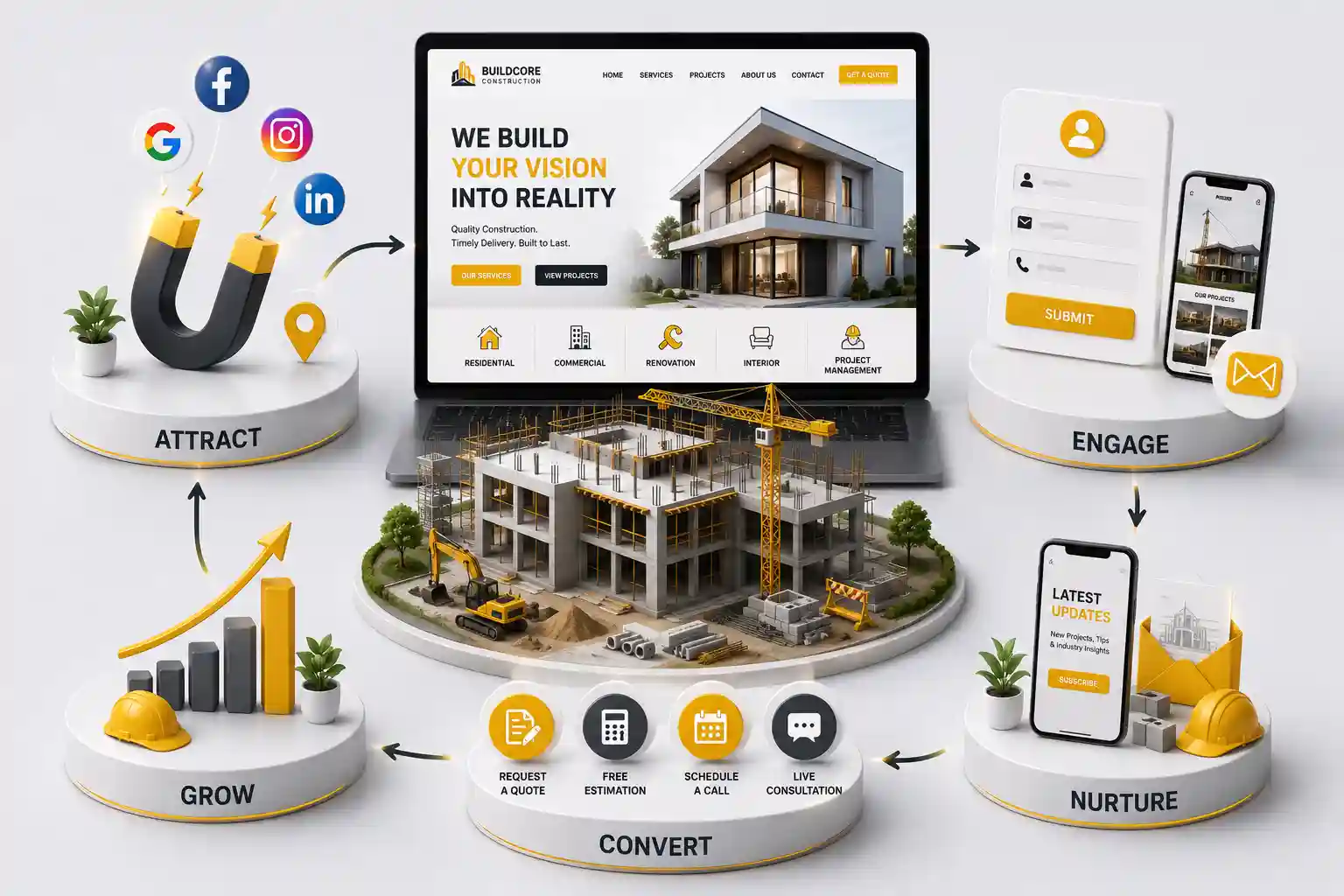
Construction Company Website Mumbai: The 2026 Guide to Winning More Projects
A practical construction company website Mumbai guide covering RFQ forms, project proof, safety credentials, and mobile-first quote flows that turn site visitors into bid invitations. This guide covers how a construction company website Mumbai contractors should actually structure their site in 2026: the RFQ form fields that replace generic contact forms, how to present project proof and safety credentials so procurement teams trust you before the first call, mobile quote flows for site engineers, local SEO across Mumbai, Pune, and Bengaluru, and a rollout plan that does not require rebuilding everything at once.
Most Mumbai construction companies still run on a static brochure website: a home page with a logo, a vague services list, and a generic contact form that nobody checks before Monday. Meanwhile the buyer on the other end is a procurement head or a developer's project manager comparing four contractors in one afternoon, and the first two firms with a real quote request flow and visible project proof get the shortlist call. Construction procurement in Mumbai has shifted online even for large commercial and residential contracts. Site visits still close deals, but the shortlist is built from search results, referrals that get verified on Google, and whichever contractor's website answers scope, safety, and timeline questions without a phone call. A construction company website Mumbai teams can actually use for bidding is now a revenue system, not a digital business card.
This guide covers how a construction company website Mumbai contractors should actually structure their site in 2026: the RFQ form fields that replace generic contact forms, how to present project proof and safety credentials so procurement teams trust you before the first call, mobile quote flows for site engineers, local SEO across Mumbai, Pune, and Bengaluru, and a rollout plan that does not require rebuilding everything at once.
Written for Mumbai construction company owners, business development leads, and marketing managers who want their website to generate qualified RFQs and bid invitations instead of sitting idle between referrals.
Why Mumbai contractors lose bids before the call even happens
A developer's project manager shortlisting contractors for a Powai residential tower or a Navi Mumbai warehouse rarely calls every listed number. They open four or five websites in a row, skim for scale of past work, safety record, and turnaround credibility, and quietly drop the ones that look unfinished or unclear. A construction company website Mumbai buyers trust needs to answer those questions in under a minute, not force a call just to learn whether you have handled a project this size before.
The common failure pattern is predictable: a homepage hero photo unrelated to actual completed work, a services page copied from a template with generic phrases like quality construction solutions, and a contact form with three fields that gives the sales team nothing to act on. By the time someone replies to that form two days later, the buyer has already shortlisted competitors who replied same-day with a scoped estimate.
This is not only a design problem. It is a pipeline problem. Every week a construction company website Mumbai runs without a working RFQ flow, safety proof, and project gallery is a week of search traffic and referral clicks that convert into nothing measurable. Fixing this does not require a full rebuild in one sprint, but it does require treating the website as the first stage of the bidding process rather than an afterthought.
Replace generic contact forms with a real RFQ flow
A contact form with name, email, and message tells your team nothing about the opportunity. A request-for-quote form built for construction should capture project type, approximate scope or built-up area, target timeline, location, and budget range where the buyer is comfortable sharing it. This alone shortens your qualification call from twenty minutes to five, because your estimator opens the enquiry already knowing what they are pricing.
Structure the RFQ as a short multi-step flow rather than one long form. Step one asks what kind of project it is: residential, commercial, industrial, or infrastructure. Step two adjusts fields based on that answer, asking for built-up area or number of units, expected start date, and site location within Mumbai, Navi Mumbai, or Thane. Step three collects contact details and an optional file upload for drawings or a brief. Multi-step forms complete at noticeably higher rates than single long forms because each step feels achievable.
Project type and scope, adjusted dynamically per selection
Location field with Mumbai, Navi Mumbai, and Thane presets
Target start date and expected duration
Budget range as a comfortable dropdown, not a mandatory exact figure
Optional drawing or brief upload for serious enquiries
WhatsApp opt-in for faster back-and-forth on scope questions
For a deeper breakdown of exact fields, validation, and routing logic, see our guide on construction website lead generation playbook, which covers how to route RFQs to the right estimator by project size and location.
Project proof that builds trust before the site visit
Procurement teams comparing Mumbai contractors want evidence of scale, not adjectives. A project gallery organised by category, such as residential towers, commercial fit-outs, industrial sheds, and infrastructure work, lets a buyer quickly confirm you have handled something comparable to their brief. Each project entry should include location, approximate scale, duration, and, where permission allows, the client or developer name.
Photos matter more than most contractors realise. A blurry phone photo of a half-finished site does more harm than no photo at all. Invest in a proper photo pass at project milestones and handover, even a same-day smartphone shoot with good lighting, because these images become the trust asset your website reuses for years. Video walk-throughs of completed projects, even sixty seconds long, outperform static galleries for commercial and industrial buyers evaluating fit-out quality.
Project proof elements by buyer type
Buyer type
What they check first
Proof that works
Residential developer
Similar scale and finish quality
Tower photos, handover timeline, RERA project link
Commercial fit-out client
Turnaround speed and finish
Before-after photos, timeline breakdown
Industrial or warehouse client
Structural capability and safety
Site photos, safety certifications, scale data
Government or infra tender
Compliance and track record
Registration proof, completed contract list
If you are still deciding which pages and modules to prioritise on the rebuild, our construction company website features guide ranks every module by impact so you do not have to guess where to start.
Turn safety and compliance credentials into a conversion tool
Large developers and corporate clients in Mumbai run vendor pre-qualification checks before a contractor even reaches the pricing stage. If your website has no dedicated page for safety policy, certifications, insurance coverage, and labour compliance, you force every serious enquirer to ask for these documents manually, which slows down the funnel and signals disorganisation.
Build a compact safety and compliance page: your safety policy summary, relevant certifications such as ISO where applicable, insurance coverage type, and a note on statutory labour compliance. You do not need to publish sensitive documents publicly. A clear summary with an offer to share full documentation on request during the RFQ process is enough to pass the buyer's first screening filter and keep the conversation moving toward a quote.
When your projects involve RERA-registered residential developments, always link the specific project registration from the official Maharashtra RERA portal rather than only stating a registration number in text. Buyers who verify details before a site visit trust a firm that makes verification easy.
Design the quote flow for site engineers on mobile, not office desktops
A large share of construction enquiry traffic in Mumbai comes from mobile browsers, often site engineers or project coordinators searching mid-visit or between meetings on patchy connectivity. If your RFQ form, project gallery, and contact buttons are not genuinely fast and thumb-friendly, you lose enquiries to a competitor's site that loads in two seconds instead of eight.
Compress project photos without losing the detail that proves scale, avoid autoplay video on mobile data, and keep the RFQ form's first step short enough to complete while standing at a site. A click-to-call button and a WhatsApp button should sit within thumb reach on every page, not buried in a footer. Speed and simplicity on mobile convert more site-level enquiries than any amount of desktop polish.
Compress and lazy-load project gallery images
Keep the RFQ first step to three fields or fewer
Sticky call and WhatsApp buttons on mobile
Avoid heavy animation that delays interaction on 4G
Test the full RFQ flow on a mid-range Android device, not only a laptop
Want an RFQ-ready construction website?
Map your project proof, safety pages, and mobile quote flow for Mumbai bidding cycles.
Local SEO across Mumbai, Pune, and Bengaluru
Contractors who operate across more than one city often make the mistake of running a single generic services page for every market. A buyer searching for a construction company in Pune wants to see evidence you actually work there, not a Mumbai-only project list with a footer line claiming pan-India coverage. Dedicated city pages with locally relevant project examples and service area notes convert better and rank better than one diluted page trying to cover every market at once.
Keep your Google Business Profile categories accurate for each location you serve, and make sure the phone number and address on the profile match the website exactly. Buyers checking a contractor before a site visit frequently cross-reference Google reviews against the website's project claims, so consistency between the two builds confidence rather than raising doubts.
See how we structure city-specific construction pages for construction website development in Mumbai, and compare coverage for teams expanding into Pune or Bengaluru, where buyer expectations and project types can differ meaningfully from Mumbai.
Measure RFQs and bid invitations, then roll out in stages
Traffic and impressions look encouraging in a monthly report, but they do not pay for materials or labour. Track RFQ form submissions, WhatsApp enquiries with project context, and calls tagged from the website separately from generic web traffic. Ask your business development team to flag which website-sourced enquiries actually convert into a site visit or a submitted bid, then review that number monthly rather than only tracking form fill counts.
Set a simple ninety day review cycle: which project categories generate the most qualified RFQs, which city pages produce enquiries that convert into site visits, and which safety or compliance content gets referenced during calls. This tells you where to invest the next round of content and design effort instead of guessing based on gut feel.
Metrics worth tracking monthly
Metric
Why it matters
Where it comes from
RFQ submissions by project type
Shows real demand mix
Website form analytics
WhatsApp enquiries with scope detail
Signals warmer leads
WhatsApp Business logs
Calls tagged from website
Confirms call-to-action performance
Call tracking number
RFQ to site-visit conversion rate
Measures true pipeline quality
Sales team CRM notes
You do not need to relaunch the entire site before seeing results. Start with the RFQ form, since it is the single highest-leverage change and usually the fastest to ship. Follow with the safety and compliance page, then reorganise the project gallery into clear categories with real photos. City-specific pages and deeper local SEO work can follow once the core conversion path is solid.
Audit current enquiry paths and count how many are usable by the estimating team as-is
Build and launch the multi-step RFQ form on the highest-traffic pages first
Publish a safety and compliance summary page with a document-on-request line
Reorganise the project gallery by category with recent, high-quality photos
Add or refresh city pages for every market you actively serve
Review RFQ volume and quality monthly, then expand what is converting
Assign clear ownership for each piece: who replies to RFQs within a set SLA, who updates the project gallery after each handover, and who keeps the safety page current after certification renewals. A construction company website Mumbai buyers trust is not a one-time project. It is maintained the same way a bid pipeline is maintained, with someone accountable for keeping it accurate.
Conclusion: treat the website as part of the bidding process
A construction company website Mumbai contractors can rely on for real bid invitations needs three things working together: an RFQ flow that captures useful scope details, project and safety proof that survives a procurement team's first screening, and a mobile experience fast enough for a site engineer standing on a jobsite. None of these require a massive budget, but they do require treating the website as a working part of the sales process rather than a static brochure.
Start with the RFQ form and the safety page this month, add proper project proof next, and let the data from real enquiries tell you where to invest next. That is how a website moves from being ignored between referrals to becoming a dependable source of qualified bid opportunities across Mumbai, Pune, and Bengaluru.
At minimum: a multi-step RFQ form, a categorised project gallery with real photos, a safety and compliance summary, city-specific pages for every market served, and click-to-call and WhatsApp buttons that stay accessible on mobile.
A basic name-email-message form gives your estimator nothing to act on. An RFQ form that captures project type, scope, timeline, and budget range lets your team qualify and respond same-day instead of chasing details over multiple calls.
Very important. Buyers use project photos to judge scale and finish quality before ever speaking with your team. Blurry or outdated photos actively hurt trust, while a well-organised, recent gallery accelerates the shortlist decision.
A summary of your safety policy, certifications, and insurance coverage should be public. Full documents can be offered on request during the RFQ process rather than published in full, which still satisfies most procurement pre-screening needs.
Yes, if you actively serve those markets. Dedicated city pages with locally relevant project examples convert and rank better than a single generic page trying to represent every market at once.
The first step should take under a minute, ideally three fields or fewer. Longer multi-step forms can collect more detail across later steps once the visitor is already committed.
Replace the generic contact form with a structured RFQ flow. It is usually the fastest change to ship and immediately improves lead quality without touching the rest of the site.
Track RFQ submissions by project type, WhatsApp enquiries with scope detail, calls tagged from the website, and how many of those convert into a site visit or submitted bid. Traffic alone is not a reliable success metric.
Yes, for RERA-registered residential projects, link the specific project record on the official Maharashtra RERA portal rather than only stating the number in text. It builds trust with buyers who verify before a site visit.
RFQ quality often improves within weeks of launching the new form and safety page. Local SEO gains from city pages typically take a few months to build meaningful organic traffic and bid invitations.
Give Bengaluru construction companies interactive project showcases—filters, walkthroughs, and enquiry paths—that match a premium, fast moving, corporate digital market.
Give Pune builders a project showcase website that presents ongoing work, MahaRERA-aligned disclosure, and site-visit forms that turn browsers into buyer enquiries.
Plan a construction website budget through scope, phased delivery, RFQ complexity, content readiness, maintenance, timelines, and comparable vendor proposals.
Explore Construction Web Development for India. Every page is planned for stronger search visibility, faster performance, clearer customer journeys, and measurable enquiries.
My Perfect Solutions helps brokers, clinics, restaurants, and growing brands launch fast, SEO-ready websites that turn search traffic into qualified enquiries across India.