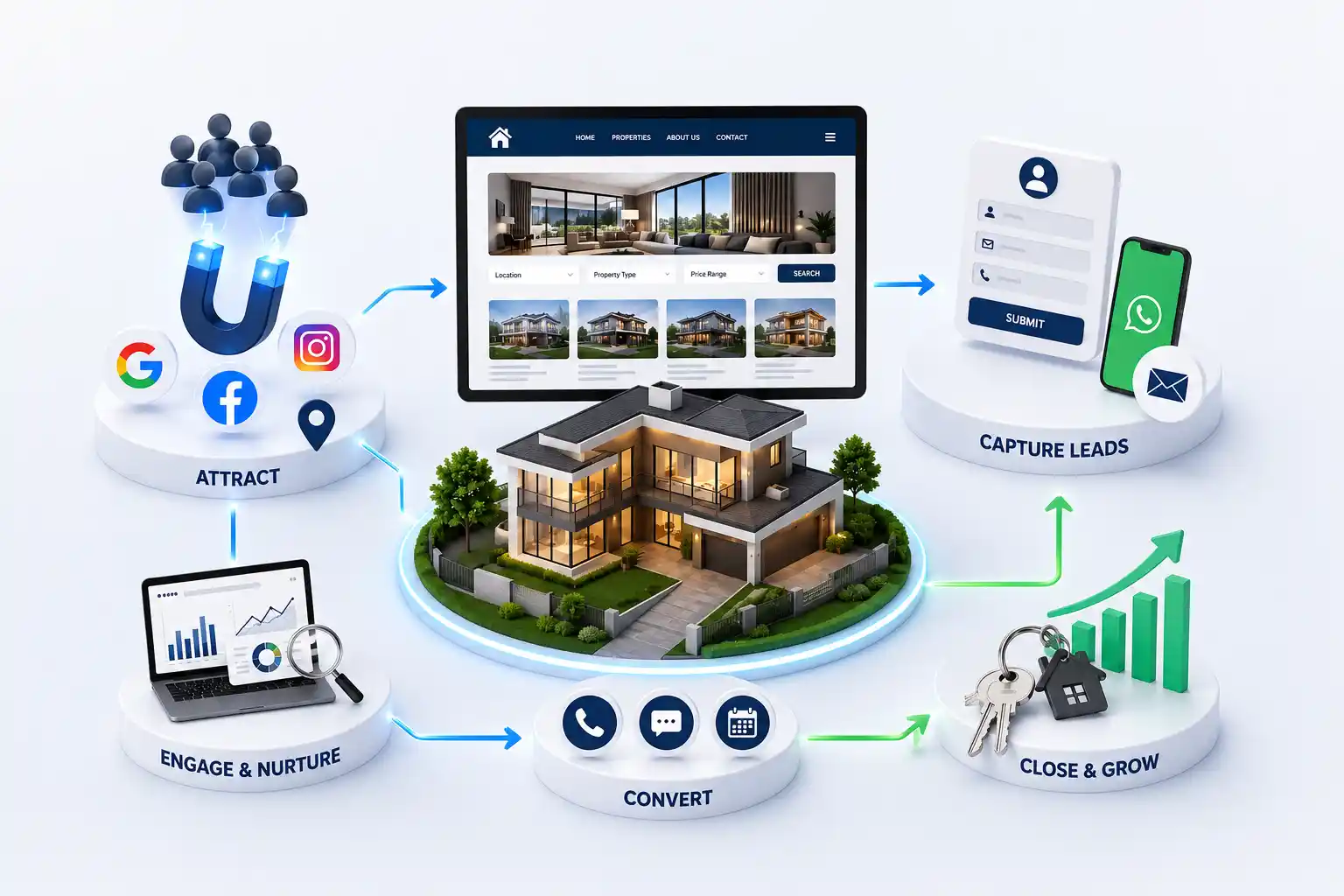
How AI Is Changing Real Estate Marketing in Mumbai (2026)
A practical Mumbai playbook for AI Overviews, ChatGPT workflows, on-site chatbots, lead scoring, and the website foundations that still decide who wins. You will learn how AI Overviews change discovery, how to use ChatGPT with guardrails, how on-site AI chatbots should hand off to WhatsApp, where lead scoring helps, what not to automate, and why owned websites and Maps still decide who converts.
Mumbai marketing teams feel pressure to “add AI” while buyers already meet AI answers in search. Teams that paste ChatGPT blurbs onto thin pages without RERA checks create compliance risk. Teams that ignore AI entirely miss faster briefing, qualification, and content workflows competitors already use. AI real estate marketing Mumbai success is not a single tool. It is a system: clearer project pages for AI citations, safer drafting workflows, chatbots that respect sales SLAs, and scoring that helps humans respond faster to high-intent buyers.
You will learn how AI Overviews change discovery, how to use ChatGPT with guardrails, how on-site AI chatbots should hand off to WhatsApp, where lead scoring helps, what not to automate, and why owned websites and Maps still decide who converts.
For Mumbai builders, brokers, and marketing managers who want practical AI adoption without hype, fake statistics, or compliance shortcuts.
What changed for Mumbai property buyers in 2026
Buyers still visit sites and message on WhatsApp, but many journeys start with an AI-assisted summary. Questions about configurations near a metro, typical possession timelines, or brand credibility may surface in AI Overviews before a blue link is clicked. Brands with clear entities, accurate project facts, and strong local proof are easier for machines—and humans—to trust.
Meanwhile sales teams drown in noisy portal leads. AI helps most when it reduces time-to-first-response and improves briefing quality, not when it generates more undifferentiated content. The Mumbai desks winning today combine sharper owned funnels with selective automation.
Buyers also expect faster answers. A family comparing two Andheri launches will message both brands within minutes. The team that replies with accurate configuration options and a clear site-visit path wins attention—even if the other brand has a flashier AI chatbot that cannot book a visit.
AI Overviews, AI search, and zero-click risk
AI Overviews can answer informational queries without a click. That raises the value of brand searches, Map Pack calls, and pages that earn citation through originality. Commodity blog posts that rewrite portal blurbs are unlikely to be chosen. Project pages with verifiable details, locality expertise, and FAQ depth stand a better chance of being referenced—and of converting when users do click through.
Do not panic-publish fifty AI articles overnight. Publish fewer assets that sales can defend in a site visit. Pair content with Google Business Profile freshness so local discovery still produces calls when search becomes more answer-oriented.
For how generative answers appear in Search, start with Google’s overview of AI features and your website, then focus on making project facts machine-readable and human-verifiable—not on gaming citations.
ChatGPT for listing and project copy—with guardrails
ChatGPT and similar tools speed outlines, FAQ drafts, ad variants, and email follow-ups. They also invent amenities, inflate distances, and invent awards if prompts are vague. Build a source pack for every project: approved RERA facts, configuration table, location notes from site engineers, and banned claims. Require human review before publish.
A practical workflow for AI real estate marketing Mumbai teams: marketing drafts with the model, sales marks factual errors, legal signs off on regulated claims, then publish. Store the approved version as the source of truth so the next prompt starts from truth—not from yesterday’s hallucinated amenities list.
Prompt with approved fact sheets only
Ban unverifiable superlatives and invented statistics
Diff AI drafts against legal-approved copy
Keep a changelog of who approved each publish
Localise examples for Andheri, Thane, or Navi Mumbai reality—not generic India filler
On-site AI chatbot and WhatsApp handoff
An AI chatbot can qualify budget range, configuration interest, and preferred visit times twenty-four hours a day. It should not pretend to be a human or invent inventory. When intent is high, hand off to WhatsApp or a callback with the transcript attached so sales continues the conversation with context.
Design the bot around a small set of jobs: answer FAQs from an approved knowledge base, capture consent and phone, book or request a site visit, and escalate edge cases. If your team cannot staff WhatsApp replies, do not promise instant human takeover in the bot script.
Knowledge bases go stale when possession dates or inventories change. Assign an owner who updates the bot corpus whenever the project page changes. Otherwise the chatbot confidently answers yesterday’s truth while the landing page and RERA block say something else—and buyers notice.
AI chatbot jobs versus human jobs
Job
AI can help
Human must own
FAQ on amenities
Yes, from approved base
Exceptions and promises
Lead capture
Yes, with consent
CRM hygiene
Price negotiation
No
Sales
RERA interpretation
Draft only
Compliance review
Complaint handling
Triage
Relationship repair
AI for lead scoring and routing
Scoring models can prioritise enquiries that mention budget, timeline, and configuration. Routing can send Navi Mumbai project interest to the right desk and Andheri resale chats to another. Start simple: rules plus light ML beats a black box nobody trusts. Feed outcomes back—site visits and bookings—so scores improve.
Avoid scoring that only rewards message length or portal source prestige. Reward behaviours that historically produced visits for your inventory. Revisit weights when you launch a new price band or micro-market.
Share score definitions with sales so agents understand why a lead is marked warm. Opaque scores get ignored. Transparent rules—budget stated, config selected, visit requested—earn adoption and improve the training data you need later for smarter models.
Combine fast project pages, WhatsApp handoff, and structured content so AI tools have something trustworthy to work with.
Creative and ad testing with AI
Use AI to generate headline and primary-text variants for Meta or search, then test systematically. Keep landing page message match tight—especially on project launches. AI can suggest angles; it should not invent discounts or views the project does not offer.
For imagery, prefer real photography. AI visuals that misrepresent towers or skylines create legal and trust problems. Use AI for layout mock brainstorming if needed, then shoot or select approved assets.
Document winning angles in a shared swipe file so the next launch starts smarter. Without that memory, teams regenerate the same weak hooks every campaign and call it innovation. AI accelerates drafting; institutional learning decides whether performance improves.
What not to automate
Final RERA and pricing disclosures
Promises about possession or loan approvals
Sensitive negotiation and objection handling
Publishing without a named human approver
Fake review generation or engagement pods
The stack that still needs a real website
AI does not replace fast project landing pages, locality proof, CRM, or Maps trust. It multiplies whatever system you already have. Weak funnels with AI create faster junk. Strong funnels with AI create faster learning. Invest in conversion architecture first, then layer assistants and scoring.
Connect AI initiatives to the same KPIs as classic performance marketing: accepted leads, site visits, and bookings. If an AI workflow cannot move those numbers, it is a toy—not a growth system.
Builders who already run dedicated project pages and Maps operations will get more from AI than teams still sending ads to brochure PDFs. Fix the foundation, then accelerate. That sequence is the unglamorous truth behind sustainable AI real estate marketing in Mumbai.
Conclusion: use AI to sharpen truth, not to invent it
AI is changing real estate marketing in Mumbai by reshaping discovery, speeding drafting, and improving qualification. The winners will be teams that keep compliance tight, hand off to humans gracefully, and anchor everything to owned digital assets buyers can verify. Tools will keep changing; clear project truth and fast follow-up will not.
Start with one project knowledge base, one chatbot handoff path, and one scoring rule set. Prove response time and visit rate improvements, then expand. Novelty fades. Operating discipline compounds. That is how AI becomes a quiet advantage instead of another unused SaaS login sitting idle on the marketing stack.
AI influences how buyers discover answers, how teams draft content, how chatbots qualify enquiries, and how leads are prioritised. It works best when paired with accurate project pages and fast human follow-up.
Use it for outlines and drafts from an approved fact pack, then require human and legal review. Never publish unverified amenities, distances, or pricing claims.
They are AI-generated answer blocks that may summarise topics without a click. Clear, trustworthy pages and strong local entities improve your chance of being cited and of converting click-throughs.
No. Chatbots can qualify and answer FAQs, but many buyers still want WhatsApp with a human. Design an explicit handoff with transcript context.
AI can improve capture and response, but leads still come from attention—organic, paid, referral, or Maps. Without traffic and a converting page, AI does not create demand.
Thin, duplicated AI content is risky. Useful, reviewed content grounded in real project and locality expertise can support SEO when it helps buyers and stays accurate.
Start with FAQ drafting from approved sources, response templates, and simple lead scoring. Delay complex personalisation until CRM data quality is solid.
Keep a single source of truth for RERA identifiers and claims. Ban AI from inventing numbers. Require named approval before anything goes live.
No. Assistants and Overviews still rely on brands with clear digital homes. Fast project pages, Maps trust, and CRM remain the conversion backbone.
Compare time-to-first-response, accepted lead rates, site-visit bookings, and content production cycle time before and after AI workflows—not vanity prompt counts.
Buyers in Bengaluru shortlist new launches online before they call. Use this simple 2026 checklist to make your project website clear, trustworthy, and enquiry-ready.
Hyderabad buyers research property online before calling. See how builders, brokers, and consultants can turn website traffic into qualified enquiries.
Bengaluru buyers expect instant answers and relevant options. See how AI chat, smart recommendations, and mobile-ready sites help agencies qualify leads faster.
Explore Real Estate Web Development for India. Every page is planned for stronger search visibility, faster performance, clearer customer journeys, and measurable enquiries.
My Perfect Solutions helps brokers, clinics, restaurants, and growing brands launch fast, SEO-ready websites that turn search traffic into qualified enquiries across India.