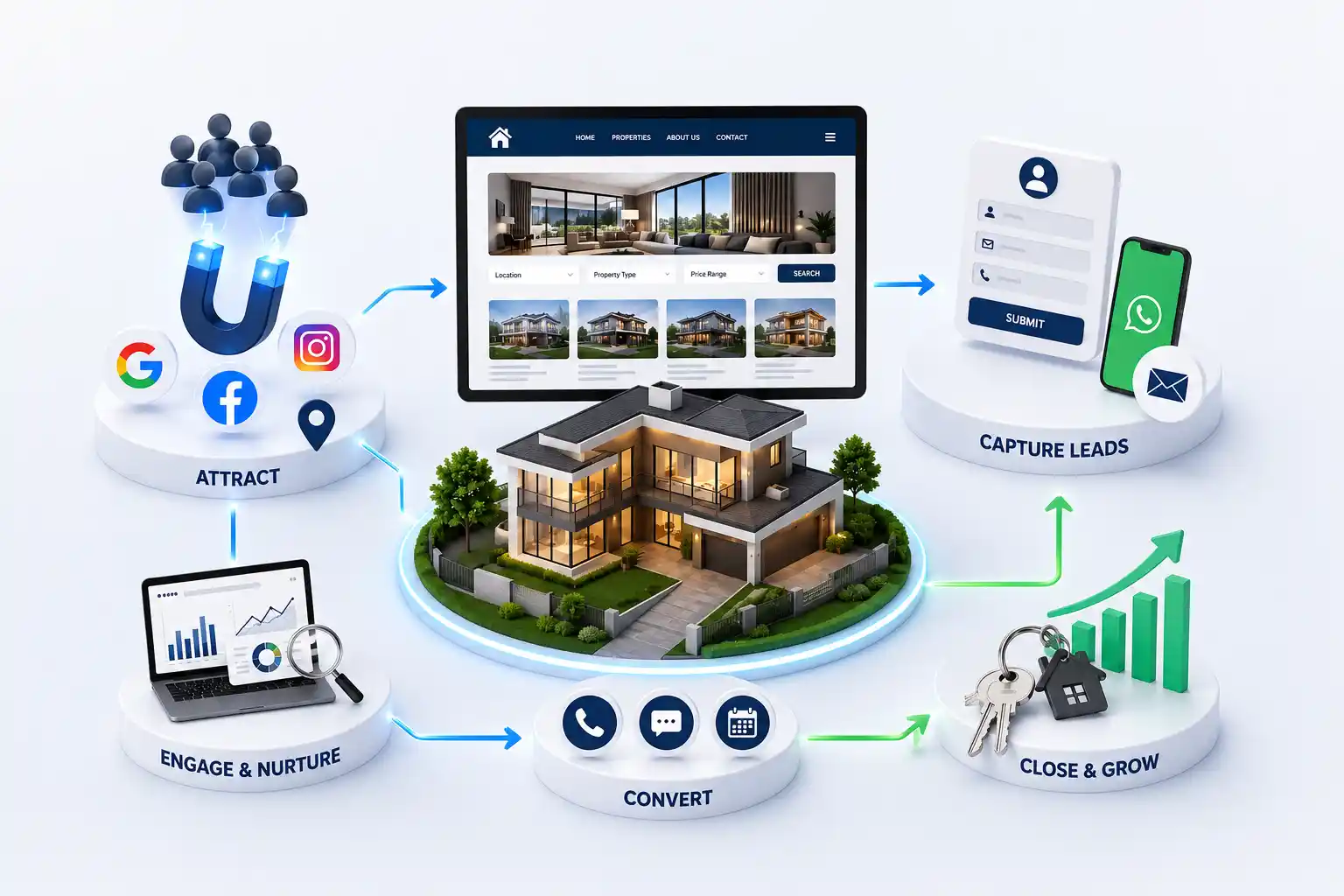
How Chennai Real Estate Websites Can Qualify Better Property Leads
A practical guide for Chennai builders and brokers who want their websites to turn local property searches into useful, sales-ready enquiries. This guide explains how to organise Chennai locality content, build decision-ready project pages, design qualification forms, support mobile enquiries, connect leads to a CRM, and measure the journey from search to site visit.
A Chennai buyer may compare an OMR apartment, a Porur project, and an ECR villa during one mobile session. If every page asks only for a name and phone number, the sales team receives an enquiry without knowing the buyer's budget, preferred area, configuration, or purchase timeline. More form submissions do not automatically mean more revenue. Chennai property businesses need a website that attracts relevant searches, explains each project clearly, and captures enough context for the right salesperson to respond with a useful next step.
This guide explains how to organise Chennai locality content, build decision-ready project pages, design qualification forms, support mobile enquiries, connect leads to a CRM, and measure the journey from search to site visit.
For Chennai builders, developers, brokers, channel partners, and property marketing teams that want fewer vague leads and more conversations with realistic buyers.
What this Chennai property lead guide covers
Define a qualified Chennai property lead
Create locality-led search journeys
Build project pages that answer buying questions
Design enquiry forms people will complete
Route and respond to every lead
Measure quality from enquiry to site visit
Define what a qualified Chennai property lead means
A qualified lead is not simply a person who submitted a phone number. For a Chennai residential project, the useful signals usually include preferred locality, budget range, property type, bedroom configuration, buying purpose, financing status, and expected purchase timeline. Commercial projects may need business type, required floor area, parking needs, and lease or purchase preference. Agreeing on these signals before redesigning the website prevents the form from collecting data that nobody uses.
Qualification should remain proportionate to the buyer's stage. Someone downloading a brochure may only be ready to share an email address and phone number, while a visitor requesting a site visit can reasonably choose a date, configuration, and budget. One oversized form for every action creates friction. Use small, action-specific forms and progressively capture more detail as intent becomes stronger.
Sales and marketing should review rejected or unresponsive leads together. If many enquiries are outside the available budget, the project page may be hiding the price range. If leads ask about sold-out configurations, availability is unclear. Website qualification improves when recurring sales objections are converted into visible information rather than handled repeatedly on calls.
Create locality-led search journeys for Chennai buyers
Chennai property searches are strongly shaped by commute and neighbourhood. A buyer may begin with apartments near the OMR technology corridor, villas along ECR, homes near Porur, or established neighbourhoods such as Anna Nagar and Velachery. A useful website reflects those choices with locality pages and filters that show relevant inventory, connectivity, price context, and lifestyle considerations without creating hundreds of thin keyword pages.
Each locality page should answer a genuine decision. Explain the project types available, typical buyer profile, important road or metro connections, nearby employment areas, schools, hospitals, and the practical trade-offs of the location. Link only to active projects in that area. When every locality page contains the same paragraph with a place name swapped, buyers notice the lack of expertise and search engines receive little unique value.
Keep navigation simple enough for mobile use. Let visitors move from city to locality to project without opening several menus. Breadcrumbs, nearby-location links, and a clear return to search help both people and crawlers understand the hierarchy. Do not hide important locality links behind interactions that require a browser script before any link appears.
Use the planning approach in our real estate local SEO guide to decide which Chennai searches deserve complete pages rather than near-duplicate variants.
Build project pages that answer real buying questions
A project page should work like a prepared sales consultation. State the project status, location, configuration options, usable area terminology, price or price range, expected possession, approvals, amenities, parking, maintenance context, and contact options. Use original photographs, labelled floor plans, and a map that gives buyers enough orientation to judge whether the project belongs on their shortlist.
Chennai buyers comparing several developments need consistency. If one page lists carpet area while another shows only a vague unit size, comparison becomes difficult. Use the same information order and labels across the portfolio. Clearly mark information that changes, such as price and inventory, with a last-updated date and a process for the sales team to request corrections.
Trust information belongs close to the decision, not buried in a footer. Display the relevant Tamil Nadu RERA registration details, developer identity, office contact information, and important disclaimers in readable language. Link to the official record where appropriate. Do not use regulatory logos in ways that imply an endorsement that has not been granted.
Our property website features guide provides a broader checklist for listings, maps, floor plans, trust signals, and conversion paths.
Design property enquiry forms buyers will actually complete
Match the form to the page and action. A project enquiry can automatically include the project identifier and page URL, so the buyer should not have to type the project name again. Ask for the minimum contact fields, then use simple choices for configuration, budget, and timeline. Explain what will happen after submission, including expected response time and whether the person will receive a call or WhatsApp message.
Give buyers more than one contact path. A visible call button helps urgent enquiries, WhatsApp suits quick questions, and a structured form captures details when buyers are researching outside office hours. Prefill messages with the project name, but never place sensitive personal information in a URL. Confirm successful submission on screen and send a concise acknowledgement so buyers know their request was recorded.
Mobile form quality is critical. Use large tap targets, appropriate keyboard types, readable error messages, and as few mandatory fields as possible. Test on slower connections and common Android devices. A beautiful form that loses entered data after a validation error is not a conversion tool; it is an advertisement for the next result in Google.
Need a better-qualified property enquiry journey?
We can review your Chennai project pages, forms, tracking, and mobile experience and recommend a practical conversion plan.
Route and respond to every enquiry with context
A qualified form is wasted if the enquiry sits in a shared inbox. Send each lead into a CRM with the project, locality, source page, campaign, selected budget, and requested action attached. Route it to the correct team based on project or geography, create an owner, and record the response deadline. Duplicate detection prevents the same buyer from receiving competing calls from several representatives.
The first response should acknowledge the buyer's stated need. If someone selected a three-bedroom home in Porur and requested a weekend visit, the reply should confirm relevant availability and propose a slot—not ask which property they viewed. Templates can speed up acknowledgement, but a salesperson should check inventory and personalise the conversation before making promises.
Create fallback rules for missed calls, invalid numbers, and enquiries submitted after hours. A helpful confirmation page can offer a brochure, project comparison, directions, or available visit slots while the buyer waits. Consent and communication preferences must be respected; repeated unsolicited messages can damage the brand and reduce future response rates.
See how structured follow-up fits into a larger real estate CRM integration plan, including ownership, statuses, attribution, and reporting.
Measure quality from search to Chennai site visit
Do not optimise only for form count. Track meaningful stages: organic landing-page visit, project view, brochure request, qualified enquiry, contacted lead, scheduled visit, completed visit, negotiation, and booking. Marketing can then see whether a locality guide produces genuine opportunities or only inexpensive traffic. Sales can see which project pages prepare buyers well enough to progress.
Review performance by page, locality, device, and lead action. A page with modest traffic and several completed site visits may deserve more internal links and updated content. A high-traffic page with no qualified enquiries may target informational intent, omit essential project facts, or attract buyers outside the available price range. Diagnose the reason before rewriting titles or adding more forms.
Treat optimisation as a monthly operating routine. Confirm inventory and prices, review search queries, test forms, listen to sales-call feedback, and improve pages that create confusion. Chennai's property market, transport links, and available projects change; a website earns trust by staying accurate and useful rather than publishing a large number of pages once and forgetting them.
For a serious project enquiry, collect contact details plus project, configuration, budget range, preferred locality, buying purpose, and timeline. Keep early-stage brochure forms shorter and capture more information only when intent increases.
No. Create a locality page only when you have relevant inventory and enough original information to help a buyer decide. Thin pages that merely replace one locality name with another can weaken overall quality.
Display an accurate price or useful range whenever possible, explain what it includes, and show when it was updated. If pricing genuinely depends on configuration, make those variables clear instead of using a vague call-for-price message.
Send an immediate acknowledgement and assign the lead at once. The human response target should reflect office hours and team capacity, but the website should state a realistic expectation and provide useful next steps while the buyer waits.
WhatsApp is valuable for fast conversations, but a structured form captures qualification fields and attribution more reliably. Offering both lets the buyer choose while preserving useful data for higher-intent actions.
Publish clear price context, configurations, eligibility details, location, and project status. Use relevant search content and a few qualification choices in the form. Do not solve poor targeting by creating an excessively long form.
Send the contact, page and project identifiers, campaign attribution, qualification answers, consent, chosen action, and timestamp. Add ownership, follow-up status, visit outcome, and booking result inside the CRM.
Technical improvements can be crawled within days or weeks, while meaningful ranking and lead trends usually need sustained measurement over months. Competition, authority, content usefulness, and project availability all influence results.
Buyers in Bengaluru shortlist new launches online before they call. Use this simple 2026 checklist to make your project website clear, trustworthy, and enquiry-ready.
Hyderabad buyers research property online before calling. See how builders, brokers, and consultants can turn website traffic into qualified enquiries.
Bengaluru buyers expect instant answers and relevant options. See how AI chat, smart recommendations, and mobile-ready sites help agencies qualify leads faster.
Explore Real Estate Web Development for India. Every page is planned for stronger search visibility, faster performance, clearer customer journeys, and measurable enquiries.
My Perfect Solutions helps brokers, clinics, restaurants, and growing brands launch fast, SEO-ready websites that turn search traffic into qualified enquiries across India.