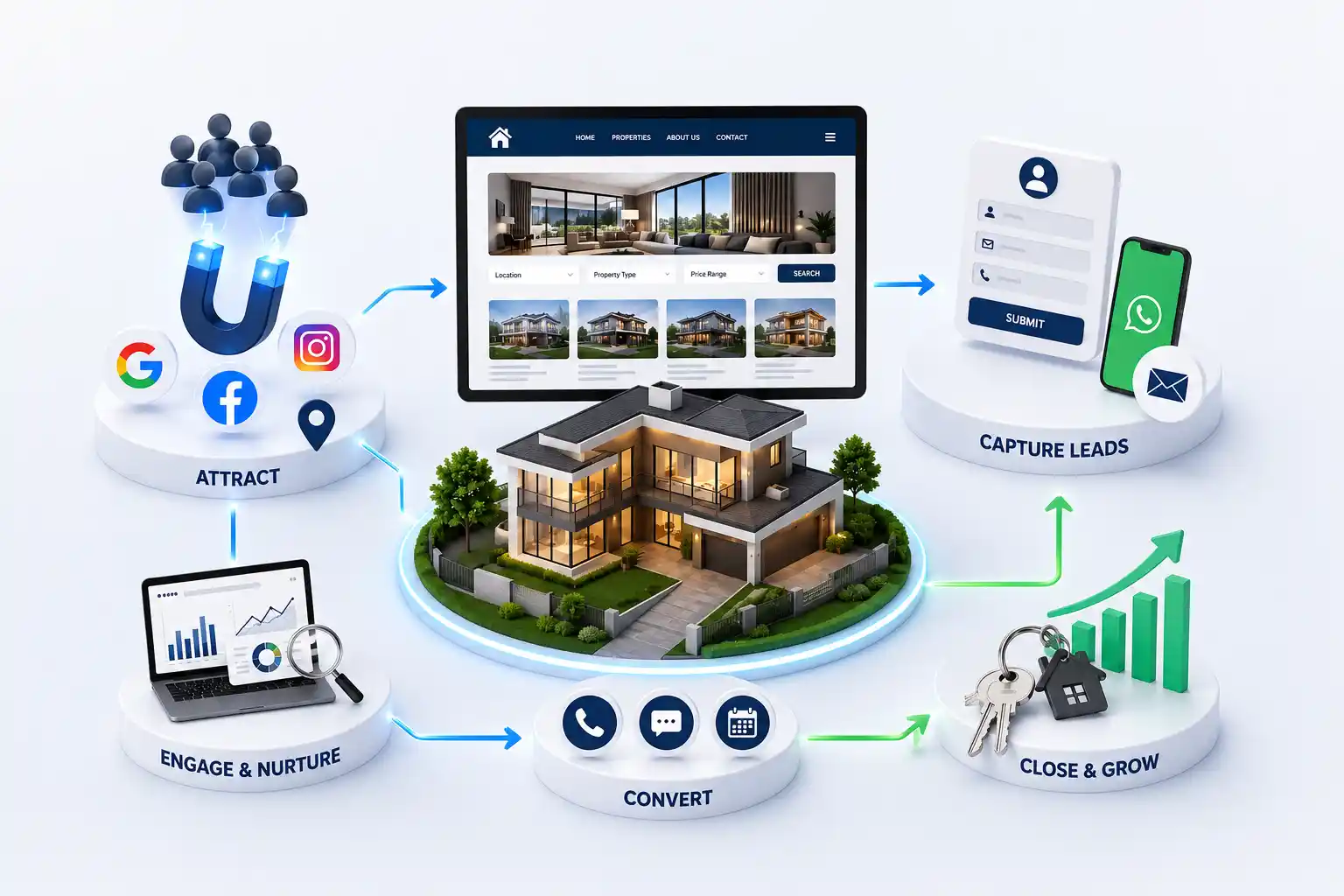
How Mumbai Builders Can Generate Property Leads Without 99acres or MagicBricks (2026)
Cut portal dependence with an owned Mumbai lead engine: project pages, WhatsApp capture, CRM routing, and organic discovery that compounds. You will learn what direct property leads really mean, which website and capture assets replace listing dependence, how to reallocate budget without freezing sales, and a practical ninety day plan to generate property leads without 99acres as the primary channel.
Mumbai builders still treat 99acres and MagicBricks as the only reliable enquiry pipes. Listing fees rise, lead quality drops, and sales teams spend evenings filtering junk while the same buyer could have booked a site visit from a clear project page. In 2026, teams that own discovery and capture outperform teams that only rent portal slots. Portal dependence locks acquisition cost to someone else’s auction. An owned stack—project landing pages, locality proof, WhatsApp with context, CRM, and Maps—turns brand searches and paid traffic into repeatable pipeline across Mumbai and the wider MMR.
You will learn what direct property leads really mean, which website and capture assets replace listing dependence, how to reallocate budget without freezing sales, and a practical ninety day plan to generate property leads without 99acres as the primary channel.
Written for Mumbai developers, marketing managers, and channel partners who want builder marketing that compounds instead of only buying portal impressions.
Why Mumbai builders overpay portals in 2026
Listing platforms still deliver volume, especially for new launches competing for attention in Andheri, Powai, Thane, and Navi Mumbai. The hidden cost is structural. You compete against every other project in the same feed, pay for clicks that never become site visits, and hand buyer intent to an intermediary that also sells the next developer. When the campaign pauses, the lead stream pauses with it.
Sales leadership often sees portal dashboards as proof of demand. Marketing leadership sees rising CPL and thinner qualification. The gap widens when the corporate website is a brochure PDF gallery with a generic contact form. Buyers who find the brand on Google or Instagram land somewhere that cannot convert them, so they bounce back to MagicBricks or Housing.com.
What direct real estate leads actually mean
Direct leads are enquiries you capture and own: form fills, calls, WhatsApp chats, and site-visit bookings that enter your CRM with project, configuration, budget signals, and source attribution. They are not vanity newsletter signups and not shared portal packages that five other sales desks also receive.
Quality shows up in conversation depth. A buyer who opens a project page, checks RERA status, compares configurations, and messages with a prefilled project name is warmer than a portal click with a phone number and no context. Builder marketing Mumbai teams that track accepted leads and visit show-rates outperform teams that celebrate raw enquiry counts.
Project and configuration attached to every chat or form
Sales SLA under fifteen minutes during business hours
CRM stages from enquiry to site visit to booking
Weekly review of cost per accepted lead by channel
Website assets that reduce listing dependence
A corporate homepage alone will not replace 99acres. You need launch-ready project pages, searchable or filterable inventory where relevant, locality proof for micro-markets you sell, and mobile speed that survives Mumbai lunch-break browsing. Each project page should answer objections before the form: possession timeline, configurations, payment outline, RERA identifiers, gallery, location map, and a single primary CTA.
If your architecture is still brochure-first, start with real estate website development in Mumbai and extend coverage for overlapping desks in Thane when the same sales team handles both markets.
Pair project pages with locality hubs only where you truly operate. Thin doorway pages for every MMR pin code waste crawl budget and trust. Depth in Powai, Bandra, Kharghar, or Mulund where you close deals beats fifty empty shells. Cross-link to a dedicated project landing page when a launch needs paid traffic that should not land on the corporate about page.
The capture stack: forms, call, WhatsApp, site visits
Mumbai buyers expect WhatsApp. Forms still matter for buyers who prefer email trails and for campaigns that need structured fields. Click-to-call remains essential for high-intent Map Pack traffic. The winning stack wires all three into one CRM with the same project identifiers.
Capture channels for direct builder leads
Channel
Best for
Must include
Project form
Paid and organic page traffic
Name, phone, config interest, consent
WhatsApp
Mobile browsers and ads
Prefill project + locality text
Click-to-call
Map Pack and retargeting
Tracked number + hours
Site visit booking
Warm mid-funnel buyers
Slot picker + confirmation SMS
Content that ranks without portal authority
Portals win broad keywords because of domain authority. Builders win specific intent: project name plus locality, RERA number searches, configuration near a landmark, and brand plus possession queries. Publish honest FAQs, construction updates, and comparison notes that only an on-ground team can write. Avoid inventing statistics. Prefer verifiable details and clear next steps.
Support content with Google Business Profile discipline so Map Pack clicks land on pages that convert. NAP consistency across the website, profile, and directories reduces trust friction. Reviews that mention project experience and site-visit quality help more than generic five-star blurbs.
When you publish RERA identifiers on project pages, verify them against the official Maharashtra RERA portal so buyers—and your compliance team—see the same facts your ads claim. Accurate disclosures reduce drop-offs when serious buyers cross-check before a site visit.
Organic discovery also rewards clarity on brand-plus-project queries. If a buyer searches your tower name with Andheri or Kharghar, the first owned result should be your page—not a scraped portal card with outdated inventory. That means clean title tags, FAQ schema where appropriate, and internal links from the corporate site and locality hubs without diluting the project URL’s job.
Budget reallocation without freezing sales
Do not switch off every listing overnight. Carve a test budget—often ten to twenty percent of monthly portal spend—into project page creative, search ads on brand and project terms, Meta traffic to the landing page, and website or CRM fixes that unblock conversion. Compare cost per site visit, not only cost per lead.
When owned CPL beats portal CPL for the same project, expand the shift. Keep portals for categories where you still need coverage, especially early in a launch when brand search is thin. The goal is diversification and ownership, not ideology.
Finance and marketing should agree on definitions before the test: what counts as an accepted lead, how site visits are verified, and which costs sit in the owned stack (creative, landing page maintenance, CRM seats). Ambiguous accounting is how portal dependence quietly returns after a promising pilot month.
Need a Mumbai builder lead engine?
Map project pages, WhatsApp capture, and CRM routing so portal spend is optional—not mandatory.
A practical ninety day switch plan
Audit portal CPL, acceptance rate, and site-visit show rate by project
Ship or rebuild one flagship project page with RERA, gallery, and CTAs
Connect forms, WhatsApp, and calls into CRM with source tags
Align GBP name, phone, and website URL with the live project page
Move a fixed slice of portal budget into owned campaigns for thirty days
Review accepted leads weekly and expand what proves cheaper and cleaner
Document ownership: who updates inventory photos, who answers WhatsApp after hours, and who refreshes FAQs after a price or possession change. Without ownership, even a strong project page decays into another brochure PDF online.
Mistakes that keep teams stuck on portals
Sending paid traffic to the corporate homepage instead of the project page
Measuring success only as portal enquiry volume
Ignoring mobile speed while running Instagram or search ads
Leaving WhatsApp unreplied for hours during launch peaks
Duplicating thin locality pages instead of deep project proof
Failing to train channel partners on the owned booking link
Conclusion: rent less attention, own more conversations
Generating property leads without 99acres as your primary engine is realistic for Mumbai builders who treat the website as a sales system. Portals can remain a coverage tool. Growth comes from project pages, disciplined capture, Maps trust, and CRM follow-up that protects every rupee of media spend.
Start with one launch, prove cleaner CPL, then scale the model across the pipeline. That is how builder marketing Mumbai teams stop renting the same buyers every quarter.
Yes. Direct leads come from project pages, brand and project search, Maps, referrals, and paid traffic to owned URLs. Portals can still provide coverage, but they should not be the only acquisition system.
Portal leads are rented enquiries shared through a marketplace. Direct leads are captured on your channels, tagged in your CRM, and owned for follow-up and remarketing.
Rarely on day one. Reduce dependence gradually while owned CPL and site-visit rates prove out. Sudden cutoffs can starve a launch that still needs category visibility.
Dedicated project landing pages with RERA details, configurations, galleries, maps, and clear CTAs matter most, supported by a fast mobile experience and WhatsApp capture.
WhatsApp is often the preferred Mumbai reply channel. Prefill project context, route chats to the right desk, and log them in CRM so reporting stays honest beside forms and calls.
Teams usually see early signal within thirty to ninety days on a single project if pages, ads, and response SLAs are tight. Full portfolio shift takes longer and should be data-led.
Track cost per accepted lead, site-visit bookings, show rate, and bookings influenced by owned sources. Raw enquiry counts alone hide poor quality.
Usually no. Use the same platform with strong project and locality pages when one sales organisation covers those markets. Separate brands may justify separate properties.
Map Pack clicks often become calls or website visits. Consistent NAP, photos, posts, and a URL that lands on the right project page turn discovery into pipeline.
Rebuild one live project page, connect WhatsApp and forms to CRM, move a fixed portal budget slice to that URL, and compare site-visit CPL for four weeks.
Buyers in Bengaluru shortlist new launches online before they call. Use this simple 2026 checklist to make your project website clear, trustworthy, and enquiry-ready.
Hyderabad buyers research property online before calling. See how builders, brokers, and consultants can turn website traffic into qualified enquiries.
Bengaluru buyers expect instant answers and relevant options. See how AI chat, smart recommendations, and mobile-ready sites help agencies qualify leads faster.
Explore Real Estate Web Development for India. Every page is planned for stronger search visibility, faster performance, clearer customer journeys, and measurable enquiries.
My Perfect Solutions helps brokers, clinics, restaurants, and growing brands launch fast, SEO-ready websites that turn search traffic into qualified enquiries across India.