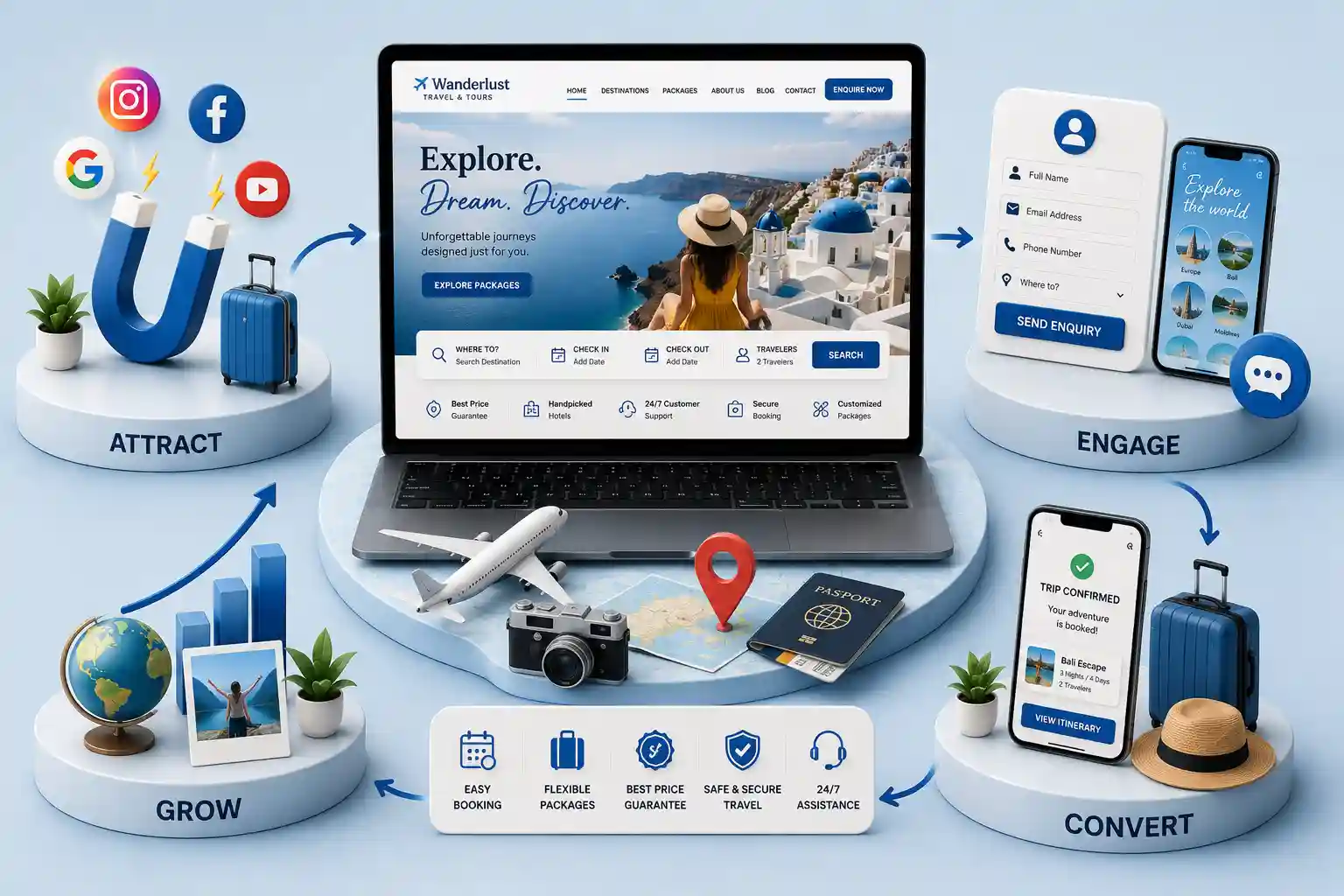
Kochi Travel Website Guide to Itinerary Pages That Win Enquiries
A practical guide for Kochi tour operators building itinerary pages that explain Kerala trips clearly, earn trust, and generate useful booking enquiries. This guide explains how to design day-by-day itineraries, communicate route and season context, present pricing honestly, establish trust, qualify enquiries, support mobile visitors, and maintain package facts after publication.
A traveller finds a Kerala package that lists Kochi, Munnar, Thekkady, and Alappuzha, but the page does not explain daily travel time, hotel areas, houseboat arrangements, inclusions, or whether the plan suits children or older parents. The route looks attractive but is too uncertain to enquire about confidently. Kochi is a major gateway for Kerala journeys, so local tour operators can answer practical questions better than generic travel portals. A strong itinerary page turns that operational knowledge into visible evidence and helps the agency receive enquiries it can price and serve accurately.
This guide explains how to design day-by-day itineraries, communicate route and season context, present pricing honestly, establish trust, qualify enquiries, support mobile visitors, and maintain package facts after publication.
For Kochi travel agencies, destination management companies, Kerala tour operators, and trip consultants who want their website to create better package enquiries.
What this Kochi itinerary-page guide covers
Start with traveller fit and route logic
Write a useful day-by-day itinerary
Explain price, inclusions, and flexibility
Build trust with operational evidence
Design a qualified trip enquiry path
Maintain and measure itinerary performance
Start with traveller fit and realistic Kerala route logic
An itinerary page should identify who the trip suits before presenting a long schedule. State whether it is designed for families, couples, small groups, first-time Kerala visitors, slower travel, wildlife interests, or a particular season. Mention the expected pace, typical start and end points, and important accessibility or activity considerations. This helps travellers reject a poor fit without consuming a consultant's time.
Use Kochi arrival context carefully. Cochin International Airport is outside the central tourist districts, and transfer time varies with traffic and destination. A first day that combines an afternoon arrival, Fort Kochi sightseeing, and a long road transfer may be unrealistic. Show when the journey assumes an early arrival or an additional night, and offer a sensible alternative for later flights.
Route order matters as much as destination choice. Travellers should understand why Munnar, Thekkady, Alappuzha, or another stop appears in a sequence and how much time is spent on the road. Maps can support orientation, but written transfer ranges and terrain context are still necessary. Avoid precise promises when weather, traffic, road work, or stops can change the duration.
Write a day-by-day itinerary that helps travellers decide
Every day should answer four questions: where the traveller begins, how they move, what is realistically included, and where they stay. Separate confirmed package elements from optional suggestions. Use approximate timing only where it helps planning, and avoid filling every hour with promotional language. Travellers need to judge energy, distance, and free time—not read a list of every attraction in the region.
Describe experiences with practical detail. A houseboat day should clarify boarding area, approximate check-in and check-out, meal plan, private or shared arrangement, air-conditioning policy, cruising expectations, and overnight location. A Munnar stay may need plantation or town context. A wildlife activity should state that sightings are never guaranteed and may depend on permits, weather, and local rules.
Support different reading depths. Start with a route summary and key highlights, then provide the detailed schedule, accommodation basis, inclusions, exclusions, and policies. On mobile, headings and short lists help travellers return to a specific day without endless scrolling. A downloadable document can be offered, but the useful itinerary must remain available as indexable web content rather than existing only inside a PDF.
Explain package price, inclusions, exclusions, and flexibility
A starting price is useful only when the assumptions are visible. State the number of travellers, room basis, hotel category, vehicle type, travel period, meal plan, and validity. Explain whether taxes, entrance fees, guide services, airport transfers, houseboat meals, and activity charges are included. If rates change significantly by date, show representative bands or ask for dates before providing a tailored quote.
Exclusions should prevent surprises rather than hide them. Mention flights or trains, personal expenses, optional activities, early check-in, special meals, peak-date supplements, and items paid directly where relevant. Keep policy language readable and link to complete terms. The goal is not to make the package appear cheaper at first glance; it is to help a suitable traveller understand the likely total decision.
Customisation needs boundaries. Explain which elements can change—duration, hotel category, room mix, activities, pickup city, or private transfers—and which route constraints remain. Let travellers request changes in the enquiry form without turning the page into an unlimited itinerary builder. Consultants can respond faster when the website captures the requested variation alongside the original package.
Build trust with evidence from real trip operations
Travellers trust specific, verifiable evidence. Show recent photographs that accurately represent the accommodation or experience category, explain how vehicles and drivers are selected, introduce the support process, and publish reviews with trip context and permission. Avoid stock images that imply a hotel, room, or view not included in the package.
Make the business easy to verify. Display the legal business name, Kochi office or service address where appropriate, working contact details, support hours, payment process, cancellation terms, privacy notice, and relevant memberships without implying guarantees. If the agency works with local partners, explain responsibility clearly so travellers know who handles changes during the trip.
Responsible travel claims need practical substance. Describe local guides, community experiences, waste practices, wildlife rules, or locally owned stays only when they form part of the actual package. Do not encourage intrusive photography or harmful wildlife interactions. Accurate expectations protect the destination, the traveller, and the agency's reputation.
The official Kerala Tourism website is a useful source for destination information, events, and responsible tourism references that should be checked before publication.
Design a qualified trip enquiry path for Kochi agencies
The itinerary identifier should pass automatically into the enquiry, along with the source page. Ask for travel dates or flexibility, number of adults and children with ages, departure city, room needs, preferred hotel level, important interests, and a budget range where it genuinely helps planning. Keep the first step short and reveal detailed questions progressively so mobile visitors are not confronted by a wall of fields.
Offer call and WhatsApp options, but attach useful context. A prefilled message should name the itinerary and requested month. Forms should explain response time and consent, show a clear success state, and send an acknowledgement containing the submitted basics. Never request passport numbers or sensitive identity documents in a general marketing form; collect necessary documents later through an appropriate secure process.
Route each enquiry to a consultant with the full context and campaign source. Use statuses such as new, contacted, qualified, proposal sent, revision requested, confirmed, and lost with a reason. This lets the agency learn whether a page attracts unsuitable budgets, unrealistic dates, or strong-fit travellers. The lesson can then improve the page, package, targeting, or sales response.
Want stronger itinerary pages for your Kochi travel business?
We can review your package structure, mobile journey, SEO, enquiry forms, and tracking before your next travel campaign.
Maintain itinerary facts and measure booking quality
Assign an owner and review date to every active itinerary. Check hotel relationships, transfer assumptions, activity access, seasonal limitations, price basis, policy links, photographs, and contact routing. Mark unavailable packages clearly or redirect them to a relevant alternative instead of leaving an enquiry form attached to a trip the agency can no longer provide.
Measure beyond page views. Track itinerary engagement, enquiry starts and completions, call or WhatsApp actions, qualified enquiries, proposal rate, confirmation rate, average booking value, response time, and lost reasons. Compare by itinerary, source, device, and season. A low-volume route that consistently confirms can be more valuable than a broad guide attracting research traffic without booking intent.
Search performance requires patience and editorial discipline. Update genuinely changed information and record the modification date; do not change dates merely to appear fresh. Add new pages only when the agency has a distinct route, audience, or operational advantage to explain. A smaller collection of accurate, internally linked itineraries can earn more trust than hundreds of near-identical destination combinations.
Finally, compare website promises with post-trip feedback. If travellers report rushed days, unclear meal expectations, or a different room category, correct the page and operating process together. The strongest Kochi travel website is not a separate marketing layer—it is an accurate public version of the trip the team can reliably deliver.
Include traveller fit, route summary, day-by-day plan, transfer context, accommodation basis, meals, activities, inclusions, exclusions, price assumptions, customisation boundaries, policies, trust evidence, and a contextual enquiry path.
Display a price or range when the assumptions can be stated accurately. Include traveller count, room basis, category, dates, transport, taxes, and validity. When variables are substantial, request dates and needs before quoting.
Give realistic ranges and route context rather than guaranteed minute-by-minute promises. Mention terrain, arrival assumptions, and long travel days so families and older travellers can judge the pace.
Useful, original itinerary pages can earn relevant visibility when they match search intent, explain a real package, link coherently, load well, and build authority. Publishing many thin route variations is unlikely to help.
Capture the itinerary, dates or flexibility, adults, children's ages, departure city, room needs, interests, preferred category, and useful budget context. Collect sensitive identity documents later through a secure process.
A PDF can help travellers save or share a plan, but the useful content should also appear in accessible HTML. This improves mobile usability, updating, internal linking, and search discovery.
Review active packages on a defined schedule and whenever a hotel, route, activity, regulation, price assumption, or season changes. High-volume and seasonal pages may need more frequent operational checks.
Track qualified enquiries, proposal rate, confirmations, booking value, response time, lost reasons, and post-trip feedback alongside page engagement and search visibility. Evaluate by route, source, device, and season.
Chat is fast. Forms capture detail. See when travel agencies should lead with WhatsApp, when the website wins, and how a dual path stops lost package enquiries.
A practical 2026 launch guide for Indian travel agencies: choose the right MVP, publish package and destination pages, capture enquiries, and phase payments without overbuilding.
Turn package and itinerary interest into qualified travel enquiries with clear trip pages, trust signals, fast forms, and follow-up-ready website features.
Explore Tours Web Development for India. Every page is planned for stronger search visibility, faster performance, clearer customer journeys, and measurable enquiries.
My Perfect Solutions helps brokers, clinics, restaurants, and growing brands launch fast, SEO-ready websites that turn search traffic into qualified enquiries across India.