Hotel Website Bookings: Fix the Leak Between Visit and Stay
Traffic without reservations is expensive. Learn why hotel sites lose guests after the click and how room clarity, mobile booking, and trust turn visits into confirmed stays. This guide walks through the common leaks—speed, room presentation, mobile booking, reservation systems, photography, reviews, maps, and local SEO—and how each one quietly pushes guests toward OTAs. It is written for owners and GMs, not developers.
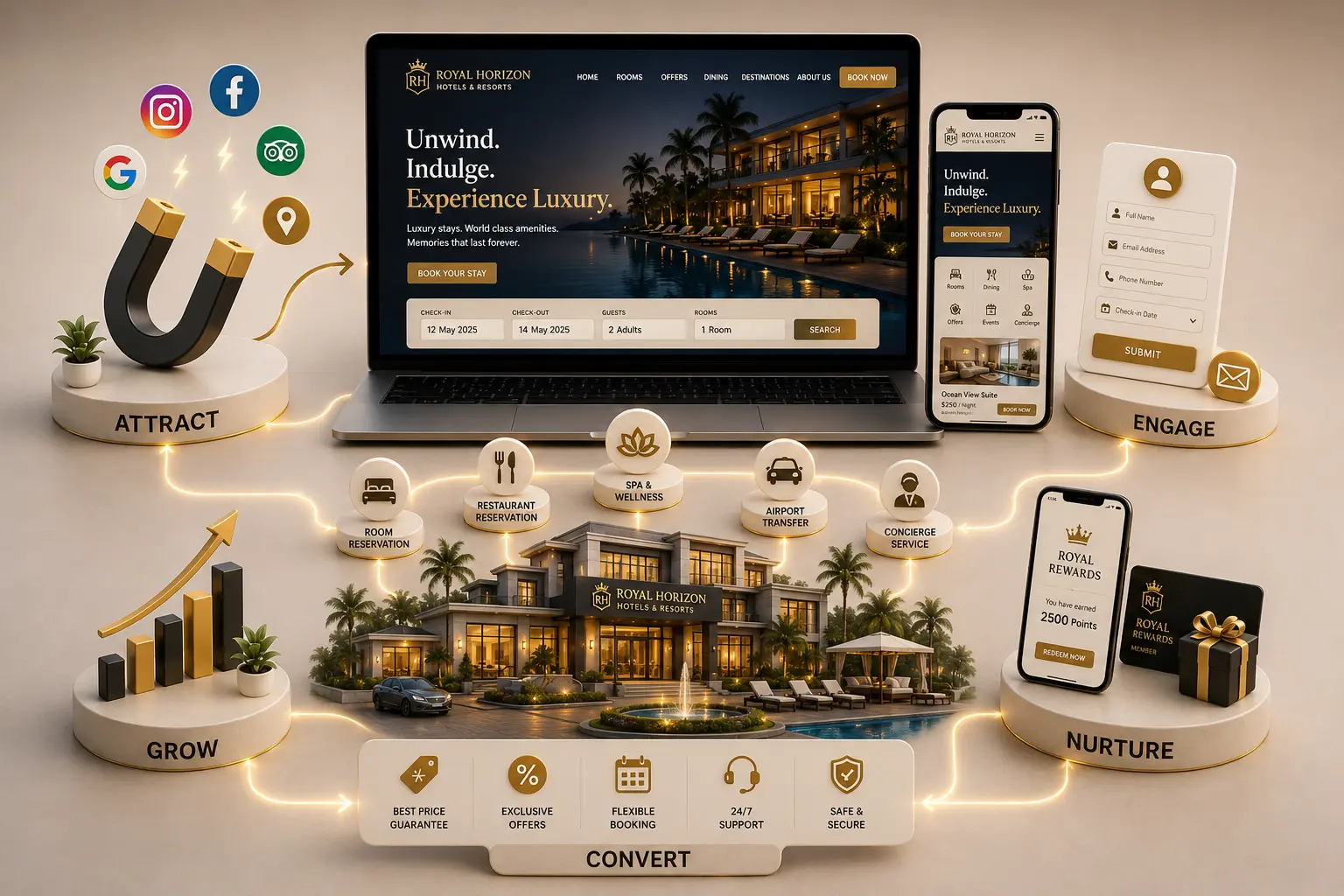
Many hotels watch analytics climb and still wonder why the reservations desk stays quiet. Ads send people to a homepage that looks fine on a laptop. On a phone the gallery stutters, rates hide behind “contact us,” and the guest opens Booking.com instead. The property did not lose the guest at the gate—it lost them between the first click and a confirmed stay. That gap is where marketing spend turns into someone else’s commission. Hotel website bookings only happen when the site answers the same questions an OTA answers faster: which room, for which dates, at what price, with what cancellation rules, and how do I pay without calling. If your pages are slow, vague, or enquiry-only, traffic becomes a cost centre. Fixing conversion is usually cheaper than buying more clicks into the same broken path.
This guide walks through the common leaks—speed, room presentation, mobile booking, reservation systems, photography, reviews, maps, and local SEO—and how each one quietly pushes guests toward OTAs. It is written for owners and GMs, not developers.
Hotels, resorts, and boutique properties that already attract website visitors but want more confirmed direct stays instead of abandoned sessions and OTA referrals.
1. Slow websites lose bookings before the room loads
A guest comparing three hotels on a train will not wait for a heavy homepage carousel. If your hero image is a multi-megabyte slideshow and the “Check availability” button appears late, they bounce. Speed is not a vanity metric here—it is whether the booking intent survives long enough to see a rate. Compress images, limit autoplay video above the fold, and keep room templates light enough that mid-range Android phones can open them without stuttering.
Measure what guests feel: time to first useful content on room pages, not only homepage Lighthouse scores. A pretty lobby film that blocks the date picker is worse than a plain page that lets someone book in under a minute. When your site feels slow, the OTA app already feels familiar—and familiarity wins. If your team only tests on office Wi‑Fi and new iPhones, you will miss the stalls that cost weekend bookings on hotel Wi‑Fi and older Androids.
Set a simple speed budget for room templates: compressed hero, lazy-loaded secondary gallery, and scripts that do not block the date picker. Marketing can keep storytelling pages heavier; the book path should stay lean. That split alone recovers hotel website bookings without a full redesign.
2. Poor room presentation creates doubt you never hear about
Guests leave when they cannot tell what they are buying. A single exterior shot, a “Deluxe Room” label with no bed type, and a paragraph of adjectives do not replace square footage, occupancy, view, bathroom style, or what breakfast includes. If two room types look identical in the gallery, people assume the cheaper OTA listing is safer because at least other travellers left comments there.
Write room pages the way a front-desk agent answers the phone: bed configuration, max guests, what is included, what costs extra, and any honest caveats (street-facing, no elevator, renovating wing). Pair that with several real photos—not one wide angle that hides a tight bathroom. Clarity reduces emails and increases completed hotel website bookings.
Add a short “good for” line—couples, families, business travellers—so guests self-select before they open the calendar. When room pages answer the same questions a receptionist would, fewer people abandon the site to “just check one more option” on an OTA and never return.
3. The mobile booking experience is the real front desk
Most research happens on a phone. If your booking widget requires pinch-zooming, if date fields break in Safari, or if the “Book” button sits under a sticky chat bubble, you trained the guest to leave. Design the path around thumbs: large date controls, visible total price before payment, and a confirmation screen that does not depend on reading a tiny email later.
Test the full flow yourself on the same mid-range handset your guests use. Enter real dates for a weekend, choose a room, apply a promo if you offer one, and pay with a common card or UPI method. Every friction point you find is a silent no. Fix those before you spend more on ads that only amplify the leak.
4. An online reservation system beats “call to book”
Enquiry forms and phone numbers still matter for groups, weddings, and long stays. They are a weak primary path for a standard two-night leisure booking. Guests who can finish a stay on an OTA in three minutes will not wait for someone to call back after lunch. A real reservation path—availability calendar, rate, deposit or pay-at-hotel rules, and confirmation—turns intent into inventory holds you control.
If you already use a channel manager, connect it cleanly so website rates do not contradict OTA rates in a way that looks dishonest. Guests notice when the same room is cheaper on a third-party site. Either match the offer with a direct incentive or stop sending paid traffic to a site that cannot compete on clarity.
Getting visits but not reservations?
Share how guests currently book—phone, WhatsApp, or OTA—and we will outline a hotel website that finishes the booking on your domain.
5. Photography and guest proof close the trust gap
Stock lobby photos from another property destroy trust the moment a guest arrives and notices. Use current images of rooms, bathrooms, breakfast, and outdoor spaces. Show the less glamorous but important details: parking entrance, pool depth markers if relevant, meeting room layout. Honesty converts better than a fantasy gallery that creates chargebacks and bad reviews later.
Surface recent guest reviews on the site—or link clearly to sources you maintain—so first-time visitors are not forced to open a third-party app for social proof. Answer the common worries in plain language: check-in times, ID rules, pet policy, late arrival. The fewer surprises, the fewer abandoned carts.
6. Maps and local SEO bring bookers who already intend to stay
Someone searching “boutique hotel near [landmark]” is closer to booking than a cold social scroller. If your Google Business Profile and website disagree on address, phone, or hours, you look unreliable. Embed a correct map, write a short location page that names nearby demand drivers without stuffing keywords, and keep NAP (name, address, phone) identical everywhere.
Treat local pages as useful answers, not doorways. For search quality fundamentals that still apply to hospitality sites, use Google Search documentation. Thin city pages that only repeat the hotel name will not fix a weak booking path.
7. When “everyone books on OTAs” is a website symptom
OTA dependence is partly distribution strategy and partly conversion failure. If your site cannot show live rates, guests will finish where rates are visible. If your mobile flow fails, the app they already installed wins. Improving hotel website bookings does not mean deleting OTAs tomorrow—it means earning the guests who already found you and would have booked direct if the path felt safe.
Once the site converts, you can go further on margin and ownership with a dedicated playbook for increasing hotel direct bookings without high OTA fees. Fix the leak first; then reduce unnecessary commission on demand you already paid to attract.
Visit-to-booking leaks and fixes
Leak
What guests feel
Practical fix
Slow room pages
Site is broken; open the app instead
Compress media; prioritise date picker
Vague room copy
Cannot compare bed or inclusions
Structured room facts + real photos
Enquiry-only CTA
Must wait for a call back
Live availability and confirmation
Broken mobile form
Payment fails or fields jump
Thumb-friendly booking on real devices
No reviews or map
Looks like a shell site
Proof, policies, accurate Maps embed
8. A practical path from traffic to confirmed stays
Record a full mobile booking attempt on your live site this week and list every friction point
Rewrite the top three room pages with bed type, occupancy, inclusions, and current photos
Put rates and availability above the fold on mobile—not only after an enquiry form
Align Google Business Profile details with the website footer and contact page
Measure room-page to booking-start rate before buying more traffic
You do not need a flashy redesign to stop losing guests. You need a site that behaves like a competent front desk: fast answers, honest rooms, and a way to confirm the stay without leaving your domain. Traffic without that path will keep funding the platforms that already perfected the checkout.
Explore hotel web development, start from the homepage, review delivery work in the portfolio, meet the team on the about page, or reach us via contact when you are ready to turn hotel website visits into reservations you own.
“Visitors are not bookings. A hotel site that answers room, rate, and trust questions on a phone earns the stay that ads already paid for.”
Common causes are slow pages, unclear room details, mobile booking friction, enquiry-only CTAs, weak trust signals, and rates that are harder to find than on OTAs. Guests leave when the path to confirmation feels risky or incomplete.
Forms help groups and special requests. For standard leisure stays, guests expect live dates, rates, and confirmation. Relying only on call-backs usually loses urgency to OTAs.
Critical. Most research happens on phones. If date pickers, room selection, or payment break on mobile, your conversion rate will stay low no matter how good the desktop design looks.
You need current, honest photos of rooms and facilities. Stock or outdated images create distrust. Professional shoots help, but accuracy and coverage matter more than heavy filters.
Not necessarily. OTAs remain a distribution channel. The goal is to convert guests who already found you directly, then reduce unnecessary commission on demand you can own. Strategy details differ by property.
First-time guests look for proof. Showing recent feedback and clear policies on your site reduces the need to open a third-party app for reassurance before paying.
Keep name, address, and phone consistent, maintain Google Business Profile accuracy, embed a correct map, and publish useful location context—not thin keyword pages.
Speed, room clarity, and a working mobile book path often move metrics within weeks because they remove friction for intent that already exists. SEO gains take longer than UX fixes.
Track room-page views to booking starts, mobile completion rate, and abandoned payment steps. Pair that with call or WhatsApp volume to see whether the site is still forcing offline workarounds.
One brand, two addresses, and a messy website is how guests book the wrong property—or leave for an OTA. Here is how to structure a multi-property hotel website that stays clear.
A booking engine is not a widget. Use this 2026 buyer checklist for PMS sync, mobile checkout, fees, embed options, red flags, and a 30-day pilot before you commit.
OTAs fill rooms and take a cut. See how a professional hotel website, booking engine, and trust signals help you win more direct bookings and keep more of each stay.
Hotel websites that drive direct bookings with room showcases, rate clarity, enquiry paths, and multi-property structure. Available for hotels and hospitality brands across major Indian cities. Every page is planned for stronger search visibility, faster performance, clearer customer journeys, and measurable enquiries.
My Perfect Solutions helps brokers, clinics, restaurants, and growing brands launch fast, SEO-ready websites that turn search traffic into qualified enquiries across India.