Hotel Direct Bookings: Own More Stays Without OTA Markup
OTAs fill rooms and take a cut. See how a professional hotel website, booking engine, and trust signals help you win more direct bookings and keep more of each stay. This guide covers why OTA-only reliance is risky, what direct stays buy you, and the practical website pieces that shift share: trust signals, offers, room comparison, payments, booking engines, Google presence, local SEO, and testimonials. It complements conversion fixes; it does not replace them.
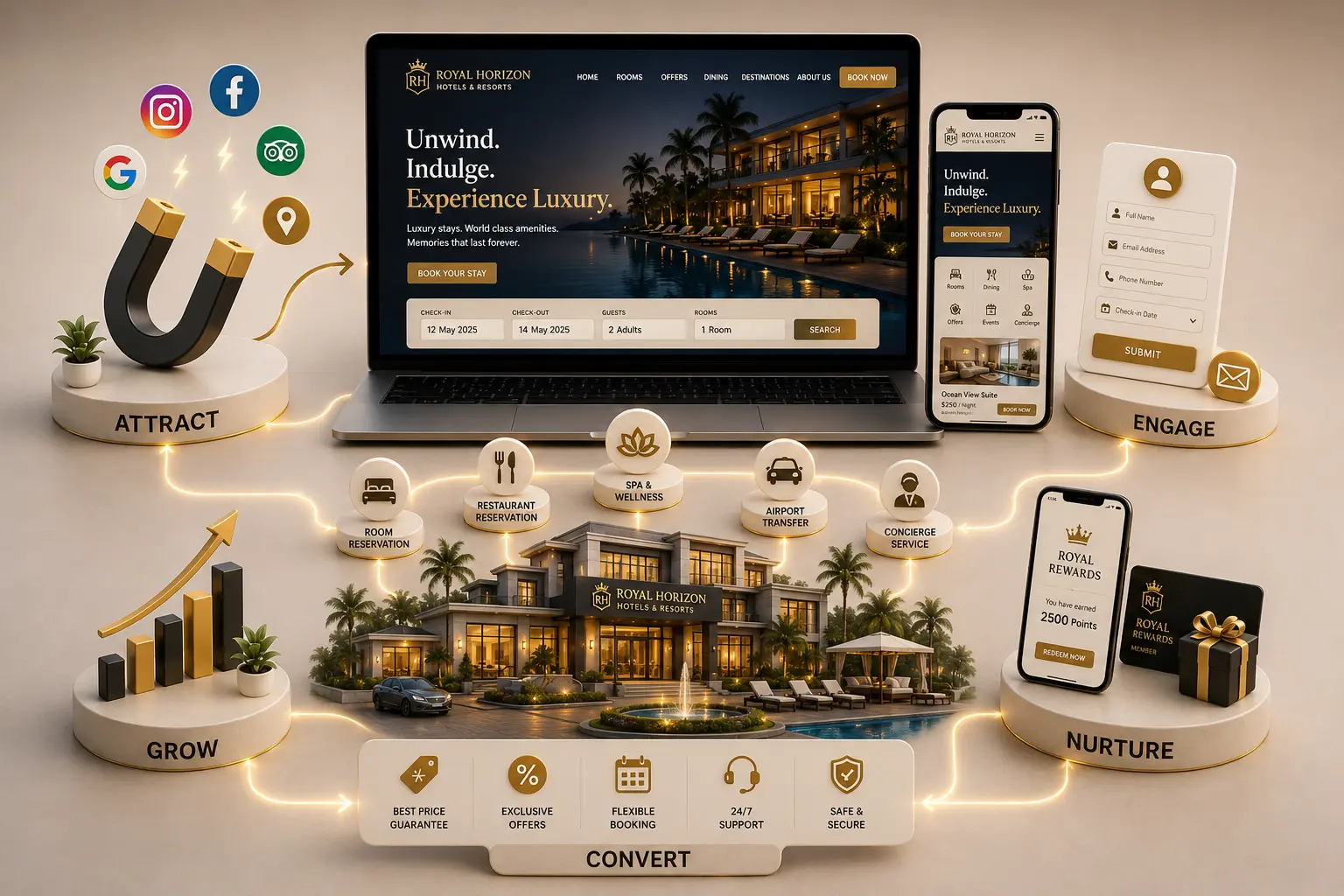
For many hotels, Booking.com and similar OTAs became the default front desk. Rooms fill, then the statement arrives and a large slice of revenue is gone. Worse, the guest’s email and loyalty sit on someone else’s platform, so the next stay starts with another commission. Owners feel trapped: turn off OTAs and occupancy dips; keep them and margins shrink. The missing piece is usually not “more ads”—it is a hotel website that can win hotel direct bookings when a guest is ready to choose. Direct bookings improve margin, let you set fair cancellation rules, and give you a list you can market to again. OTAs remain useful for discovery, especially for new properties. The goal is balance: use platforms for reach, then earn the confirmation on your domain whenever the guest is willing. That only works if your site matches OTA convenience—rates, rooms, payment, and trust—without the same fee.
This guide covers why OTA-only reliance is risky, what direct stays buy you, and the practical website pieces that shift share: trust signals, offers, room comparison, payments, booking engines, Google presence, local SEO, and testimonials. It complements conversion fixes; it does not replace them.
Hotel owners, resort managers, and boutique operators who already use OTAs and want a credible direct channel that reduces commission without guessing at flashy redesigns.
1. Why relying only on OTAs is risky
OTAs change ranking rules, promote competitors, and can raise effective cost when you lean harder on visibility tools. If a large share of your occupancy sits on one platform, a ranking dip or policy change hits revenue immediately. You also train guests to search the OTA brand, not yours. When every stay starts on someone else’s app, you rent demand instead of building it.
That does not mean quitting OTAs overnight. It means refusing to make them the only place rates and rooms are easy to buy. A property that can take a polished direct booking has leverage: you can still list on platforms while shifting repeat and brand-aware guests to your site.
Watch concentration risk the same way you watch a single large corporate account. If one OTA is more than half of room nights, a ranking change becomes a revenue event. Building hotel direct bookings is insurance as much as margin improvement—especially for independents without a chain loyalty programme behind them.
2. What direct bookings actually buy you
Margin is the obvious win: commission that stays in-house funds payroll, maintenance, or marketing you control. Control is the quieter win: you decide how to describe rooms, which packages to push, and how to handle loyalty. Data is the long win: emails and stay history let you offer a second-night deal or a weekday special without buying the same guest again from an OTA.
Direct also reduces awkward rate conversations at the desk when a guest shows an OTA screenshot that undercuts your walk-in price. When your website offers a clear “book direct” benefit, staff have a story that is fair and consistent.
Owned guest data also improves operations. You can message arrival instructions, upsell a late checkout, or invite a return stay in the off-season without buying the same traveller again. OTAs rarely hand you that relationship on terms you control. Over a year, the compounding value of a clean email list often exceeds a single month of saved commission.
None of that appears if the website cannot take payment. Treat the booking engine as core infrastructure—like the PMS—not a marketing afterthought funded only when occupancy dips.
3. Website trust signals that make direct feel safe
Guests trust OTAs partly because of reviews and partly because payment feels familiar. Your site needs the same cues: HTTPS everywhere, recognisable payment options, clear cancellation and deposit rules, and contact details that look staffed. Show real photos and a physical address. Hide nothing that an OTA would show in the booking summary.
Put policies next to the book button, not in a footer PDF. First-time guests decide in seconds whether “pay on this hotel site” feels legitimate. Ambiguity sends them back to the platform where the rules are already written in bold.
4. Special offers and room comparison pages
Give people a reason to choose you. A free breakfast for direct bookers, flexible cancellation on selected dates, late checkout for members, or a package with transfers can tip a comparison even when the room rate looks similar. Publish those offers on the site and in confirmation emails so the benefit is obvious—not buried in a staff script.
Room comparison pages help guests who would otherwise use an OTA filter. Let them see bed type, size, view, and inclusions side by side. When comparison is easy on your domain, fewer people leave to “just check Booking.com” and never return.
Ready to shift more stays off OTA fees?
Tell us your current booking mix and we will outline a hotel website and booking path built for direct reservations.
5. Secure payments and a booking engine that works
A professional booking engine is the difference between a brochure and a till. Guests need live availability, rate clarity, and a confirmation they can save. Sync with your channel manager so you do not double-book or show stale inventory. If payment fails often on mobile, direct share will stall no matter how good the offer is.
Support the methods your market expects—cards, and where relevant UPI or local wallets—without surprising fees at the last step. Spell out pay-now versus pay-at-hotel rules before the guest enters card details. Surprises at payment are how you lose a stay you already almost won.
Train the front desk on what the website promised. If the confirmation says breakfast is included for direct bookers, breakfast must be included. Broken promises destroy the trust you spent money building and push the next stay back onto OTAs. Consistency between site copy, engine rules, and desk behaviour is part of the product.
6. Google Hotel presence and local SEO
Many travellers start on Google, not on an OTA homepage. An accurate Google Business Profile, consistent NAP, and a website that can accept the booking when someone clicks through are essential. If Google surfaces your rates but the landing page cannot complete a stay, you trained the guest to use the OTA module instead.
Keep profile details honest and up to date. For search-quality basics that support findability, use Google Search documentation. Local pages should help travellers choose a stay—not spam city names into thin templates.
7. Guest testimonials that support the direct pitch
Collect permissioned quotes and recent stay feedback on your site. Highlight specifics—“quiet courtyard room,” “breakfast included on direct book”—so testimonials reinforce the offer, not generic five-star fluff. Pair them with response habits: if someone asks a pre-arrival question on the site chat or form, answer quickly. Slow replies push people back to OTA messaging they already use.
If traffic already arrives but stalls before payment, fix conversion leaks first with why hotel websites get visits but few bookings. Direct strategy fails when the book path itself is broken.
OTA-heavy habit versus direct-ready habit
Moment
OTA-heavy habit
Direct-ready habit
Guest finds you
Only OTA listing is polished
Site + Google profile match and invite book
Compare rooms
Filters only on the OTA
Clear comparison on your site
Price decision
No direct incentive
Visible member or direct-only benefit
Pay
Sent to third-party checkout
Secure engine on your domain
After stay
No owned email list
Permissioned follow-up for return stays
8. A practical rollout that does not scare occupancy
Keep OTAs live while you launch a working direct book path on mobile
Add one clear direct incentive you can honour at the desk
Align website rates with channel manager rules so you do not look dishonest
Promote the direct URL in email signatures, WhatsApp replies, and Google posts
Track direct share of room nights monthly—not only website sessions
Reducing OTA commissions is a share-shift project, not a weekend redesign. The hotel that wins is the one that makes direct as easy as the app guests already trust—then gives them a fair reason to prefer you. Do that, and every marketing rupee that already sent someone to your brand has a better chance of becoming a stay you keep.
Explore hotel web development, visit the homepage, see related work in the portfolio, learn about the team on the about page, or get in touch via contact when you want more hotel direct bookings and less unnecessary commission.
“OTAs can fill rooms. A hotel that owns its booking path fills rooms and keeps the relationship—and more of the rate.”
Usually no, especially for discovery. Use OTAs for reach while building a direct path for brand-aware and repeat guests. Sudden removal can hurt occupancy before the website is ready.
A working mobile booking engine, clear rates, one honest direct incentive, and trust signals (reviews, policies, secure payment). Marketing without that path rarely moves share.
Match clarity first, then add a direct benefit such as breakfast, flexible cancellation, or a member rate. Competing only on a lower bare rate can trigger parity issues—align with your commercial rules.
Forms help complex enquiries. Standard stays convert better with live availability and confirmation. Guests who can finish on an OTA in minutes will not wait for call-backs.
Accurate profiles and a site that can complete the stay capture people who search by hotel name or location. If the click lands on a weak page, guests often finish on an OTA module instead.
Direct share of room nights, website booking completion rate on mobile, and commission paid to OTAs as a percentage of revenue. Sessions alone do not prove share shift.
Yes. Boutique properties often win on story and service—if the site makes booking as easy as the big platforms for a simple stay.
Bundle value guests care about—breakfast, late checkout, transfers—rather than cutting the room rate alone. Publish the benefit clearly on the book path.
Fix sync first. Inconsistent rates look dishonest and push guests back to OTAs. Direct strategy depends on trustworthy pricing.
One brand, two addresses, and a messy website is how guests book the wrong property—or leave for an OTA. Here is how to structure a multi-property hotel website that stays clear.
A booking engine is not a widget. Use this 2026 buyer checklist for PMS sync, mobile checkout, fees, embed options, red flags, and a 30-day pilot before you commit.
Traffic without reservations is expensive. Learn why hotel sites lose guests after the click and how room clarity, mobile booking, and trust turn visits into confirmed stays.
Hotel websites that drive direct bookings with room showcases, rate clarity, enquiry paths, and multi-property structure. Available for hotels and hospitality brands across major Indian cities. Every page is planned for stronger search visibility, faster performance, clearer customer journeys, and measurable enquiries.
My Perfect Solutions helps brokers, clinics, restaurants, and growing brands launch fast, SEO-ready websites that turn search traffic into qualified enquiries across India.