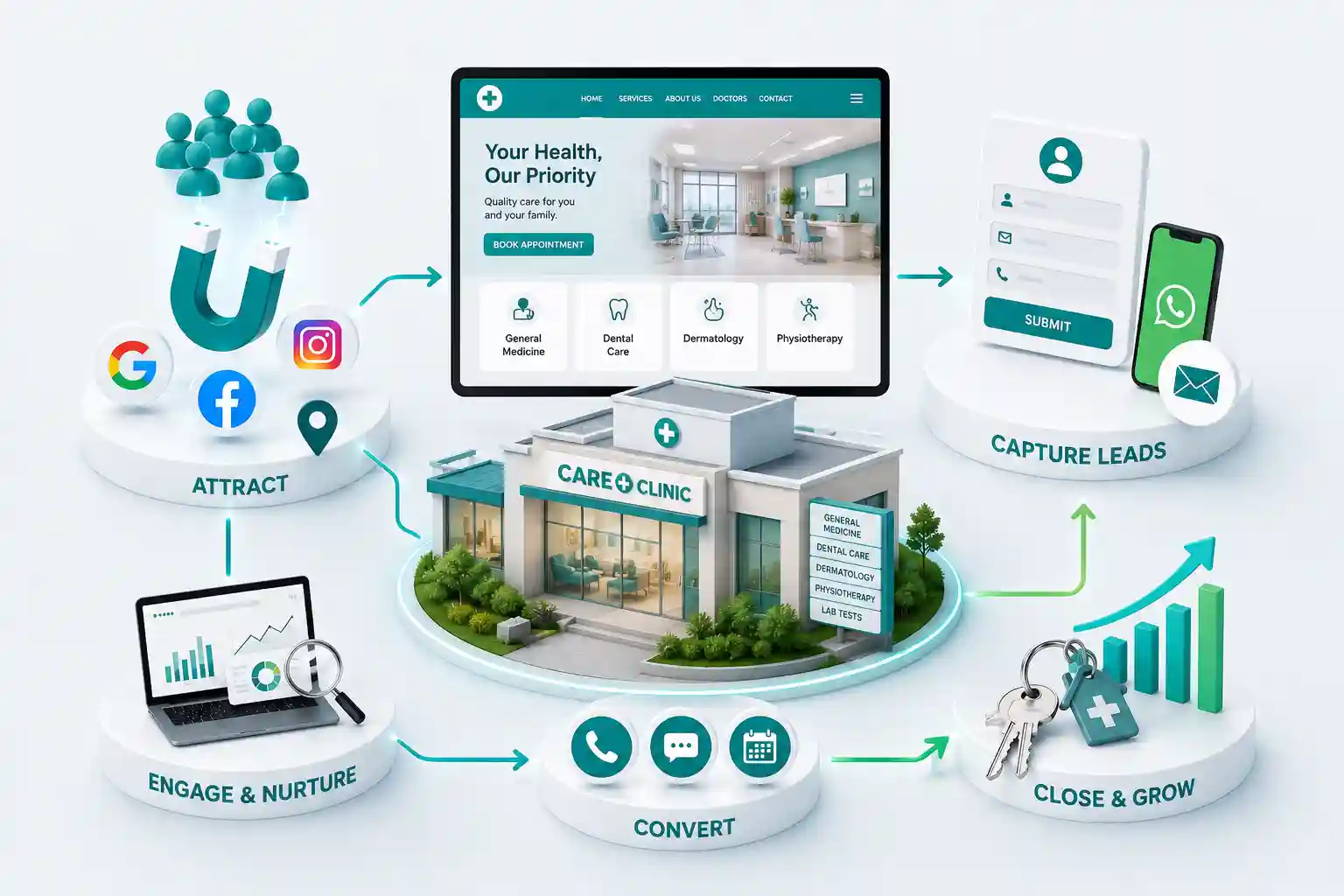
Clinic Website Development Cost in India: Scope, Features and Budget
Compare clinic website development budgets in India by scope, content, appointment workflows, integrations, compliance work, and ongoing support. This guide explains useful planning ranges in India, the decisions that change price, what a quotation should include, how to phase features, and how to budget for maintenance. All ranges are indicative examples for planning, not fixed offers or guarantees.
Clinic website quotations often place very different products under one heading. One estimate may cover a small information site, while another includes service content, doctor profiles, location pages, appointment requests, reminders, analytics, accessibility work, and integration with an existing system. Comparing only the total hides those differences. A clinic website supports practical patient tasks before a call or visit. If the scope omits content ownership, mobile testing, privacy controls, or reliable appointment handoff, a low initial price can produce manual work and costly revisions. An oversized first release can also consume budget without solving the most common visitor needs.
This guide explains useful planning ranges in India, the decisions that change price, what a quotation should include, how to phase features, and how to budget for maintenance. All ranges are indicative examples for planning, not fixed offers or guarantees.
It is for independent doctors, clinic owners, practice managers, and healthcare groups evaluating a new website or replacing an outdated one. The focus is website strategy and operations, not clinical guidance.
Define the clinic website job before discussing price
Begin with the visitor tasks the website must support. Typical tasks include checking whether the clinic offers a relevant service, understanding who provides it, locating a branch, reviewing opening hours, preparing for an appointment, and choosing a contact or booking route. A website that only introduces the practice needs less design, content, and testing than one that coordinates appointment availability across several doctors.
Also define the internal job. Decide who updates hours, doctor availability, service information, notices, and frequently asked questions. State whether reception receives an email, a dashboard task, or a record in practice software. The clinic website development cost in India becomes easier to estimate when each public action has a named operational owner and a testable result.
An independent clinic information website with custom presentation, responsive pages, a manageable content system, basic search setup, and tested contact paths may be planned around ₹50,000 to ₹1.25 lakh. A growth website with richer service architecture, multiple profiles or locations, appointment requests, content support, analytics, and stronger conversion design may sit around ₹1.25 lakh to ₹3.5 lakh.
A connected clinic platform that displays availability, supports account based workflows, sends notifications, or exchanges data with practice software may start around ₹3.5 lakh and rise materially with complexity. These are illustrative planning bands, not market promises. Vendor experience, content condition, design depth, data migration, security requirements, and integration documentation all affect the final clinic website quotation.
Illustrative clinic website budget bands in India
Website level
Indicative budget
Best suited to
Focused information site
₹50,000 to ₹1.25 lakh
One clinic with simple contact paths
Growth and appointment site
₹1.25 lakh to ₹3.5 lakh
Clinics investing in discovery and managed requests
Connected clinic platform
₹3.5 lakh and above
Multi-doctor or multi-location workflows with integrations
Practical example: Clinic A needs eight approved pages, four doctor profiles, one location, and a request form reviewed by reception. Clinic B needs the same visible pages plus live schedules, two-way appointment changes, SMS reminders, and synchronization with existing software. Their screen counts may look similar, but Clinic B carries integration, failure handling, privacy, and support work that should produce a different budget.
Understand which features change development cost
Page quantity alone is a weak pricing measure. A reusable service template is efficient when every service follows a consistent information structure. Unique layouts for procedures, departments, campaigns, and locations require more design and quality assurance. Doctor profiles become more involved when the clinic needs filters, location associations, schedule ownership, qualifications fields, or a central profile management workflow.
Appointment request forms with service, doctor, branch, and preferred time context
Live slot selection with temporary holds, confirmation, cancellation, and rescheduling
Multiple locations with distinct hours, directions, contact details, and teams
Multilingual content with translation review and language-specific navigation
Accessible components, keyboard support, form errors, captions, and readable contrast
Migration from an old website, documents, spreadsheets, or profile directories
Role based editing, approval, scheduling, and audit history in the CMS
Email, SMS, calendar, payment, analytics, or practice software integrations
Separate essential features from attractive extras. Search may be valuable for a large specialty group but unnecessary for a five-service clinic. Online payment may fit a documented booking workflow but should not be added simply because a vendor offers it. Every feature introduces content states, errors, mobile behaviour, staff training, and maintenance. Budget should follow a real patient or staff task.
Budget for content, design, accessibility, and trust
A technically complete website can still be unusable when content is vague or difficult to scan. Content work may include stakeholder interviews, page planning, service copy editing, profile normalization, location instructions, preparation information supplied by the clinic, FAQs, metadata, image selection, and migration. Clarify who verifies factual content and how future changes receive approval.
Design should help visitors identify the clinic, understand services, read on a small screen, and find the next appropriate action without pressure. Trust comes from clear ownership, real contact details, consistent profile information, transparent appointment language, and visible privacy information. Avoid urgency patterns, unclear consent boxes, and unsupported claims. A clinic website is not the place for exaggerated marketing promises.
Include accessibility in the original design and acceptance criteria. The W3C overview of Web Content Accessibility Guidelines is an authoritative starting point for perceivable content, keyboard use, understandable forms, and robust interfaces. Your project team should translate relevant guidance into specific tests.
“A useful clinic website reduces uncertainty about the next administrative step without pretending to replace a conversation with a qualified professional.”
Price integrations by workflow, risk, and testing
The phrase booking integration can mean a link to an external page, a form that creates a reception task, one-way slot display, or two-way synchronization with a practice management system. Each option has a different cost and reliability profile. Before pricing, document the system owner, available API, authentication, fields, status mapping, duplicate rules, retry behaviour, support contact, and test environment.
Collect only information needed for the stated website task. Explain why it is requested, where it goes, who can access it, and how long it remains available according to the clinic's documented policy and applicable obligations. Developers should not invent clinical fields or retention rules. Clinic leadership and qualified advisers must define requirements, while the delivery team implements and tests them.
Integration detail that affects effort
Area
Simple implementation
Higher effort implementation
Booking
External booking link
Live slots with change workflows
Notification
Staff email alert
Templated SMS with delivery status
Calendar
Downloadable event
Two-way schedule synchronization
Analytics
Page and form events
Consent-aware cross-system attribution
Migration
Approved page copy
Mapped profiles, services, and redirects
Practical example: a form can show a successful message while the receiving mailbox rejects delivery. Acceptance testing must verify the full route, not only the browser state. Test validation, duplicate submissions, slow connections, staff notifications, unavailable integrations, cancellation handling, analytics events, and safe recovery. Monitoring and an escalation owner belong in the operating plan.
Need a realistic clinic website scope?
Map pages, content, appointment workflows, integrations, and phased budget before requesting a final build quotation.
Plan timeline, maintenance, and ownership together
A focused clinic site may take six to ten weeks when content, feedback, and approvals are ready. A growth website may need ten to sixteen weeks, while connected platforms are better delivered in planned releases. These ranges should include discovery, information architecture, design, content preparation, development, integration, accessibility review, device testing, training, and launch checks.
Confirm scope, responsibilities, constraints, and acceptance criteria
Approve the sitemap, page templates, content plan, and visitor journeys
Design and review mobile and desktop interfaces with real content
Develop CMS components, forms, analytics, and agreed integrations
Test accessibility, privacy controls, performance, redirects, and handoffs
Train owners, launch with monitoring, and record deferred improvements
Post-launch cost may cover hosting, backups, dependency and security updates, availability monitoring, form checks, integration monitoring, content assistance, accessibility regression checks, analytics review, and planned improvements. Ask vendors to separate routine care, incident response, and enhancement hours. Confirm response expectations and what happens when an external booking or messaging provider changes its interface.
Compare proposals and phase the budget responsibly
Give shortlisted vendors the same written brief. Request a breakdown for discovery, design, content, development, integrations, migration, testing, training, launch, and support. Ask what is excluded, which third-party charges recur, who owns deliverables, and how change requests are estimated. A credible proposal connects cost to assumptions and acceptance criteria rather than offering a page count with vague premium features.
Phase one can establish service and profile content, locations, mobile contact paths, a managed appointment request, analytics, accessibility foundations, and search essentials. Phase two can improve content depth, local discovery, reminders, and operational reporting. Live availability or deeper practice software synchronization can follow when workflows, system access, and support ownership are mature.
Review our clinic web development service, browse relevant work in the portfolio, and learn about our approach. When your brief is ready, use the contact page to discuss scope. Since this is the first clinic article in the series, it deliberately avoids linking to unpublished clinic guides.
A focused custom information site may be planned around ₹50,000 to ₹1.25 lakh, a growth website around ₹1.25 lakh to ₹3.5 lakh, and a connected platform from about ₹3.5 lakh upward. These are illustrative planning bands. Pages, content, profiles, locations, booking complexity, integrations, migration, testing, and support determine an actual quotation.
The same label can describe a basic information site or an operational platform. One quote may exclude writing, profile migration, accessibility, analytics, appointment handoff, software integration, training, and maintenance. Compare assumptions and deliverables line by line, then confirm that each critical workflow has acceptance criteria.
A sound first release usually includes clear clinic and service information, verified doctor profiles, location details, opening hours, accessible mobile navigation, appropriate contact or appointment paths, privacy information, analytics, basic search setup, and a manageable editing process. Exact pages should reflect the clinic's real services and operations.
Yes, particularly when the site displays live slots, prevents conflicts, supports cancellation or rescheduling, sends reminders, and synchronizes with existing software. A simple external link or managed request form costs less. Choose the level that reception can operate and that the connected system can support reliably.
Yes, either as a vendor deliverable or an explicitly owned clinic task. Budget for interviews, page structure, drafting or editing, factual review, profile normalization, metadata, media preparation, and future updates. Development cannot compensate for missing, duplicated, unclear, or unapproved information.
A focused site may take six to ten weeks with ready content and prompt approvals. A growth website may need ten to sixteen weeks. Connected systems should be planned in releases. Timeline depends on content readiness, stakeholder decisions, integration access, migration quality, testing depth, and staff training.
Plan for hosting, backups, monitoring, software updates, security maintenance, form and integration checks, content changes, analytics review, and periodic accessibility and performance testing. Messaging, booking, email, or other providers may charge separately. The support agreement should distinguish routine care, incidents, and new features.
A template can suit a small, stable information site if it remains accessible, fast, maintainable, and aligned with the clinic's content. Savings shrink when extensive customization, plugins, complex booking, or duplicated layouts are needed. Evaluate total ownership and future flexibility, not only the launch price.
Provide one brief and score vendors on scope clarity, relevant workflow experience, content process, accessibility, privacy implementation, integration testing, ownership, maintenance, and communication. Ask them to explain failure handling and demonstrate how staff update information. Select a team whose assumptions and trade-offs are explicit, not one that promises every feature at the lowest headline cost.
Patients find your clinic online, then leave before booking. Fix the friction in forms, doctor info, services, mobile speed, local SEO, and contact options.
A website UX guide for clinics: clearer care discovery, usable practitioner profiles, appointment paths, accessible forms, and dependable content operations.
Plan useful doctor profile pages with verified credentials, clear scope, practical availability, accessible content, and appointment paths that help patients choose confidently.
Healthcare websites that build patient trust, simplify appointments, and help clinics grow. Available for doctors and hospitals across major Indian cities. Every page is planned for stronger search visibility, faster performance, clearer customer journeys, and measurable enquiries.
My Perfect Solutions helps brokers, clinics, restaurants, and growing brands launch fast, SEO-ready websites that turn search traffic into qualified enquiries across India.