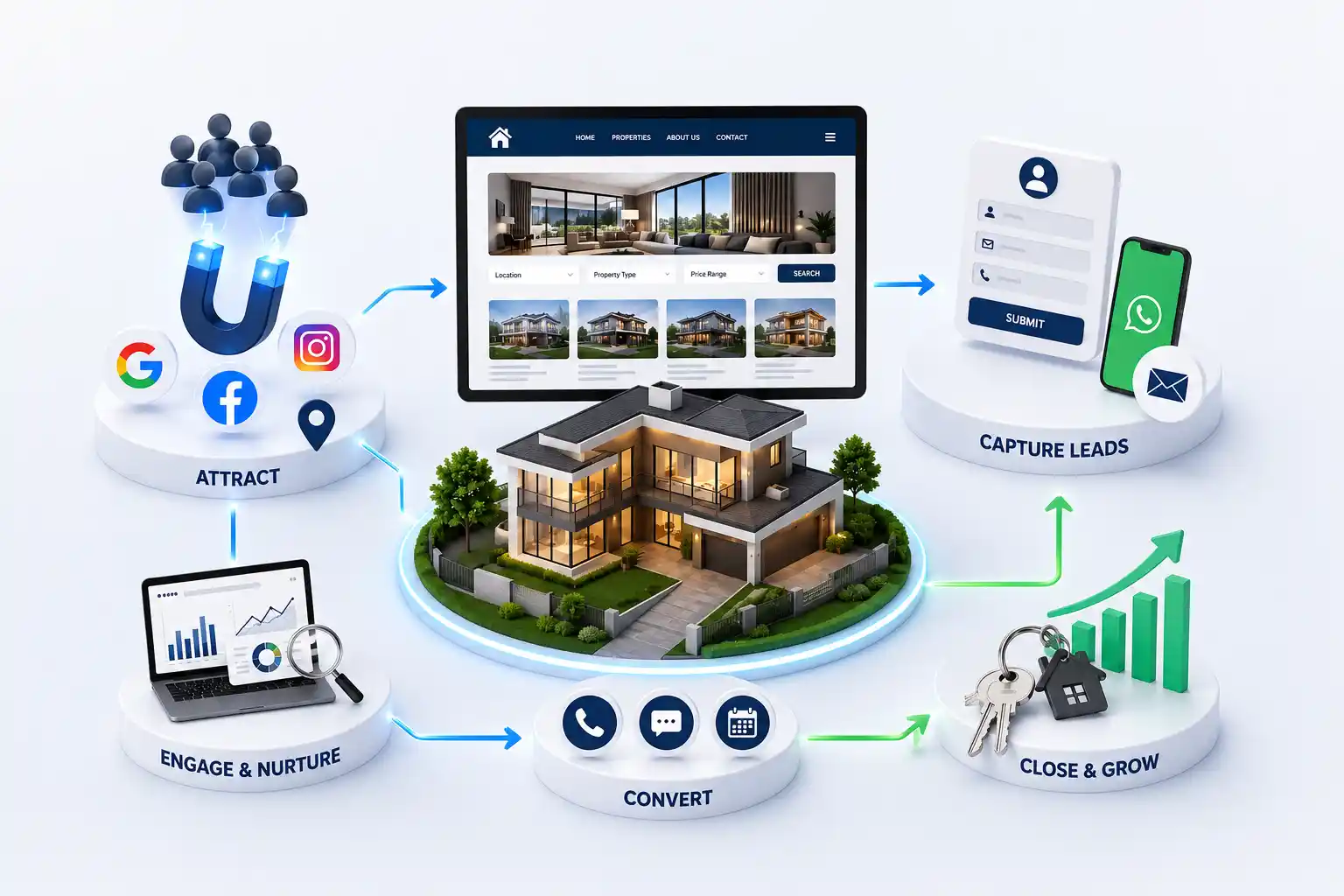
Why Every Real Estate Agency Needs a Professional Website in 2026
Buyers search online first. A professional property website builds trust, captures leads, and keeps your listings in front of qualified enquiries. This guide explains how a real estate website supports trust, lead ownership, and local discovery. You will see what separates a brochure site from a conversion engine, how teams in Mumbai, Bengaluru, and tier-2 cities use owned channels, and which features matter first when budget is limited.
Many brokers still depend on portals, phone referrals, and scattered social posts. That works until a competitor shows up with a faster site, clearer listings, and one-tap WhatsApp enquiry on every project page. You lose visibility not because your inventory is weak, but because buyers never experience your brand as the primary source. Property research starts on search and maps. If your agency has no dedicated website, you rent attention on third-party apps, pay for duplicated leads, and cannot control how projects are presented. A professional site becomes your always-on sales desk: open 24/7, measurable, and shaped around your micro-markets.
This guide explains how a real estate website supports trust, lead ownership, and local discovery. You will see what separates a brochure site from a conversion engine, how teams in Mumbai, Bengaluru, and tier-2 cities use owned channels, and which features matter first when budget is limited.
Written for agency owners, broker-owners, builder marketing teams, and property consultants who want practical website strategy without agency jargon.
Before you invest in ads or more portal subscriptions, decide what you want the website to do: showcase inventory, capture qualified enquiries, or support field agents with consistent project data. Clarity here saves months of rework. Explore our real estate web development service when you are ready to scope a build.
Buyers start online, even when they buy offline
Most residential and commercial buyers browse on mobile during commutes and after work. They compare locations, scan photos, and shortlist two or three agents before making a call. If your presence is only a portal profile, you look interchangeable. A branded website lets you lead with your strengths: niche localities, developer tie-ups, or premium furnished rentals.
Real-world example: a boutique agency in Pune focused on gated-community resales. After launching a mobile-first listing site with map pins and WhatsApp on each unit, call-ins from organic search rose within eight weeks because project pages matched how people actually searched (society name plus BHK).
Trust is decided in the first five seconds
Blurry galleries, broken filters, and generic stock photos signal risk in a high-ticket purchase. Professional layout, consistent typography, and accurate copy reduce bounce rates. Trust also comes from transparency: RERA references where applicable, agent credentials, and office location on maps.
Basic site vs professional property website
Factor
Basic / template site
Professional real estate site
Listing presentation
Static PDFs or image dumps
Structured filters, galleries, map view
Lead capture
Single contact form
Per-listing WhatsApp, call, visit scheduling
Local SEO
Thin duplicate pages
Area guides, unique project copy
Speed on mobile
Heavy sliders, slow load
Optimized images, fast LCP
Measurement
No event tracking
Form, chat, and call analytics
Own your leads instead of renting them
Portal leads are often shared among multiple agents. Website leads arrive with context: which listing, which budget band, which locality page. That context improves first-call conversion and reduces junk enquiries. Pair forms with a simple CRM or automation workflow so no night-time submission sits unanswered until Monday.
Tag leads by project ID and source page
Auto-route commercial vs residential to the right desk
Send instant WhatsApp acknowledgment templates
Review weekly: top listings by enquiry volume
Planning a lead-ready property site?
We build listing layouts, enquiry flows, and agent handoffs tailored to Indian buyers.
Your website is the hub for local SEO
Google Business Profile drives calls, but your site anchors topical authority. Publish useful area pages, buying guides, and project FAQs that answer real questions. Internal links between localities and listings help crawlers understand coverage. Combine this with clean technical SEO: titles, meta descriptions, and structured data where appropriate.
Most property searches happen on phones. Slow hero images and intrusive pop-ups destroy conversion. Prioritize readable fonts, thumb-friendly filters, and sticky call or WhatsApp actions. Test on mid-range Android devices common in your market, not only flagship iPhones.
Compress gallery images without visible quality loss
Lazy-load below-the-fold listings
Keep filter panels simple: price, BHK, location
Use click-to-call and deep-linked WhatsApp messages
Support your team with clear workflows
A website should make agents faster, not create duplicate data entry forever. When marketing updates a project page, field teams should trust that inventory is current. Dashboards for lead status, viewing notes, and follow-up reminders reduce leakage between marketing and sales.
“Our site did not replace relationships; it made the first conversation warmer because buyers already knew our projects.”
What to build first when budget is tight
Start with a focused MVP: homepage, project listing grid, detail template, contact paths, and three area pages you actually serve. Add virtual tours, multilingual copy, or portal sync later. Shipping a excellent small site beats waiting for a perfect mega portal.
Set baselines before redesign: organic sessions, enquiry count, average response time, and percentage of leads mentioning your website. Review monthly with sales and marketing together so numbers translate into listing updates, not blame.
Compare channel quality, not just volume. A portal lead answered in two hours may convert worse than a website lead answered in ten minutes with project context. Track assisted conversions when buyers mention articles or area guides during calls.
Working with developers and marketers
Agencies get the best results when marketing owns messaging and sales validates listing data before publish. Developers need clear acceptance criteria: filter behavior, map defaults, form fields, and analytics events. Change requests after launch are normal, so plan a monthly improvement slot.
Provide photography standards up front
Nominate one approver for go-live
Document enquiry routing rules
Keep a backlog of locality pages to add quarterly
Future-proofing your property brand online
Regulations, portal policies, and ad costs change. Owned websites let you adapt offers, highlight new towers, and publish market commentary without waiting for marketplace approvals. Invest in content depth and speed now so algorithm shifts hurt less later.
Video, virtual tours, and investor portals can layer onto a solid core. Skip the reverse order because fancy media on a slow, untrusted site rarely fixes fundamental UX gaps.
Content operations for busy broker teams
Treat listing copy like inventory: stale units erode trust. Assign one marketing owner to approve price changes weekly. Agents should submit photos and USPs in a standard template so web updates stay fast during hot launches.
Monday: review new enquiries and top landing pages
Wednesday: update sold or hold statuses
Friday: publish one micro-insight on social linking back to site
When content operations run smoothly, SEO and paid campaigns amplify work you already completed instead of creating constant firefighting.
Conclusion: treat your website as core infrastructure
In 2026, a professional real estate website is not a vanity project. It is how you earn trust, capture measurable demand, and compound local visibility. Portals still matter, but owned digital property keeps you in control when algorithms and pricing change.
Agencies that document buyer objections from sales calls and reflect answers on the site see fewer repetitive enquiries and higher close rates on first visits.
Cost depends on listing count, map integrations, CRM hooks, and design depth. A focused agency site with search, WhatsApp leads, and local pages typically falls in a moderate band compared to full custom portals. After a short discovery call, we share a fixed scope quote with milestones so marketing and sales know what ships when.
Often yes, depending on API or export formats. Many teams start manual for speed, then automate once fields and photo standards are stable. We plan integrations so agents are not double-entering data indefinitely.
Most agency sites launch in a few weeks when content and photos are ready. Larger inventories or custom MLS-style search extend timelines. We provide a week-by-week plan covering design, listing templates, QA on mobile, and analytics setup.
A site alone is not enough, but it is the foundation. Combine fast pages, unique locality content, internal links, and a maintained Google Business Profile. Over time, owned content builds authority that paid portal slots cannot replicate.
Yes for flagship inventory. Unique URLs with structured titles, galleries, FAQs, and enquiry actions rank better and convert better than dumping every unit on one endless page.
In India, buyers expect it. Contextual WhatsApp messages prefilled with project name reduce friction and improve response rates compared to generic contact forms alone.
Templates ship fast but limit filter logic, map behavior, and brand storytelling. Custom or semi-custom builds align UX with how your team sells, whether luxury resales or commercial leasing.
Track enquiries by listing, call clicks, form submits, and assisted offline deals where agents ask how buyers found you. Compare cost per lead to portal spend quarterly.
Yes, with clear city or micro-market hubs and unique copy per area. Avoid duplicate thin pages; each hub should reflect real inventory and local expertise.
Gather logo files, brand colors, listing spreadsheets, photography standards, RERA references, and a priority list of localities. Prepared content shortens launch time dramatically.
Plan a practical real estate CRM integration that captures enquiry context, assigns the right agent, supports timely follow up, and gives managers reliable pipeline visibility.
Use this practical redesign checklist to diagnose an outdated property website, preserve search visibility, improve buyer journeys, strengthen enquiry quality, and plan a controlled launch with fewer migration risks.
Property listing websites with search, lead capture, and broker ready tools. Available for agencies and builders across major Indian cities. Every page is planned for stronger search visibility, faster performance, clearer customer journeys, and measurable enquiries.
My Perfect Solutions helps brokers, clinics, restaurants, and growing brands launch fast, SEO-ready websites that turn search traffic into qualified enquiries across India.