Real Estate Website Development Cost in India: Features, Timeline and ROI
Understand what drives real estate website cost in India, which features deserve budget first, realistic timelines, and how to judge long-term return. This guide explains realistic cost bands, the features and integrations that move pricing, how long each phase takes, what maintenance includes, and a practical method for estimating return without relying on vanity traffic.
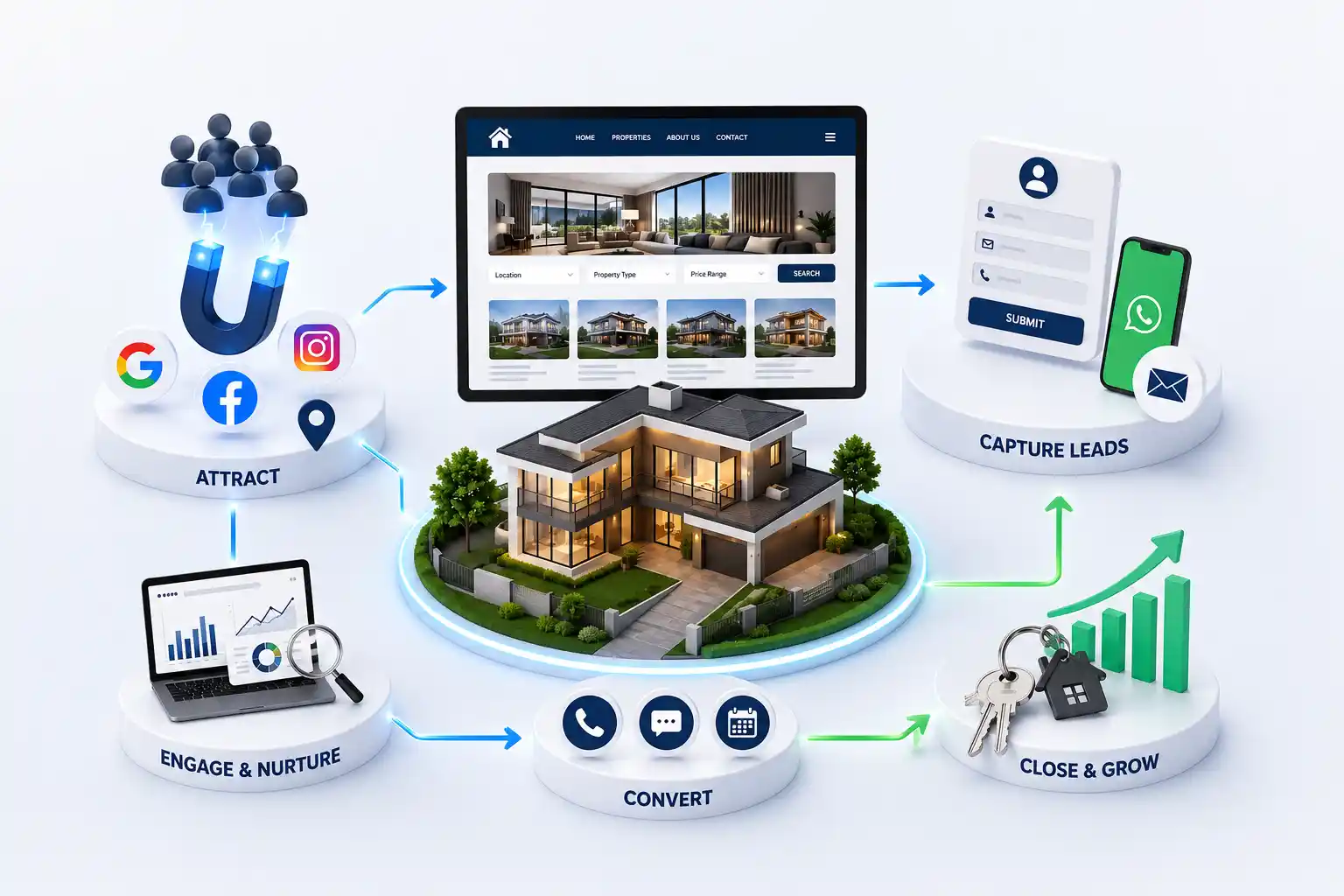
Real estate businesses often ask for a website quotation before defining how listings enter the system, how buyers search, or where enquiries should go. That makes proposals difficult to compare: one may price a brochure site while another includes search, maps, integrations, migration, and a content workflow. The cheapest estimate can become expensive when essential work appears later, while an oversized first release can lock capital into features buyers never use. A useful budget connects scope to sales operations, launch priorities, and measurable lead outcomes.
This guide explains realistic cost bands, the features and integrations that move pricing, how long each phase takes, what maintenance includes, and a practical method for estimating return without relying on vanity traffic.
It is written for brokers, developers, channel partners, and marketing teams planning a first website or replacing an ageing property portal in India.
Why real estate website cost is not one fixed number
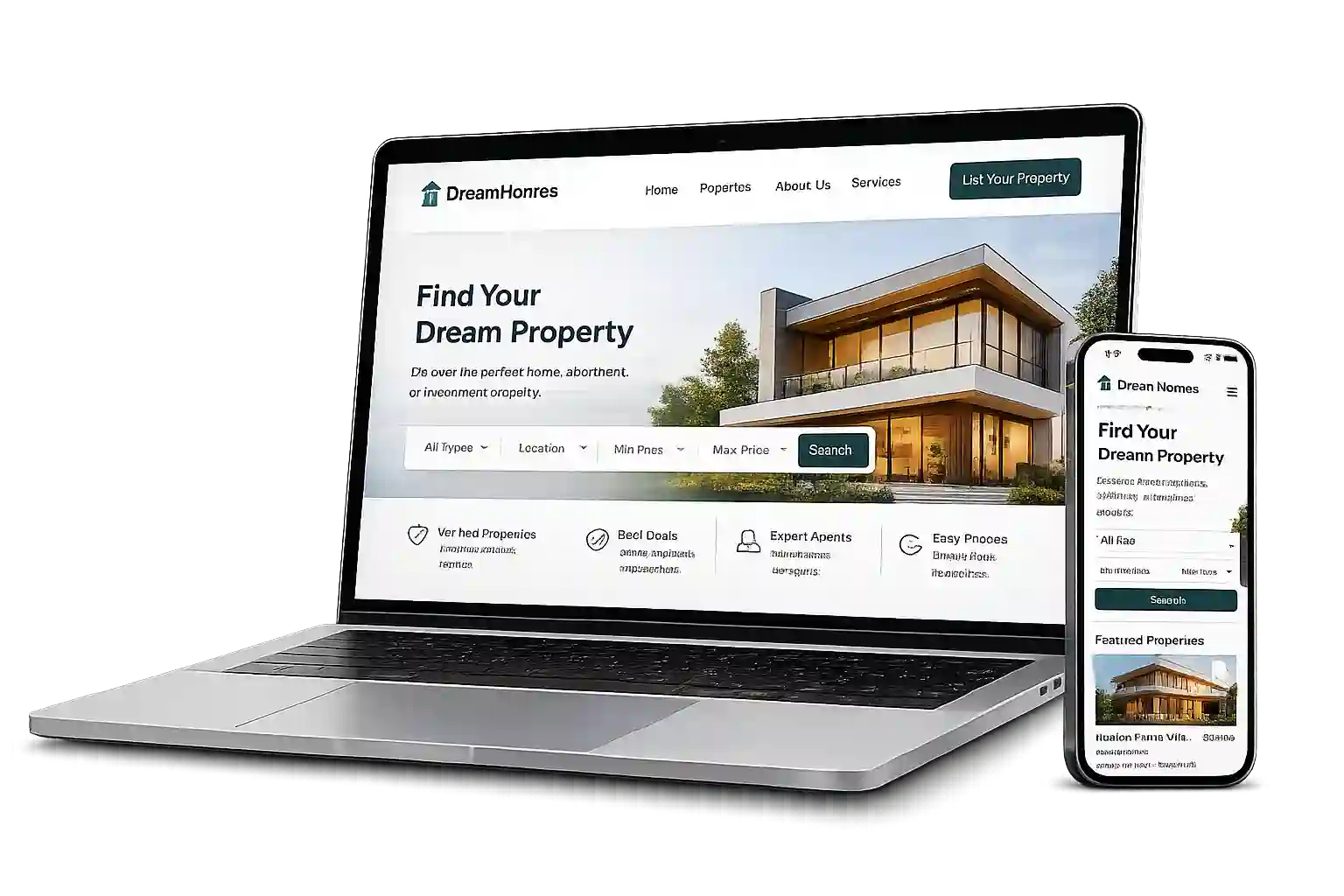
A five-page broker website and a searchable property platform may look similar in a quotation title, but they solve different operational problems. A brochure site presents the company, services, selected projects, and contact details. A platform stores structured inventory, supports combinations of filters, creates detail pages, routes enquiries, and may synchronize with a CRM. The second product needs more discovery, data modelling, quality assurance, and post-launch support.
Price also reflects the condition of your inputs. A team with approved copy, consistent photography, a clean inventory spreadsheet, and one decision-maker can move efficiently. If the developer must repair duplicate data, source missing specifications, rewrite every page, and coordinate several approvers, the delivery effort grows. Ask every vendor to state assumptions so you compare equivalent scope rather than headline totals.
Indicative development ranges in India
For planning purposes, a focused custom marketing website may begin around ₹60,000 to ₹1.5 lakh. A growth website with managed listings, advanced filters, locality content, analytics, and stronger conversion design commonly sits around ₹1.5 lakh to ₹4 lakh. A property portal with user accounts, complex search, dashboards, feeds, or custom CRM workflows can move from ₹4 lakh into substantially higher territory.
These bands vary by inventory scale, design depth, integration quality, migration risk, and support commitments. Template assembly can cost less, but recurring plugin licences, limited flexibility, and weak performance may shift cost into later repairs. A custom build costs more upfront when the business requires distinctive workflows, yet it can remove manual lead handling and support expansion without replacing the foundation.
Planning ranges for different real estate website scopes
Website level
Typical scope
Indicative investment
Professional brochure
Company, projects, services, enquiry, basic SEO
₹60,000–₹1.5 lakh
Growth listing website
Managed listings, filters, maps, local SEO, analytics
₹1.5–₹4 lakh
Custom property platform
Accounts, dashboards, feeds, CRM and workflow automation
₹4 lakh and above
Features that have the biggest effect on budget
Structured property management is the first major cost driver. Every listing may include location, price, configuration, possession status, amenities, plans, galleries, documents, and agent ownership. The administration interface must validate those fields and keep publishing simple. Search then has to return accurate combinations quickly. A few static project pages do not require the same engineering as ten thousand changing units.
Maps, multilingual content, mortgage calculators, favourites, comparison tools, login areas, saved searches, and personalized alerts add separate design and testing paths. None is automatically essential. Prioritize features that answer a known buyer question or remove a measured sales bottleneck. If agents mainly need contextual WhatsApp enquiries, launch that flow before investing in a complex customer dashboard.
Number and complexity of property records
Search, sort, map, and comparison behaviour
Content management permissions and approval workflow
Lead routing, CRM, email, WhatsApp, or telephony integrations
Data migration from spreadsheets, portals, or an old website
Custom calculators, accounts, alerts, and dashboards
Multilingual pages and city or locality SEO templates
Design, content, and SEO are part of the product
Real estate design is not a decorative layer added after development. Buyers must distinguish projects, understand price context, inspect floor plans, and find the next action on a small screen. A thoughtful design phase maps these decisions before code begins. Custom page systems cost more than applying a purchased theme, but they prevent the fragmented experience caused by forcing listings into generic cards.
Content production may include strategy, interviews, project copy, locality guides, image preparation, title tags, internal links, and schema. Search performance depends on original, accurate pages rather than hundreds of thin location variations. Clarify whether your estimate includes writing and migration or only empty templates. Otherwise the site may be technically complete but months away from a useful launch.
“A website is ready when a buyer can understand the offer and enquire confidently, not when the final component has merely been coded.”
Integrations and migration need careful discovery
CRM integration ranges from sending a form payload to building two-way synchronization with ownership, status updates, deduplication, and retry logic. Vendors need API documentation, sandbox access, field mappings, and clear failure behaviour before pricing accurately. The same applies to property feeds and portal exports. An integration described only as connect CRM is not a testable requirement.
Migration is often underestimated. Old records may use inconsistent locations, image names, price formats, and possession labels. Cleaning these records protects filters and SEO. Plan a sample migration early, identify what should be archived, and retain redirects for valuable old URLs. This work costs less than launching with broken images, duplicate projects, and search results buyers cannot trust.
A realistic development timeline
A focused professional site can take six to ten weeks when content and approvals are available. A listing-led growth website often needs ten to sixteen weeks. Larger platforms are best planned in releases over four to nine months. These ranges include discovery, information architecture, design, development, content loading, testing, training, and launch preparation, not just coding time.
Approval delay is a major schedule risk. One accountable product owner should collect feedback from sales, marketing, and leadership, then provide a single decision. Weekly demonstrations reduce surprises. Protect time for mobile testing, forms, analytics, redirects, and content review; cutting those steps to meet an arbitrary announcement date usually creates a public debugging period.
Discovery and requirements: one to two weeks
Information architecture and content plan: one to two weeks
Interface design and approval: two to four weeks
Development and integrations: four to ten weeks
Content migration, testing, training, and launch: two to four weeks
What ongoing maintenance should cover
Hosting is only one ongoing cost. A healthy website needs security updates, backups, availability monitoring, form tests, dependency maintenance, analytics review, and performance checks. Listing teams also need a content routine so sold inventory is removed and new projects appear promptly. Ask whether support reacts to incidents or proactively prevents them while improving conversion.
Include measurable loading, responsiveness, and visual stability targets based on Google's Core Web Vitals guidance. Performance work should be part of delivery and maintenance rather than an optional repair after campaigns begin.
Budget a monthly allowance based on business impact and release frequency. A small brochure site may need a modest care plan, while a lead-generating platform deserves monitored support and planned enhancement hours. Keep ownership of the domain, analytics, source assets, and important accounts in the company name. Good documentation lowers switching risk and makes future work more efficient.
How to calculate website ROI
Start with qualified enquiries rather than visits. Record current monthly spend on portals and ads, leads received, response rate, site visits, and closed deals. After launch, track the same funnel for website leads, including assisted conversions from locality guides. If the website produces twenty qualified enquiries a month and one additional transaction covers the annualized investment, that is more meaningful than a large increase in impressions.
Return also appears through efficiency: agents receive project context, repetitive questions fall, content can be reused in campaigns, and the business retains first-party audience data. Use conservative assumptions and review quarterly. SEO compounds slowly, while a clearer enquiry flow can improve paid and referral traffic immediately. Separate these effects so expectations remain credible.
Useful ROI measures
Measure
Why it matters
Review frequency
Qualified website leads
Shows commercial intent
Monthly
Lead-to-site-visit rate
Tests lead quality and follow-up
Monthly
Cost per qualified lead
Compares owned and rented channels
Quarterly
Response time
Reveals routing efficiency
Weekly
Organic assisted conversions
Credits useful research content
Quarterly
How to phase the investment without creating rework
Phase one should establish positioning, a dependable listing structure, core project pages, mobile enquiry actions, analytics, and foundational SEO. Phase two can add locality content, richer maps, CRM rules, and campaign landing pages using evidence from actual behaviour. Phase three may introduce accounts, alerts, agent dashboards, or feed automation when volume justifies the complexity.
Phasing succeeds only when the initial architecture anticipates future data and permissions. A low-cost temporary build that stores every project as unstructured page text may need replacement before advanced search can exist. Tell vendors the three-year direction even if the current budget funds only the first release. They can then avoid decisions that close important paths.
Need a scope before requesting quotations?
Review the features, content, and lead workflow your real estate website actually needs.
How to compare development partners
Look beyond visual portfolios. Ask candidates to explain how they would structure listings, preserve SEO during migration, measure enquiries, handle accessibility, and test integrations. Strong partners ask about your sales process before recommending technology. They should identify risks, define what is excluded, and describe who supports the site after launch.
Compare proposals using the same requirements and score scope clarity, relevant experience, communication, performance approach, ownership, support, and total cost. References are useful when you ask specific questions about reliability and change management. The best fit is not necessarily the largest agency or lowest quote; it is the team capable of making sound trade-offs with your business.
Review examples in our portfolio and use the contact page to request a practical scope discussion for your project.
Conclusion: budget for business outcomes
Real estate website development cost in India makes sense only beside a defined outcome. A brochure website, a lead-generation engine, and a custom property platform require different investment and governance. Define the buyer journey, data model, content responsibility, integrations, and measurement plan before treating any quotation as comparable.
Invest first in trust, mobile discovery, accurate listings, fast enquiry, and reliable tracking. Add complexity when evidence supports it. That approach protects budget, produces a useful launch sooner, and gives the website a credible chance to become an owned source of qualified demand rather than another digital brochure.
A professional brochure site may begin around ₹60,000, while listing-led growth websites commonly range from roughly ₹1.5 lakh to ₹4 lakh. Custom portals with accounts, feeds, dashboards, and CRM automation can exceed ₹4 lakh. These are planning ranges; content, inventory, integrations, design depth, and support determine the actual quotation.
Vendors may be pricing completely different products under the same label. Confirm the number of templates, listing workflow, filters, content, migration, integrations, SEO, analytics, testing, training, hosting, and support included in each estimate.
A template can work for a small broker with limited, stable inventory and simple enquiry needs. It becomes restrictive when the business needs advanced search, unique project storytelling, fast performance, integrations, or a scalable locality SEO structure.
Focused sites often take six to ten weeks, growth listing websites ten to sixteen weeks, and larger platforms several phased months. Content readiness, integration access, and approval speed have as much influence as development complexity.
Maintenance should cover security and dependency updates, backups, monitoring, form testing, performance checks, technical support, and a clear process for content changes. Higher-volume platforms also benefit from proactive analytics and improvement time.
Include it early if manual lead forwarding is already slow or unreliable. A simple, tested lead push may be enough initially. Two-way synchronization and complex assignment rules can follow once the team has documented the workflow.
Prepare clean content and inventory, appoint one approver, prioritize features by buyer value, reuse a consistent design system, and launch in planned phases. Do not save money by omitting mobile testing, analytics, security, redirects, or basic SEO.
Track qualified website enquiries, response time, site-visit rate, closed transactions, and cost per qualified lead. Compare these with portal and paid channels, and include assisted conversions where buyers used area guides before contacting an agent.
The business should control its domain, hosting or cloud account, analytics, search tools, CRM credentials, source assets, and backups. The contract should clearly state code ownership, licences, handover, and post-launch access.
Choose custom platform development when inventory scale, user roles, feed integration, search complexity, customer accounts, or operational automation create measurable value. Avoid platform complexity when a well-designed managed listing website can meet present demand.
Plan a practical real estate CRM integration that captures enquiry context, assigns the right agent, supports timely follow up, and gives managers reliable pipeline visibility.
Use this practical redesign checklist to diagnose an outdated property website, preserve search visibility, improve buyer journeys, strengthen enquiry quality, and plan a controlled launch with fewer migration risks.
Property listing websites with search, lead capture, and broker ready tools. Available for agencies and builders across major Indian cities. Every page is planned for stronger search visibility, faster performance, clearer customer journeys, and measurable enquiries.
My Perfect Solutions helps brokers, clinics, restaurants, and growing brands launch fast, SEO-ready websites that turn search traffic into qualified enquiries across India.