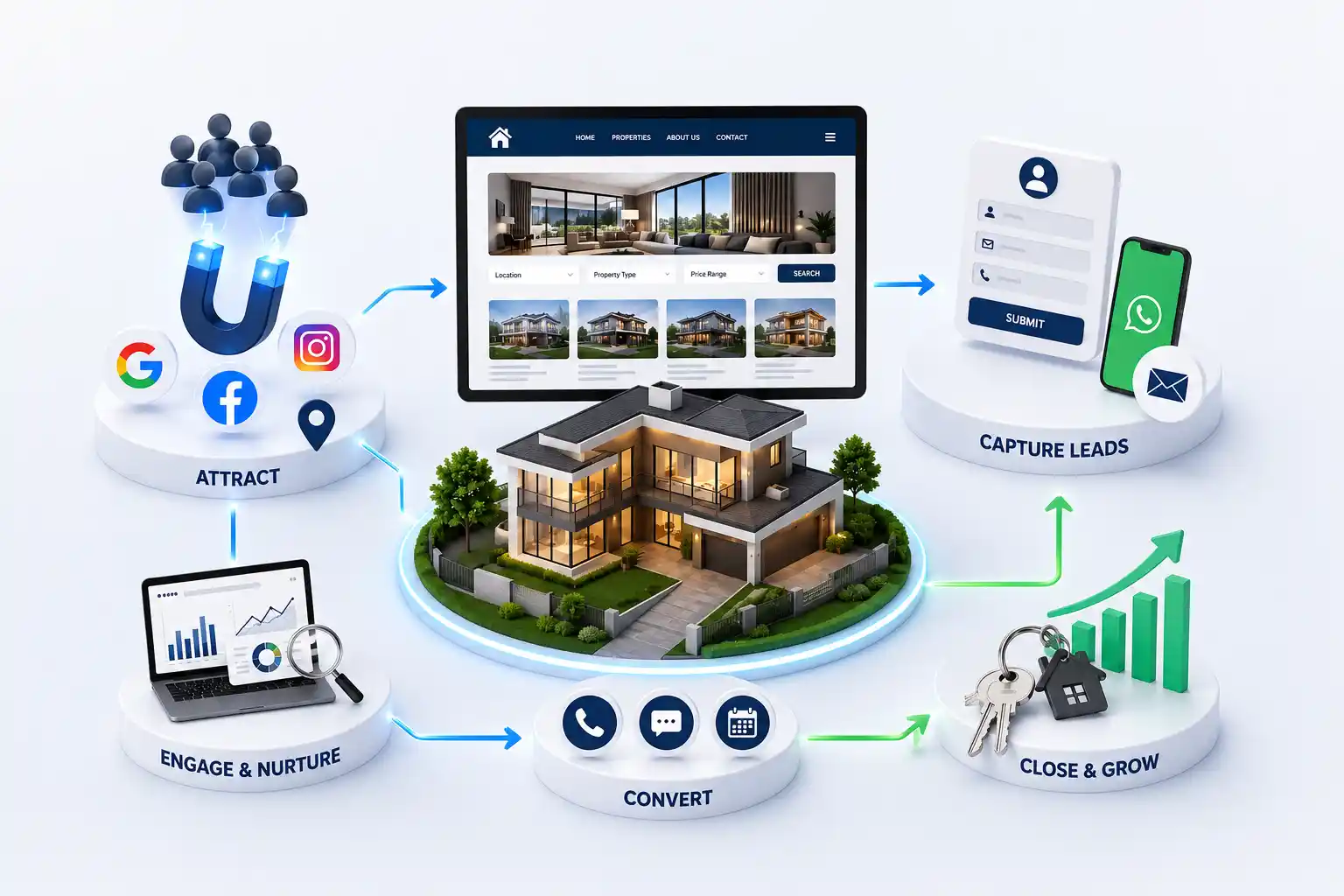
Realtor Website Features US Agents Need to Convert Buyers in 2026
Prioritize realtor website features that turn listing views into appointments: search, mobile CTAs, proof, lead routing, and local market content. This guide ranks the realtor website features that most improve real estate lead generation, explains how realtor website development should phase them, and shows how market pages in competitive US cities support conversion beyond IDX search alone.
Many websites for realtors look finished yet fail at the moments that matter: a buyer cannot filter usefully, a listing CTA loses context, or the agent page offers no proof beyond a stock headshot. Teams then blame traffic quality when the real gap is property website features and follow-up design. US buyers compare agents after comparing homes. Real estate website design that clarifies expertise, local coverage, and next steps shortens that comparison. Strong realtor website features also protect paid spend—ad clicks die on slow galleries and vague contact forms.
This guide ranks the realtor website features that most improve real estate lead generation, explains how realtor website development should phase them, and shows how market pages in competitive US cities support conversion beyond IDX search alone.
Written for US realtors, team leads, and brokerage marketers prioritizing a practical website for realtors without chasing every trendy widget.
Start with discovery that matches buyer language. Whether you rely on IDX or featured inventory, filters should cover price, beds, baths, property type, and location with predictable results. Map views help when commute and school-area intuition matter. Listing detail pages need ordered galleries, key facts above the fold, honest remarks, and a single primary CTA that is easy to tap on a phone.
Real estate lead generation fails when enquiry actions are generic. Prefer listing-aware forms, click-to-call, and optional scheduling that pass MLS number or address into the CRM. Instant acknowledgment—email or text—sets expectations while an ISA or agent responds. Sticky mobile contact patterns outperform buried footer forms for evening browsers who will not fill long questionnaires.
Performance is a conversion feature, not a technical footnote. Heavy slideshows, uncompressed hero videos, and third-party widgets that block interaction punish cellular users comparing five agents in one sitting. Set a gallery performance budget during realtor website development and test listing detail pages on mid-range phones. Buyers rarely complain about speed—they simply leave for a competitor whose photos load first.
Search and listing detail clarity on mobile first
Primary CTA with listing context and CRM field mapping
Agent or team proof: reviews, sold stories, credentials
Fast image delivery and stable layout for gallery browsing
Analytics events for form, call, and chat conversions
Priority property website features for US realtor sites
Feature
Buyer job
Launch priority
IDX or inventory search
Shortlist homes that fit constraints
Phase one
Listing-aware enquiry
Request info or a showing quickly
Phase one
Agent trust block
Decide who to contact
Phase one
Neighborhood guides
Understand local trade-offs
Phase two
Saved searches / alerts
Return when inventory changes
Phase two
Trust, local content, and design signals that win
Real estate website design for US agents is a trust product. Buyers look for recent closings, clear service areas, professional photography standards, and bios that explain niches—first-time buyers, relocation, luxury, or investment. Vague slogans do not replace market evidence. Pair Google Business Profile consistency with on-site proof so search visitors land on a coherent brand story.
Local content turns a website for realtors into a research hub. Neighborhood pages, buyer guides, and monthly market notes support SEO and give ISAs something useful to send after first contact. Keep pages specific: commute patterns, housing stock, and who the area serves. Thin city clones without unique insight waste crawl budget and fail the credibility test when a serious buyer compares two agents.
Accessibility and clarity overlap with trust. Readable contrast, keyboard-friendly forms, descriptive alt text for listing photos, and captions that explain floor plans help more buyers complete an enquiry. These details also reduce support friction when relocating clients share links with spouses or parents who review on different devices. Treat inclusive real estate website design as part of professional service quality, not as optional polish after launch.
“The best realtor website features remove friction between curiosity and a conversation—without forcing buyers through a portal-shaped maze.”
Want a feature roadmap for your market?
We prioritize realtor website development around search, enquiry, and trust signals that create appointments in your US markets.
How to phase features and measure what works
Realtor website development should ship a revenue path before a feature museum. Phase one: positioning, search or featured listings, mobile CTAs, CRM notifications, analytics, and foundational SEO. Phase two: neighborhood depth, saved searches, richer media, and campaign landing pages informed by real queries. Phase three: portals, advanced personalization, or agent dashboards when volume justifies complexity.
Measurement keeps the roadmap honest. Define what a qualified website lead means for your team—showing requested, pre-approved buyer, or seller consultation booked—then review that definition monthly with sales leadership. Property website features that look impressive in demos but never appear in closed-file attribution should move down the backlog. Features that shorten response time or raise appointment set rate deserve budget even if they are less visually glamorous.
Baseline current enquiry volume, response time, and appointment rate
Instrument every primary CTA before launching paid campaigns
Review top listing and market pages weekly with sales leadership
Add only features that fix a measured drop-off or support request
Retire unused widgets that slow mobile pages or confuse buyers
Stay aligned with professional standards and consumer expectations published by the National Association of Realtors. Learn more about our team on the about page, browse the portfolio, or send a brief through the contact page when you are ready to prioritize features for launch.
Realtor website features succeed when they support a human sales process. IDX search without follow-up is a brochure. Beautiful real estate website design without listing-aware leads wastes attention. Build the shortest reliable path from a home a buyer likes to a conversation with the right agent, then layer market content and automation that compound trust over time.
Prioritize features by buyer jobs, not vendor demos
List the jobs a visitor must complete: find relevant homes, understand the market, trust the agent, and start a conversation. Score every proposed feature against those jobs. Chat widgets, animated heroes, and speculative AI tools can wait until search, listing detail, and enquiry paths are fast and clear on mobile.
Interview recent clients about where they hesitated online. Friction often hides in photo galleries that stall, unclear price formats, missing school or commute context, or forms that ask for too much too soon. Fix those before adding another interactive map layer that looks impressive in a pitch deck.
Make the mobile listing experience non-negotiable
Most US buyers browse on phones between errands. Sticky contact actions, readable property facts, and swipeable galleries matter more than desktop-only layouts. Test with throttled networks. If a listing page takes longer than a few seconds to become useful, paid traffic will abandon before IDX results even finish painting.
Keep primary CTA visible without covering critical facts
Compress hero media without muddy detail shots
Avoid hover-only interactions for filters and menus
Validate click-to-call and SMS options on real devices
Connect website features to CRM and nurture workflows
A feature creates value when the right teammate receives context. Saved searches should create follow-up tasks. Listing alerts should carry property IDs into the CRM. Valuation forms should tag source campaigns. Without that plumbing, even excellent UX becomes a leaky funnel that frustrates both buyers and agents.
Document which events fire on which pages and who owns incomplete records. ISAs need speed; listing agents need property context; managers need conversion reporting. Align website fields with those roles so nobody retypes notes after every enquiry.
Retire low-value widgets before they become permanent clutter
Audit quarterly for tools that attract clicks but never create conversations. Remove or hide them. Every unused script taxes performance and distracts from the features that already work. A leaner site is easier to train on, faster to update, and clearer for buyers comparing you with portal experiences.
Export feature usage and conversion for ninety days
Interview two agents and one ISA about friction
Remove or replace the weakest performer
Reinvest the attention into content or listing quality
Prioritize accurate search or featured inventory, fast mobile listing pages, listing-aware enquiry CTAs, CRM notifications, agent trust proof, and basic analytics. Add neighborhood content and alerts after the core conversion path works.
IDX helps when buyers expect to browse active board inventory on your site. Some niche agents succeed with curated featured listings and strong market content. Choose based on how your clients shop, not on vendor demos alone.
Sticky or clearly visible contact actions, simplified filters, compressed galleries, stable layouts, and short forms with listing context improve mobile conversion. Avoid autoplaying media and multi-step forms on listing pages.
Consistent photography, readable typography, clear service areas, recent sold stories, reviews, and transparent contact details signal professionalism. Avoid stock-heavy pages that look interchangeable with every other agent site.
Only if someone monitors chat with a defined SLA. Unanswered chat damages trust. Many teams get better results from call and form CTAs that route instantly to an ISA queue during coverage hours.
Specific local pages attract research traffic, support SEO, and give agents useful follow-up assets. They work when content is unique and linked to relevant listings—not when dozens of thin pages repeat the same boilerplate.
At minimum, map source, listing identifier, contact fields, and timestamp into your CRM with a tested notification path. Document ownership rules so weekend and after-hours leads do not sit unassigned.
Ship the smallest set that lets a buyer find a home, trust the agent, and enquire with context. Extra calculators, portals, and dashboards can wait until analytics show the core path converting.
Review search queries, heat on listing CTAs, support tickets from agents, and drop-off points in analytics. Add features that remove a measured friction point rather than copying a competitor’s full widget list.
Zillow can put your listings in front of shoppers. It cannot own your brand, your follow-up, or your next listing appointment. Here is why US agents still need a site they control.
Property listing websites with search, lead capture, and broker ready tools. Available for agencies and builders across major Indian cities. Every page is planned for stronger search visibility, faster performance, clearer customer journeys, and measurable enquiries.
My Perfect Solutions helps brokers, clinics, restaurants, and growing brands launch fast, SEO-ready websites that turn search traffic into qualified enquiries across India.