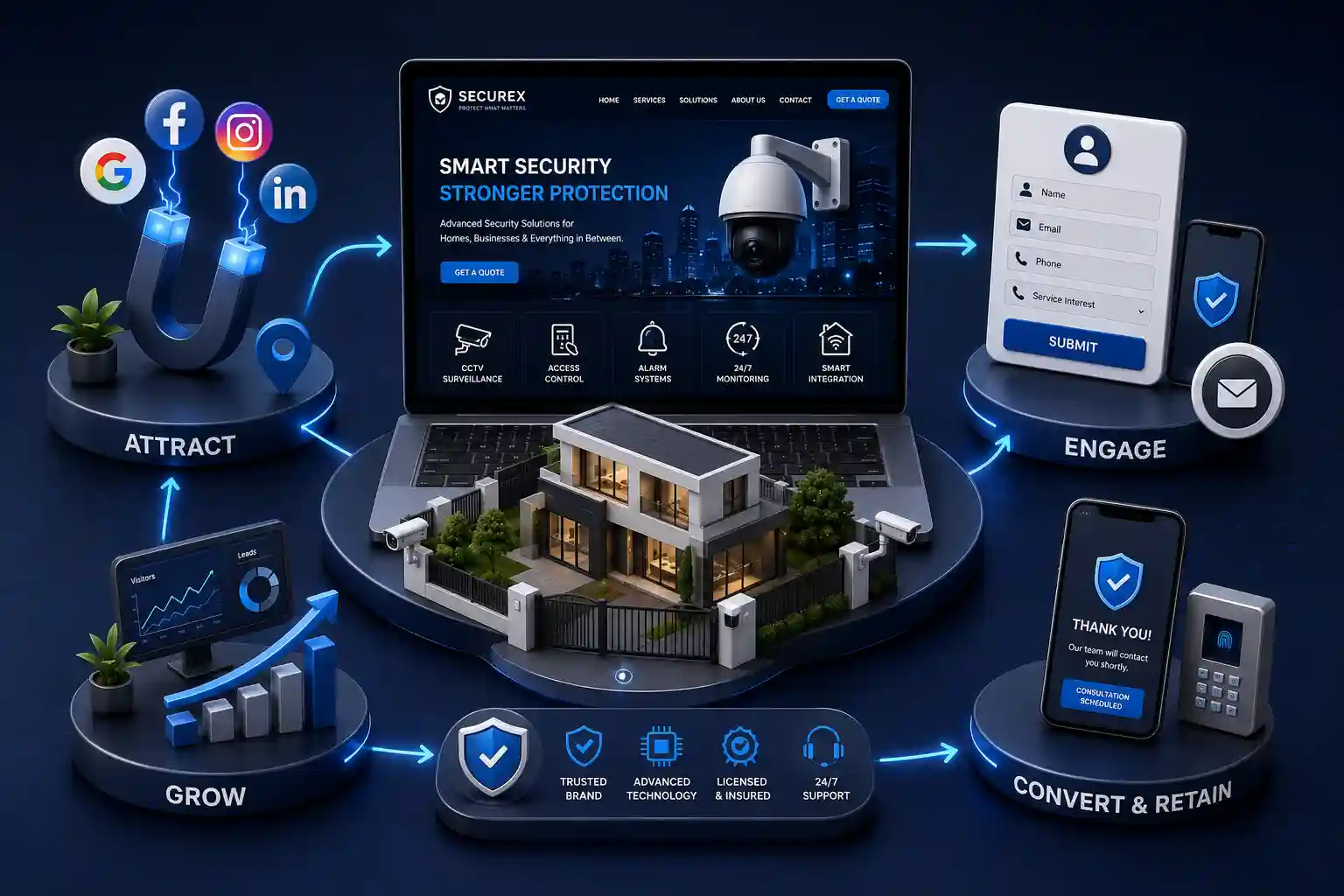
Review CCTV service pages for environment, system boundaries, maintenance, supported certification evidence, cybersecurity, safe surveys, and careful specifications. This CCTV company service page checklist covers environmental context, system boundaries, outcome-led specifications, maintenance, verifiable certification evidence, cybersecurity, surveys, enquiry safety, and content review. It does not prescribe a particular product, retention period, camera count, legal basis, or surveillance design. Technical, privacy, cybersecurity, procurement, and legal decisions require competent assessment of the actual site and current obligations.
Many CCTV service pages begin with camera resolution, lens numbers, storage days, or artificial-intelligence labels before explaining the environment and purpose. That ordering encourages false precision. A suitable design for a lit indoor reception is not automatically suitable for a perimeter, warehouse, vehicle entrance, low-light corridor, corrosive area, or remote site. Product logos and certificate graphics can add a second problem when their holder, model, scope, status, and relevance are not stated. A surveillance solution is a system, not a camera catalogue. Image quality depends on scene, mounting, light, lens, compression, network, display, storage, configuration, maintenance, and the task an authorised operator must perform. Cybersecurity and access governance continue after installation. Website shortcuts can create unrealistic expectations, imply unsupported certification, or invite visitors to expose layouts and vulnerabilities through a public survey form.
This CCTV company service page checklist covers environmental context, system boundaries, outcome-led specifications, maintenance, verifiable certification evidence, cybersecurity, surveys, enquiry safety, and content review. It does not prescribe a particular product, retention period, camera count, legal basis, or surveillance design. Technical, privacy, cybersecurity, procurement, and legal decisions require competent assessment of the actual site and current obligations.
It is for CCTV integrators, security companies, consultants, facility teams, marketers, technical writers, designers, developers, and reviewers building Indian service pages. The aim is careful commercial information that supports a qualified next conversation and gives technical reviewers a clear approval trail. Never imply certification without evidence, publish customer layouts, expose credentials, reveal camera blind spots, or request detailed vulnerabilities through an ordinary website form.
Describe the environment and required outcome first
Frame each service around the conditions a design must address and the authorised task it should support. Useful context includes indoor or outdoor use, lighting change, weather exposure, dust, vibration, distance, scene movement, network availability, power resilience, monitoring model, and operating hours. Describe outcomes cautiously: observe activity, support review, or capture usable scene evidence under defined conditions rather than guarantee identification or incident prevention.
Write scenario guidance without pretending to survey
A page can explain why entrances, cash-handling areas, warehouses, residential common areas, or remote sites create different design questions. It should not prescribe a camera count or model from a generic floor-area range. State which facts require a survey, who performs it, and what deliverable follows. Keep client names, active sites, camera positions, blind spots, and incident examples out of public content unless release has been specifically approved.
Environmental questions for service content
Condition
Why it changes design
Careful page wording
Light
Affects exposure and usable detail
Assessment covers expected lighting states
Distance
Changes scene detail and lens choice
Final selection follows measured views
Weather
Influences enclosure and mounting
Suitability is confirmed for the location
Network
Constrains transport and remote access
Connectivity is assessed, not assumed
Power
Affects availability and recovery
Resilience options depend on site needs
Operations
Defines who observes and responds
Monitoring workflow is agreed separately
Define the complete system scope and boundaries
Explain what the offered service may include: cameras, lenses, housings, mounts, switches, cabling, wireless links, recorders, video management software, displays, power, backup, time synchronisation, identity, remote access, integrations, documentation, testing, and training. Then state common exclusions or dependencies. A camera warranty does not cover network performance, and an installation quote may not include civil work, monitoring staff, internet service, or third-party licences.
Map responsibility across suppliers and client teams
Visitors need to understand where design, supply, installation, configuration, commissioning, acceptance, maintenance, monitoring, and incident response sit. Use a responsibility matrix internally, then summarise relevant boundaries in plain language. Identify client dependencies such as approved mounting, power availability, network segments, user lists, privacy decisions, and response procedures without shifting every risk into vague terms.
Separate device supply from system design and commissioning
Name network, power, storage, identity, and software dependencies
Explain whether monitoring or response is included
Distinguish manufacturer warranty from maintenance service
Define documentation, training, and handover outputs
State how third-party integrations are assessed and supported
“A clear CCTV service page shows where the system begins, where it ends, and which decisions remain site-specific.”
Write specifications as conditions, not guarantees
Technical figures need context. Resolution alone does not establish useful scene detail. Infrared range, low-light labels, frame rate, bitrate, storage duration, analytics, weather ratings, and compression claims depend on test conditions, configuration, scene, interoperability, and operational purpose. Attribute manufacturer data, identify the relevant model, and avoid combining the best figures from different variants into one imaginary capability.
Connect storage and image settings to purpose
Do not promise a universal number of retention days from disk capacity alone. Camera count, resolution, frame rate, codec, scene movement, continuous or event recording, redundancy, overhead, health, export needs, and policy all affect capacity. Likewise, more pixels do not repair poor placement or lighting. Explain that final settings and retention follow approved objectives, measured conditions, risk decisions, and applicable obligations.
Specification claims that need context
Claim
Missing question
Better treatment
Resolution
What scene detail is required?
Link choice to measured viewing task
Low light
Under which illumination and settings?
Use supported test context
Analytics
What event and error tolerance?
Describe limits and validation
Storage
Which recording profile and policy?
Calculate after requirements
Weather rating
Does mounting preserve suitability?
Assess complete installation
Interoperability
Which versions and features?
Verify the exact combination
Present certification and testing evidence precisely
Before showing any certificate, mark, or tested claim, confirm the issuer, scheme, certificate holder, exact product and model, hardware and software version where applicable, scope, issue and validity information, status, and permitted public use. Evidence for one model or configuration does not automatically cover a family, installation, cloud service, installer, or complete surveillance outcome. The page caption should make the supported scope understandable.
Keep the controlled certificate or official lookup, approved wording, model mapping, publication permission, owner, review date, and withdrawal trigger together. Check status before release and after product, firmware, manufacturing, scheme, or certificate changes. If evidence expires or cannot be verified, remove or qualify the claim promptly. Never create a certification badge from a logo and a marketing sentence.
Identify the exact claim the page intends to make
Locate current evidence from the issuer or controlled record
Match holder, scheme, model, version, scope, and dates
Confirm logo and document publication permission
Write a factual caption that preserves limitations
Assign review, expiry, and withdrawal ownership
Cover maintenance and cybersecurity through retirement
Maintenance content should go beyond cleaning lenses and replacing failed hardware. Explain health checks, image review, time accuracy, storage tests, export tests, user and privilege review, configuration backup, firmware assessment, vulnerability handling, log review, certificate renewal, integration checks, documentation updates, and secure retirement. State service windows, remote-access conditions, exclusions, escalation, and reporting without promising universal restoration times.
Explain secure operation without exposing configuration
Describe principles such as unique credentials, least privilege, network segmentation, encrypted supported protocols, controlled remote access, protected exports, logging, time synchronisation, update governance, and removal of unused services. Do not publish IP schemes, ports, usernames, recovery methods, remote-access endpoints, configuration files, or live topology. Cybersecurity statements should reflect actual delivery capability and shared client responsibilities.
Lifecycle topics for a maintenance page
Topic
Service question
Evidence of completion
Image health
Are views still useful and unobstructed?
Approved test record
Storage
Can required footage be found and exported?
Recovery sample and capacity review
Access
Are users and privileges current?
Authorised access review
Updates
How are advisories assessed?
Decision and deployment record
Configuration
Can settings be restored safely?
Protected backup test
Retirement
How are data and credentials removed?
Approved disposal record
Where service claims include regulatory or licence context, pair this review with the PSARA website compliance checklist so jurisdiction, credentials, expiry ownership, and public wording remain evidence-led.
Design a safe survey and enquiry journey
The first form should collect organisation, contact route, city or locality, broad site category, service interest, project stage, approximate scale, desired timing, and a non-sensitive objective. Warn users not to include credentials, alarm details, camera locations, blind spots, active vulnerabilities, detailed incidents, network diagrams, or floor plans. Those details should move to a controlled discovery process after requester and purpose checks.
Qualify access before requesting site detail
Define who may authorise a survey, which participants attend, what areas can be inspected, whether photography is permitted, how notes are classified, where records are stored, and how findings are shared. A website request is not permission to inspect a site. If optional uploads are unavoidable, validate, isolate, scan, restrict, expire, and monitor them, and never encourage sensitive layouts through ordinary email.
Need a careful CCTV service website?
Plan environment-led pages, system boundaries, supported evidence, lifecycle services, cybersecurity, and safe survey enquiries before publishing.
Review representative environment, installation, maintenance, product, location, about, and enquiry pages against controlled evidence. Inspect mobile output, image text, metadata, structured data, downloads, old URLs, and cached assets. Confirm that technical figures belong to the named model, credentials remain current, claims preserve conditions, and no customer diagram or configuration has entered the public media library.
Record findings and release acceptance
For each finding, capture URL, statement, screenshot, source evidence, affected scope, risk, temporary action, owner, due date, approver, and retest. Prioritise false certification implications, exposed credentials or layouts, unsafe upload paths, unsupported guarantees, and model-data mismatches. Repeat checks after product changes, firmware updates, certificate events, service redesigns, acquisitions, and major content-system releases.
Match each environment claim to a supported assessment process
Reconcile system scope, exclusions, and shared responsibilities
Check every technical figure against exact current source data
Verify certification holder, model, scope, version, and status
Review maintenance and cybersecurity lifecycle wording
Test survey warnings, routing, uploads, receipts, and fallbacks
Remove sensitive assets and retest rendered output
Start with the environment, authorised viewing or review objective, operating conditions, monitoring model, and decisions that require a survey. Then explain system scope, responsibilities, maintenance, cybersecurity, and the next enquiry step. Avoid leading with a universal camera count or product maximum. Equipment selection follows measured conditions, supported requirements, risk decisions, and competent technical assessment.
A generic floor-area formula is usually too crude for a dependable recommendation. Camera quantity and placement depend on scene geometry, required detail, obstructions, lighting, distance, movement, mounting, privacy constraints, network, storage, and operational purpose. The page may explain those factors and survey process, but final design should follow site-specific assessment rather than an online area calculator.
Name the exact product or service context, attribute source data, and preserve test conditions, versions, dependencies, and limitations. Resolution, low-light performance, analytics, weather rating, compression, storage, and interoperability do not independently guarantee a site outcome. Avoid mixing specifications from different variants. Validate final settings and performance in the intended environment through approved acceptance criteria.
Only when current verifiable evidence supports that exact wording and scope. Confirm the scheme, issuer, holder, product model, hardware or software version where relevant, certificate status, dates, and permitted use. Evidence for one product does not automatically certify an installer, complete system, service, location, or model family. If scope is uncertain, do not imply certification.
Cover image and view checks, cleaning and physical inspection, time accuracy, storage health, sample retrieval and export, user and privilege review, firmware assessment, vulnerability handling, configuration backup, logging, integration tests, documentation, reporting, escalation, and secure retirement. Distinguish warranty from maintenance and state service windows, remote-access conditions, dependencies, and exclusions cautiously.
Describe supported principles such as unique credentials, least privilege, network segmentation, secure protocols, controlled remote access, logging, updates, configuration protection, and retirement. Explain shared responsibilities without exposing ports, addresses, usernames, topology, recovery methods, or client configurations. Claims should match the provider's real delivery capability and should not promise that any connected system is risk-free.
Collect minimum initial context: organisation, contact route, city or locality, broad site category, service interest, project stage, approximate scale, desired timing, and non-sensitive objective. Do not request credentials, network diagrams, camera positions, blind spots, detailed incidents, alarm data, or floor plans routinely. Arrange controlled discovery only after requester, authority, purpose, participants, and handling are checked.
Avoid promising a universal duration. Retention depends on approved purpose and obligations as well as camera count, recording profile, codec, scene movement, redundancy, storage health, export needs, and operational policy. Explain that capacity and settings are calculated after requirements are defined. Legal, privacy, technical, and security owners should approve the actual period and access model.
Review before release and after product, firmware, certificate, scheme, service, integration, maintenance, or content-platform changes. Also use scheduled sampled checks for drift. Verify rendered pages, downloads, metadata, old URLs, and media assets against current evidence. Record each issue's scope, source, risk, owner, due date, approval, and retest, prioritising exposed sensitive information and unsupported certification claims.
Win more guard, CCTV, and monitoring enquiries with clearer service pages, quote forms, emergency CTAs, trust credentials, industry pages, and Google visibility.
Turn guard and CCTV research into qualified RFQs with clear service pages, scope-aware forms, evidence, fast mobile paths, and reliable follow-up expectations.
Plan a security guard RFQ form that qualifies an initial site survey, minimises collection, protects uploads, routes cases, and survives operational failures.
Trust-building websites for security agencies with clear services, enquiry forms, and professional credibility. Available for agencies across major Indian cities. Every page is planned for stronger search visibility, faster performance, clearer customer journeys, and measurable enquiries.
My Perfect Solutions helps brokers, clinics, restaurants, and growing brands launch fast, SEO-ready websites that turn search traffic into qualified enquiries across India.