Still Running the Business by Hand? What Automation Can Save
Copy-paste, missed follow-ups, and spreadsheet routing feel cheap until they eat evenings. See what custom business automation software can take off your team—without pretending every process should be a robot. This guide names the real cost of manual operations, what custom automation can and cannot save, which processes to leave alone at first, a concrete enquiry-to-CRM example, and how to roll out without boiling the ocean. It is for operators, not a vendor demo script.
The work still gets done—on WhatsApp threads, shared inboxes, and a spreadsheet someone named FINAL_v7. A lead sits unanswered because the form email went to a folder. A customer is billed twice because two people updated the same row. Owners call this “how we operate.” Staff call it overtime. Nothing looks broken until a deal slips or a key person takes leave. Business automation software is not a badge. It is a way to stop paying humans to copy the same fields between systems that already know the answer. The savings are hours, fewer errors, and faster response—not a fantasy of a company that runs itself. Firms that automate the wrong thing create faster chaos. Firms that automate a documented, painful path get evenings back.
This guide names the real cost of manual operations, what custom automation can and cannot save, which processes to leave alone at first, a concrete enquiry-to-CRM example, and how to roll out without boiling the ocean. It is for operators, not a vendor demo script.
Owners, operations managers, and team leads who know the business still depends on heroic staff and want software that removes repetition without hiding accountability.
What this guide covers
What “managing manually” actually costs
What business automation software can save
What you should not automate first
A concrete path: enquiry to CRM without re-typing
How to judge time and cost without fake ROI slides
Phased rollout that staff will actually use
When custom beats another SaaS login
A practical next step this month
1. What “managing manually” actually costs
Manual is not free. Someone types the website enquiry into the CRM. Someone else pastes the same phone number into a chat. A third person asks the customer for details already on the form. Each hop adds delay and a chance to mistype. The visible cost is salary. The hidden cost is a lead who hired the competitor who replied in ten minutes.
Errors compound. Duplicate records mean two people call the same customer. A missed status update means operations ships the wrong package or sales quotes an expired price. Spreadsheets feel flexible until two versions disagree and nobody knows which is true. That is not culture. That is an unowned system of record.
Leave and sickness expose the model. If only one coordinator knows which inbox is “real,” you do not have a process—you have a person. Automation is often sold as efficiency. For small teams it is also continuity: the next enquiry still routes when that person is offline.
There is a reputation cost too. Customers do not see your spreadsheet. They see a late reply, a wrong amount, or a second request for information they already sent. Manual hops feel internal until they leak into the experience. Counting only staff hours understates the damage. Count the conversations you had to repair.
2. What business automation software can save
Good automation removes repetition that already has a clear trigger: form submitted, payment captured, status changed, appointment booked. The software moves data, notifies the right owner, and records what happened. People stay on exceptions, judgment, and relationships. That split is where time actually returns.
Savings show up as shorter cycle time (enquiry to first human reply), fewer duplicate records, less after-hours copy-paste, and fewer “what is the status?” pings. They do not show up as a promise to cut headcount next quarter. If your pitch to the team is “the robot replaces you,” adoption dies. If the pitch is “stop retyping what the site already captured,” people help you find the next bottleneck.
Custom business automation software earns its keep when your mix of CRM, website, payments, and chat is not a single vendor’s happy path. Off-the-shelf tools can still be part of the design. The automation layer is the contract between them: payloads, retries, and who owns a failure.
Think in jobs, not features. “Create the CRM record” is a job. “AI-powered synergy dashboard” is not. When a vendor cannot name the job, the trigger, and the failure owner, you are buying a story. Stories do not return hours. Completed jobs do. Write those jobs on a whiteboard the operations team can edit; if they cannot, the software will not match how work actually moves.
3. What you should not automate first
Do not start with the rarest, most political process. Do not start with a workflow that changes every week. Do not start by replacing a skilled negotiator with a chatbot. Those projects look strategic in a slide deck and stall in week three.
Leave one-off custom quotes, complaints that need tone, and anything legally sensitive until the plumbing is boring and reliable. Automate notifications and data movement first. Add decision rules only when staff agree the rule in writing. If two managers still argue about who owns a lead, software cannot settle the argument—it can only route to the wrong person faster.
Before you write a single integration, document triggers, APIs, and acceptance tests using the business workflow automation requirements guide. Scope on paper is cheaper than scope in production.
4. A concrete path: enquiry to CRM without re-typing
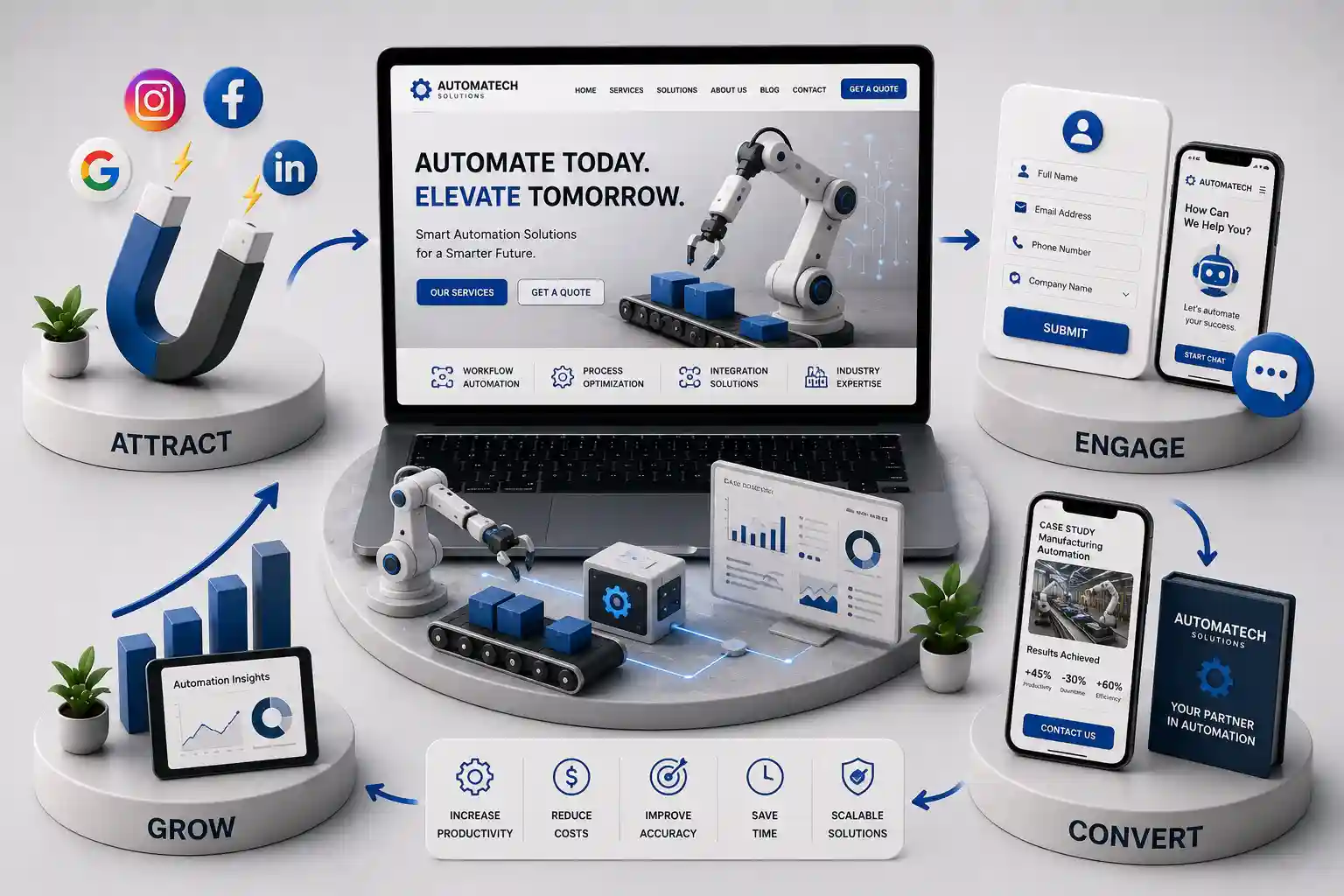
Most service businesses share a painful first automation: a website or WhatsApp enquiry that must become a CRM record with the right owner, source, and page context. Today a human copies fields. Tomorrow a webhook creates the record, assigns the queue, and alerts the phone that is actually on duty. Failures go to a visible exception list—not a silent email.
That single path returns time every day. It also teaches the team how automation feels: faster when it works, loud when it breaks. If you cannot operate this well, you are not ready for multi-system orchestration.
Resist the urge to add scoring, chatbots, and auto-emails on day one. Get the record created correctly, assigned, and alerted. Then add a same-day reminder if nobody opened it. Layering five clever rules on a broken create step just produces five kinds of wrong. Boring reliability is the product.
For field mapping, routing, and failure ownership on this exact path, use the CRM enquiry routing automation checklist. Treat it as an implementation brief, not a brochure.
Still pasting enquiries into the CRM?
Describe the manual hops your team still runs. We will outline business automation software that removes the repeatable ones first.
5. How to judge time and cost without fake ROI slides
Count minutes on the current path for one week: how long from form submit to CRM record, how often fields are wrong, how many leads get no reply the same day. Those numbers are your baseline. After launch, measure the same three. If they do not move, you automated theater.
Cost is build plus operation: monitoring, credential rotation, and someone who can read a failed job. A cheap script with no owner becomes another manual process—the person who restarts it. Budget for that ownership or do not start.
For search and documentation hygiene around the systems you expose, Google Search documentation is a reminder that public pages still need to be truthful and maintainable—automation does not excuse a broken contact path.
Manual habit versus automated habit
Moment
Manual habit
Automated habit
New website enquiry
Copy into CRM when someone remembers
Webhook creates the record with source and page
Who owns it
Group inbox, first person to notice
Rule-based queue plus on-duty alert
Something fails
Silent; customer waits
Exception list with an owner and retry policy
Staff leave
Process lives in their head
Runbook and credentials the next person can use
Success metric
“We were busy”
Time to first reply and error rate
6. Phased rollout that staff will actually use
Ship one path, watch it for a real week, then add the next. Parallel “big bang” cutovers fail because nobody trusts the new queue and everyone keeps the spreadsheet “just in case.” Dual running is fine for a short overlap. Dual running forever means you automated nothing.
Train the exception path harder than the happy path. People need to know what to do when the CRM is down or a payload is incomplete. If the only instruction is “it just works,” the first incident returns everyone to WhatsApp. Write that fallback in the same place you write holiday hours: short, owned, and reviewed when staff change.
Share a weekly snapshot with the people who live in the queue: how many jobs succeeded, how many hit the exception list, how long the oldest open item sat. Transparency beats a launch party. If the numbers look worse than the spreadsheet week, pause the next workflow and fix the first one before anyone asks for another new dashboard.
7. When custom beats another SaaS login
Another subscription can be the right answer when your process matches the product. Custom business automation software is the right answer when you are already paying people to stitch five tools by hand. The goal is fewer hops, not more logos. If a no-code zap covers the trigger safely, use it—and still write the runbook.
Custom work is justified when routing rules, data residency, or audit needs do not fit a generic zap; when failure must be visible to your team; or when the website, CRM, and ops tools must share one definition of a customer. Buying six overlapping apps is not automation. It is a new kind of manual: tab switching.
Ask vendors to show the failure case, not only the happy demo. Who is paged? What is retried? What is never silently dropped? Business automation software that cannot answer those questions will recreate the spreadsheet—except now the mistakes are faster and harder to see.
8. A practical next step this month
Pick one repetitive path that happens daily (usually new enquiries)
Time it for five working days and note error types
Write the trigger, the success record, and the failure owner on one page
Automate only that path with alerts you will actually see
Review the three metrics before you add a second workflow
Still managing the business manually is not a moral failure. It is a sign the work grew faster than the system. Business automation software earns a place when it returns hours you can measure and failures you can see. Start there. Leave the science-fiction operating system for later. A single reliable path beats a roadmap nobody on the team can staff.
Software that moves data and notifications between your existing tools when a known trigger happens—form submit, payment, status change—so people are not retyping the same fields. It is not a replacement for judgment or customer conversations.
Treat that as a separate staffing decision. Most small teams use the time for faster replies and fewer errors. Selling automation as job cuts usually blocks adoption.
A daily, boring path with a clear trigger—often website or chat enquiries into the CRM. Avoid rare, political, or constantly changing processes as the first project.
Yes when the path is simple and failure is acceptable to handle manually. Custom work fits when routing, audit, or reliability needs exceed a generic zap—and you still need a runbook.
Baseline time-to-first-reply, error or duplicate rate, and same-day response for one week. Measure the same after launch. If those do not move, fix the design before adding more workflows.
Define an exception queue and a fallback (alert a named owner). Silent failure is worse than the old spreadsheet because nobody is watching.
No. Automation here means reliable routing and data movement. AI features can sit later on top of clean processes. Do not start by asking a model to invent your intake rules.
A well-scoped enquiry-to-CRM path can be weeks, not a year—if requirements, owners, and tests are written. Unscoped “automate the company” programmes take much longer.
Name an operations owner for exceptions and a technical owner for credentials and monitoring. Software without those names becomes another manual burden.
An outdated business website quietly loses trust, mobile visitors, and enquiries. Learn the warning signs, the cost of delay, and how a modern business website upgrade restores conversion.
Google Business Profile wins local discovery; your website owns conversion, proof, and follow-up. Learn why Indian local businesses need both—not one or the other.
A practical website redesign checklist for Indian businesses: audit, UX, content, SEO migration, launch QA, and conversion measurement—without treating redesign as a theme swap.
A practical guide to AI business websites: assisted chat routing, content operations, CRM handoff, governed automation, and measurable improvement without hype.
Custom platforms that connect CRM, workflows, and APIs so your business runs faster with less manual work. Available for growing businesses across major Indian cities. Every page is planned for stronger search visibility, faster performance, clearer customer journeys, and measurable enquiries.
My Perfect Solutions helps brokers, clinics, restaurants, and growing brands launch fast, SEO-ready websites that turn search traffic into qualified enquiries across India.